\n
## Diagram: Model Card Framework Population Process
### Overview
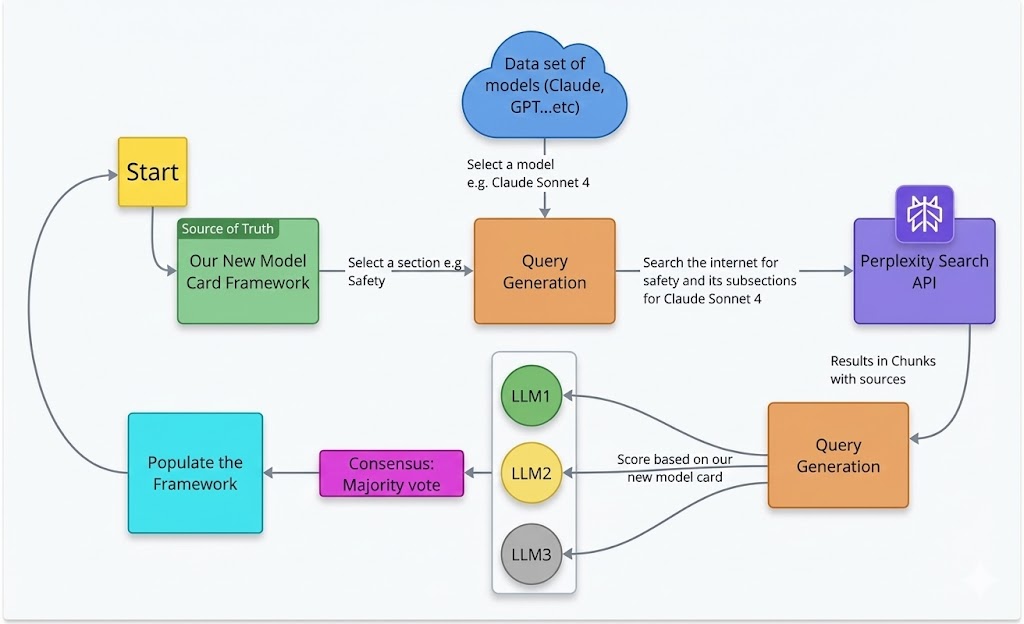
This diagram illustrates the process of populating a new model card framework using a combination of Large Language Models (LLMs) and internet search. The process begins with selecting a model and a section of the framework, then leverages LLMs and a search API to gather information, score it, and reach a consensus to populate the framework.
### Components/Axes
The diagram consists of several rectangular blocks representing process steps, ovals representing data sources or outputs, and arrows indicating the flow of information. Key components include:
* **Start:** The beginning of the process.
* **Data set of models (Claude, GPT...etc):** An oval representing the available models.
* **Our New Model Card Framework:** A rectangular block representing the target framework. Labeled "Source of Truth".
* **Query Generation:** Two rectangular blocks, one for initial query generation and another for subsequent query generation based on search results.
* **Perplexity Search API:** An icon representing the search API used to gather information.
* **LLM1, LLM2, LLM3:** Three oval blocks representing individual Large Language Models.
* **Consensus: Majority vote:** An oval representing the consensus mechanism.
* **Populate the Framework:** A rectangular block representing the final step of populating the framework.
The arrows indicate the direction of the process flow.
### Detailed Analysis or Content Details
The process flow is as follows:
1. **Start** initiates the process.
2. A model is **Selected** from the "Data set of models (Claude, GPT...etc)". An example model given is "Claude Sonnet 4".
3. A section is **Selected** from the "Our New Model Card Framework". An example section given is "Safety".
4. **Query Generation** creates a query to "Search the internet for safety and its subsections for Claude Sonnet 4".
5. The **Perplexity Search API** is used to retrieve "Results in Chunks with sources".
6. The results are fed into **LLM1, LLM2, and LLM3**.
7. Each LLM **Scores** the results "based on our new model card".
8. A **Consensus** is reached through a "Majority vote".
9. The framework is **Populated** with the consensus results.
10. The process loops back to the "Our New Model Card Framework" to continue populating other sections.
### Key Observations
The diagram highlights a multi-stage process that leverages multiple LLMs to reduce bias and improve the accuracy of the model card framework. The use of a search API ensures that the framework is informed by up-to-date information. The consensus mechanism is a key element in ensuring the reliability of the populated framework.
### Interpretation
This diagram demonstrates a robust methodology for creating comprehensive and reliable model cards. By combining the strengths of LLMs with external knowledge sources and a consensus-based approach, the process aims to mitigate the risks associated with relying on a single source of information or a single model's perspective. The "Source of Truth" designation for the Model Card Framework emphasizes its importance as the central repository for model information. The iterative loop back to the framework suggests a continuous improvement process, where the framework is constantly updated and refined. The use of the Perplexity Search API indicates a focus on leveraging external knowledge to enhance the model card's completeness and accuracy. The diagram suggests a commitment to transparency and accountability in model development and deployment.