## Flowchart: Model Card Framework and Query Generation Process
### Overview
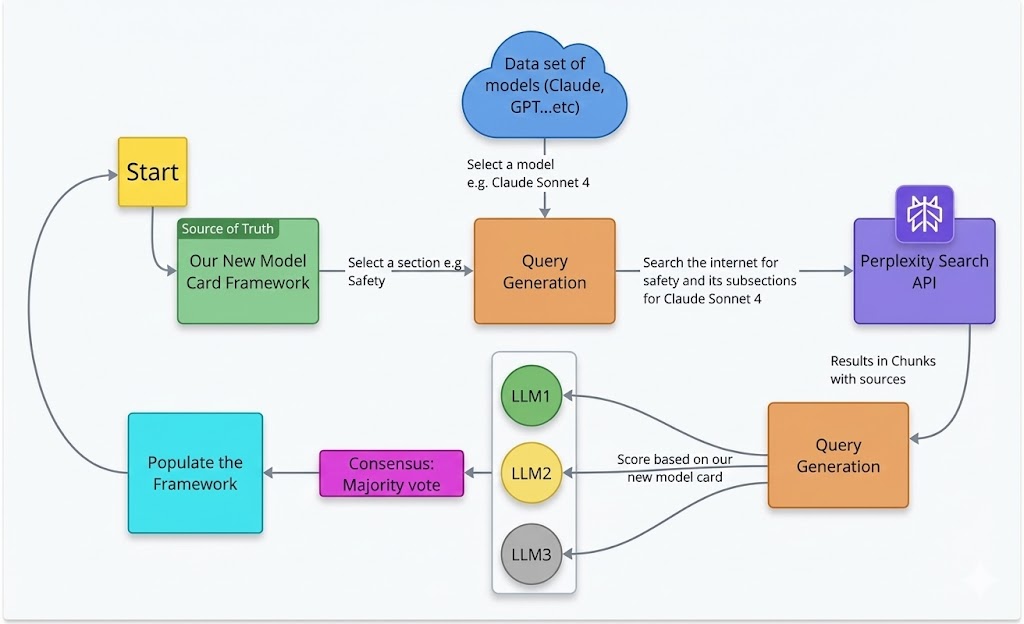
This flowchart illustrates a technical workflow for generating and validating queries using a model card framework, integrating external data sources, and leveraging multiple language models (LLMs) for consensus-based decision-making. The process is cyclical, with feedback loops between components.
### Components/Axes
1. **Start** (Yellow Box): Initiates the workflow.
2. **Source of Truth** (Green Box): Contains the "Our New Model Card Framework."
3. **Query Generation** (Orange Box): Generates queries based on selected model sections (e.g., safety).
4. **Perplexity Search API** (Purple Box): Searches the internet for safety data and subsections of models like Claude Sonnet 4, returning results in chunks with sources.
5. **Populate the Framework** (Cyan Box): Updates the model card framework using consensus outputs.
6. **Consensus: Majority Vote** (Pink Box): Aggregates outputs from three LLMs (LLM1, LLM2, LLM3) to determine the final result.
7. **LLMs** (Colored Circles):
- LLM1 (Green)
- LLM2 (Yellow)
- LLM3 (Gray)
- Outputs are scored based on the new model card.
### Detailed Analysis
- **Flow Direction**:
- Starts at "Start" → "Source of Truth" → "Our New Model Card Framework."
- Branches to "Query Generation," which connects to the "Perplexity Search API."
- API results feed back into "Query Generation," which then routes outputs to all three LLMs.
- LLM outputs are aggregated via "Consensus: Majority Vote" to "Populate the Framework," which loops back to the "Source of Truth."
- **Key Connections**:
- Arrows labeled "Select a section e.g. Safety" link the model card to query generation.
- Arrows labeled "Score based on our new model card" connect LLMs to query generation.
- Feedback loop from "Populate the Framework" to "Source of Truth" ensures iterative refinement.
### Key Observations
- **Cyclical Process**: The workflow is designed for continuous improvement, with outputs from the consensus step directly updating the foundational model card.
- **External Data Integration**: The Perplexity Search API introduces real-time, external data (e.g., safety information) to inform query generation.
- **Multi-LLM Consensus**: Three distinct LLMs contribute to decision-making, with majority voting ensuring robustness.
### Interpretation
This diagram represents a hybrid AI system that combines:
1. **Internal Knowledge** (model card framework) with **External Data** (Perplexity API) to generate context-aware queries.
2. **Model Diversity** (three LLMs) to mitigate individual model biases, using consensus to enhance reliability.
3. **Iterative Refinement**, where outputs from the consensus step directly improve the foundational model card, creating a self-improving loop.
The use of color-coding (e.g., green for safety, purple for external search) suggests a modular design where each component has a distinct role. The absence of numerical values implies this is a conceptual workflow rather than a data-driven analysis. The process emphasizes transparency (via source attribution in API results) and adaptability (through iterative framework updates).