\n
## Diagram: Question Decomposition for Knowledge Retrieval
### Overview
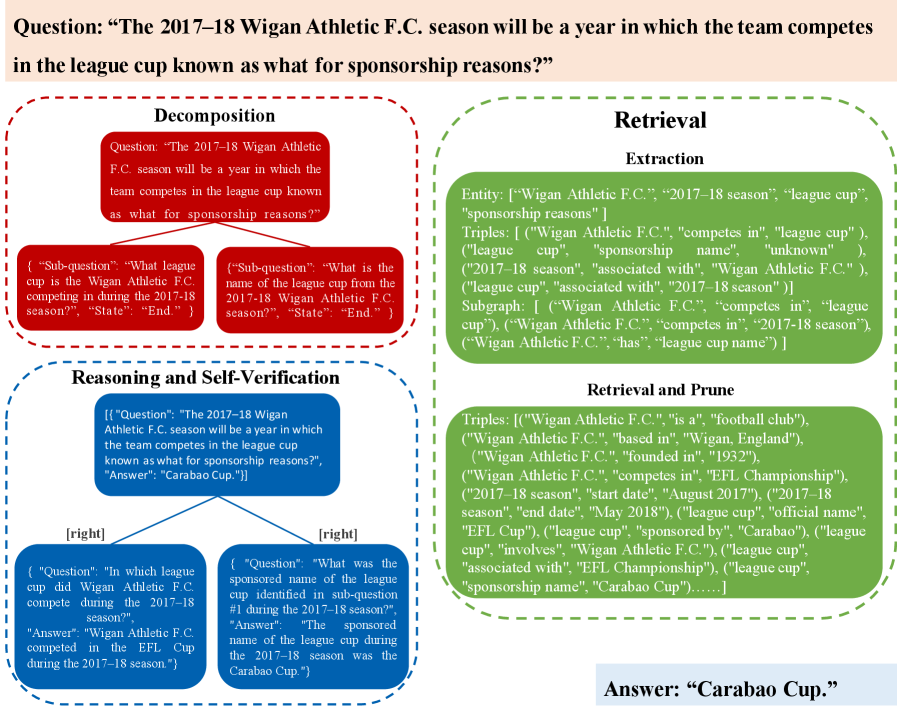
The image presents a diagram illustrating a question decomposition and retrieval process, likely within a knowledge-based system or a question-answering application. The diagram visually breaks down a complex question into sub-questions, performs information extraction, and then uses reasoning and pruning to arrive at an answer. The overall structure is a flow diagram with four main sections: Decomposition, Retrieval, Reasoning & Self-Verification, and Retrieval & Prune.
### Components/Axes
The diagram is organized into four distinct sections, each visually separated by dashed-line boxes and labeled with a title. Each section contains text blocks representing steps or results of the process. Arrows indicate the flow of information between stages. The diagram also includes a title at the top: "Question: “The 2017-18 Wigan Athletic F.C. season will be a year in which the team competes in the league cup known as what for sponsorship reasons?”". A copyright notice is present at the bottom right: "© Nanjing, CuptAI".
### Detailed Analysis or Content Details
**1. Decomposition:**
* **Question:** “The 2017-18 Wigan Athletic F.C. season will be a year in which the team competes in the league cup known as what for sponsorship reasons?”
* **Sub-question 1:** “What league cup is the Wigan Athletic F.C. competing in during the 2017-18 season?”, “State: “End””.
* **Sub-question 2:** “What is the name of the league cup from the 2017-18 Wigan Athletic F.C. season?”, “State: “End””.
**2. Retrieval:**
* **Extraction:**
* Entity: ["Wigan Athletic F.C.", "2017-18 season", "league cup", "sponsorship reasons"]
* Triples: ["Wigan Athletic F.C.", "competes in", "league cup"], ["league cup", "sponsorship name", "unknown"], ["2017-18 season", "associated with", "Wigan Athletic F.C."], ["league cup", "associated with", "2017-18 season"]
* Subgraph: ["Wigan Athletic F.C.", "competes in", "league cup"], ["Wigan Athletic F.C.", "competes in", "2017-18 season"], ["Wigan Athletic F.C.", "has", "league cup name"]
**3. Reasoning and Self-Verification:**
* **Question:** “The 2017-18 Wigan Athletic F.C. season will be a year in which the team competes in the league cup known as what for sponsorship reasons?”
* **Answer:** “Carabao Cup.”
* **[right]** (Sub-question): “In which league cup did Wigan Athletic F.C. compete during the 2017-18 season?”. Answer: “Wigan Athletic F.C. competed in the EFL Cup during the 2017-18 season.”
* **[right]** (Question): “What was the sponsored name of the league cup identified in sub-question one during the 2017-18 season?”. Answer: “The league cup during the 2017-18 season was sponsored with the name ‘Carabao Cup’”.
**4. Retrieval and Prune:**
* Triples: ["Wigan Athletic F.C.", "is a", "football club"], ["Wigan Athletic F.C.", "based in", "Wigan, England"], ["Wigan Athletic F.C.", "founded in", "1932"], ["Wigan Athletic F.C.", "competes in", "EFL Championship"], ["2017-18 season", "start date", "August 2017"], ["2017-18 season", "end date", "May 2018"], ["league cup", "official name", "EFL Cup"], ["league cup", "sponsored by", "Carabao"], ["league cup", "involves", "Wigan Athletic F.C."], ["league cup", "associated with", "EFL Championship"], ["league cup", "sponsorship name", "Carabao Cup"].
### Key Observations
The diagram demonstrates a multi-stage process for answering a complex question. The decomposition step breaks down the question into simpler, manageable sub-questions. The retrieval step extracts relevant entities and relationships. The reasoning step uses the extracted information to derive an answer, and the final retrieval and prune step refines the knowledge base. The diagram highlights the importance of both information extraction and logical reasoning in question answering.
### Interpretation
This diagram illustrates a typical workflow in a knowledge-based question answering system. The decomposition phase is crucial for handling complex queries that require multiple pieces of information. The extraction phase relies on identifying key entities and relationships within a knowledge graph or text corpus. The reasoning phase then leverages these extracted elements to infer the answer. The final pruning step ensures the answer is concise and relevant. The use of "Triples" suggests a knowledge graph representation, where facts are stored as subject-predicate-object relationships. The diagram suggests a system capable of not only retrieving facts but also performing logical inference to answer questions that require combining multiple pieces of information. The copyright notice indicates this is likely a research project or a component of a larger system developed by CuptAI. The diagram is a visual representation of a semantic reasoning process.