## Bar Chart: R1-Llama | MATH500
### Overview
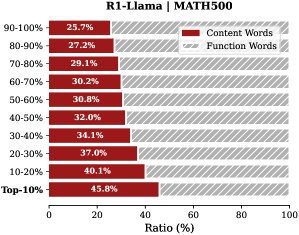
The image is a horizontal bar chart comparing the ratio of "Content Words" to "Function Words" across different performance percentiles (Top-10% to 90-100%) for R1-Llama on the MATH500 dataset. The chart shows that as performance increases (moving from 90-100% to Top-10%), the ratio of content words increases while the ratio of function words decreases.
### Components/Axes
* **Title:** R1-Llama | MATH500
* **Y-axis (Vertical):** Performance Percentiles (Top-10%, 10-20%, 20-30%, 30-40%, 40-50%, 50-60%, 60-70%, 70-80%, 80-90%, 90-100%)
* **X-axis (Horizontal):** Ratio (%) from 0 to 100
* **Legend (Top-Right):**
* Red: Content Words
* Gray (with diagonal lines): Function Words
### Detailed Analysis
The chart displays the ratio of content words and function words for each performance percentile.
* **Top-10%:** Content Words: 45.8%, Function Words: ~54.2%
* **10-20%:** Content Words: 40.1%, Function Words: ~59.9%
* **20-30%:** Content Words: 37.0%, Function Words: ~63.0%
* **30-40%:** Content Words: 34.1%, Function Words: ~65.9%
* **40-50%:** Content Words: 32.0%, Function Words: ~68.0%
* **50-60%:** Content Words: 30.8%, Function Words: ~69.2%
* **60-70%:** Content Words: 30.2%, Function Words: ~69.8%
* **70-80%:** Content Words: 29.1%, Function Words: ~70.9%
* **80-90%:** Content Words: 27.2%, Function Words: ~72.8%
* **90-100%:** Content Words: 25.7%, Function Words: ~74.3%
**Trends:**
* **Content Words:** The ratio of content words generally increases as performance improves (from 90-100% to Top-10%).
* **Function Words:** The ratio of function words generally decreases as performance improves.
### Key Observations
* The ratio of content words is highest in the Top-10% percentile.
* The ratio of function words is highest in the 90-100% percentile.
* There is a clear inverse relationship between the ratio of content words and function words as performance changes.
### Interpretation
The data suggests that higher-performing models (R1-Llama on MATH500) tend to use a higher proportion of content words compared to function words. This could indicate that better models are more concise and focused in their responses, relying less on grammatical structures and more on conveying essential information. The trend highlights a potential characteristic of successful models in this context: an ability to prioritize and effectively utilize content-rich vocabulary.