## Bar Chart: R1-Llama | MATH500
### Overview
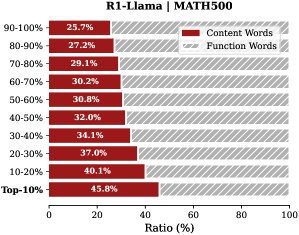
The chart compares the ratio of **Content Words** (red) and **Function Words** (gray) across performance percentiles of the R1-Llama model on the MATH500 dataset. Each horizontal bar represents a percentile range (e.g., "90-100%", "80-90%", etc.), with the x-axis showing the percentage contribution of each word type.
### Components/Axes
- **X-axis**: "Ratio (%)" (0–100% scale).
- **Y-axis**: Performance percentiles (90-100% to Top-10%).
- **Legend**:
- Red: Content Words
- Gray: Function Words
- **Bar Segmentation**: Each bar is split into red (Content Words) and gray (Function Words) segments.
### Detailed Analysis
- **90-100%**:
- Content Words: 25.7%
- Function Words: ~74.3% (100% - 25.7%)
- **80-90%**:
- Content Words: 27.2%
- Function Words: ~72.8%
- **70-80%**:
- Content Words: 29.1%
- Function Words: ~70.9%
- **60-70%**:
- Content Words: 30.2%
- Function Words: ~69.8%
- **50-60%**:
- Content Words: 30.8%
- Function Words: ~69.2%
- **40-50%**:
- Content Words: 32.0%
- Function Words: ~68.0%
- **30-40%**:
- Content Words: 34.1%
- Function Words: ~65.9%
- **20-30%**:
- Content Words: 37.0%
- Function Words: ~63.0%
- **10-20%**:
- Content Words: 40.1%
- Function Words: ~59.9%
- **Top-10%**:
- Content Words: 45.8%
- Function Words: ~54.2%
### Key Observations
1. **Inverse Relationship**: As model performance decreases (from 90-100% to Top-10%), the ratio of **Content Words** increases steadily (25.7% → 45.8%).
2. **Function Words Decline**: Function Words consistently decrease across lower percentiles, suggesting higher-performing models use fewer functional terms.
3. **Top-10% Outlier**: The highest-performing models (90-100%) use the fewest Content Words (25.7%), while the lowest-performing (Top-10%) use the most (45.8%).
### Interpretation
The data suggests that **higher-performing models** (90-100%) prioritize concise, functional language (e.g., prepositions, conjunctions) over content-heavy phrasing. Lower-performing models (Top-10%) exhibit verbosity, with nearly double the Content Word ratio. This could indicate inefficiencies in lower-performing models, such as redundant explanations or over-reliance on descriptive language. The trend aligns with linguistic theories where functional words streamline communication, while content words dominate in less structured or verbose outputs.
**Note**: All values are approximate, derived from bar segment lengths and x-axis scaling. No textual anomalies or outliers beyond the described trend.