\n
## Diagram: Cognitive Processing Levels
### Overview
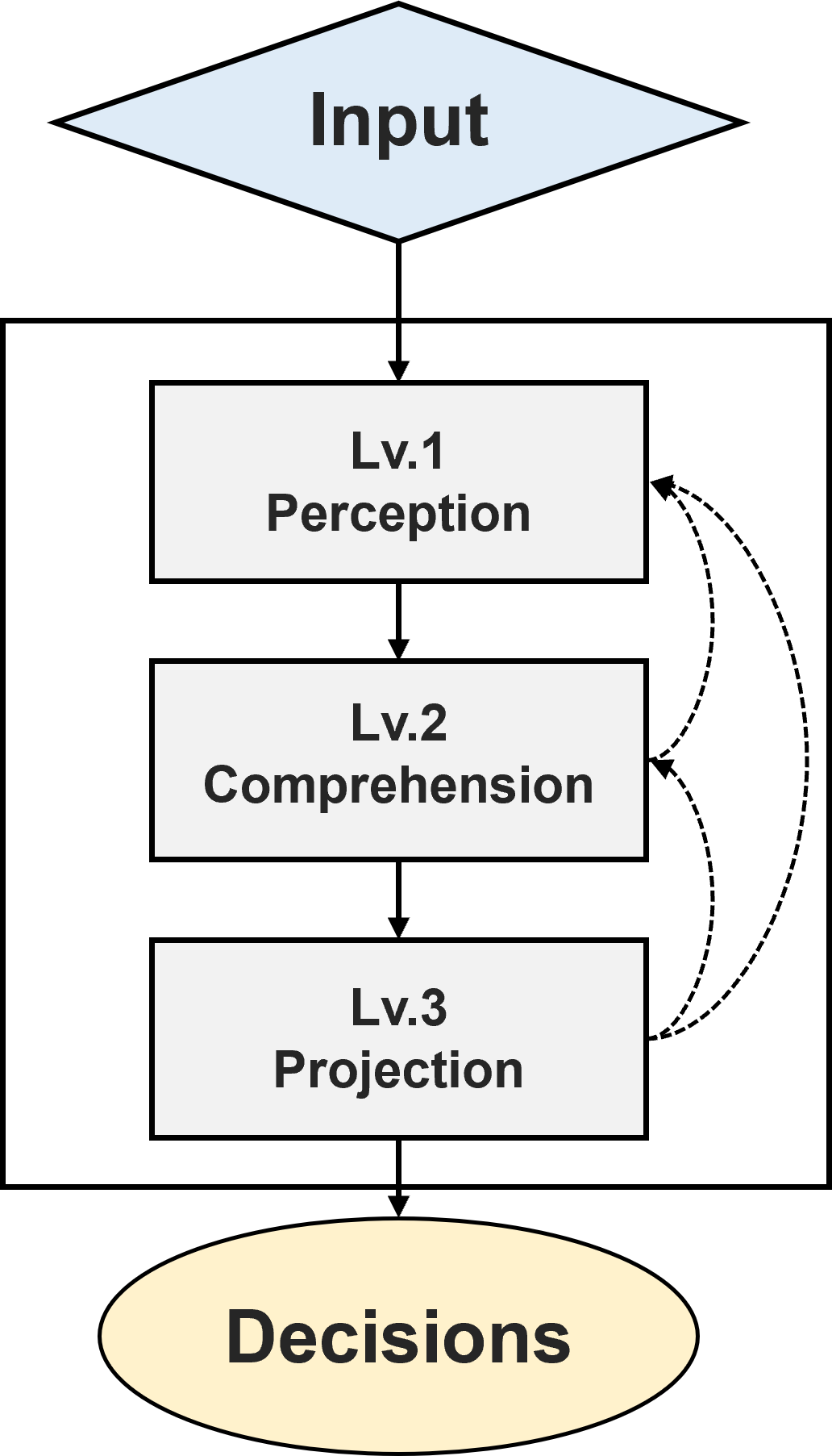
The image is a diagram illustrating a cognitive processing model with three levels: Perception, Comprehension, and Projection. It depicts a flow of information from "Input" through these levels to "Decisions". A feedback loop exists between the Projection level and the Perception level.
### Components/Axes
The diagram consists of the following components:
* **Input:** A light blue diamond shape at the top.
* **Lv.1 Perception:** A white rectangle with black text.
* **Lv.2 Comprehension:** A white rectangle with black text.
* **Lv.3 Projection:** A white rectangle with black text.
* **Decisions:** A light yellow oval shape at the bottom.
* **Arrows:** Black arrows indicating the flow of information.
* **Feedback Loop:** A dashed black arrow indicating a feedback connection.
### Detailed Analysis or Content Details
The diagram shows a sequential process:
1. **Input** is the starting point.
2. The flow proceeds downwards to **Lv.1 Perception**.
3. From Perception, the flow continues to **Lv.2 Comprehension**.
4. Comprehension leads to **Lv.3 Projection**.
5. Projection ultimately results in **Decisions**.
6. A dashed arrow indicates a feedback loop from **Lv.3 Projection** back to **Lv.1 Perception**. This suggests that projections can influence subsequent perceptions.
### Key Observations
The diagram emphasizes a hierarchical, layered approach to cognitive processing. The feedback loop suggests an iterative process where higher-level cognitive functions can refine lower-level perceptions. The levels are numbered sequentially (Lv.1, Lv.2, Lv.3), indicating a progression in complexity.
### Interpretation
This diagram likely represents a simplified model of how humans process information and make decisions. The levels suggest a progression from raw sensory input (Perception) to understanding (Comprehension) and then to anticipating future outcomes or possibilities (Projection). The feedback loop highlights the role of expectations and prior knowledge in shaping how we perceive the world. This model could be used in fields like psychology, artificial intelligence, or human-computer interaction to understand and design systems that better align with human cognitive processes. The diagram doesn't provide specific data or numerical values; it's a conceptual representation of a process. It's a high-level overview, and the specific mechanisms within each level are not detailed.