## Table: Word Clusters by Segment
### Overview
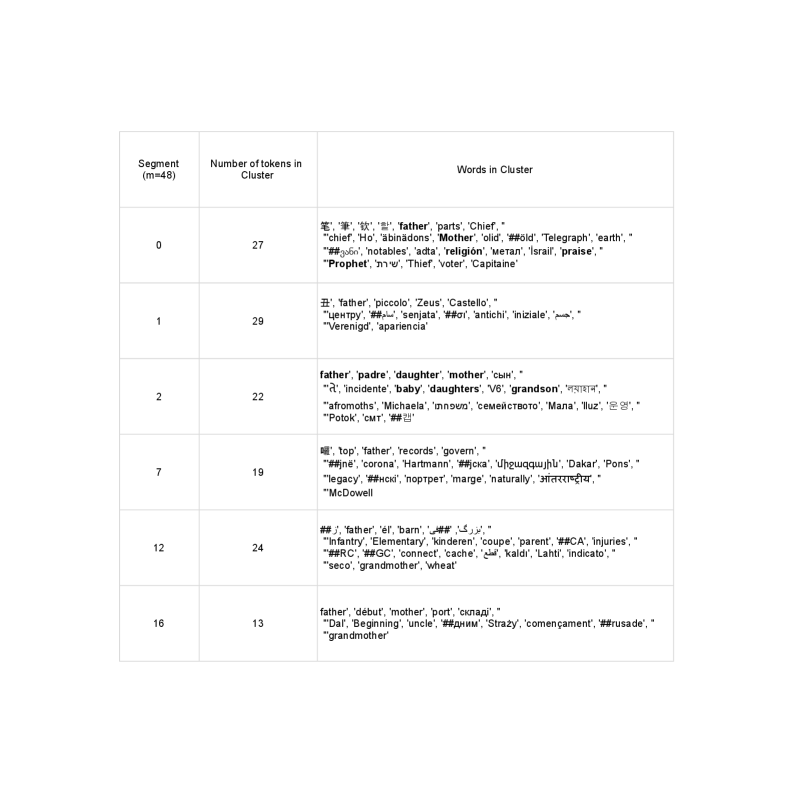
The image presents a table that categorizes words into clusters based on segments. The table has three columns: "Segment (m=48)", "Number of tokens in Cluster", and "Words in Cluster". Each row represents a different segment and lists the number of tokens (words) belonging to that segment's cluster, along with the words themselves.
### Components/Axes
* **Columns:**
* **Segment (m=48):** Identifies the segment number. The total number of segments is indicated as m=48.
* **Number of tokens in Cluster:** Indicates the number of words (tokens) that belong to the cluster for that segment.
* **Words in Cluster:** Lists the words that belong to the cluster for that segment. The words are enclosed in single quotes and separated by commas.
* **Rows:** Each row represents a different segment, with the segment number, the number of tokens in its cluster, and the words in the cluster.
### Detailed Analysis
Here's a breakdown of the table's content, row by row:
* **Segment 0:**
* Number of tokens: 27
* Words: '笔', '筆', '钦', '', 'father', 'parts', 'Chief', 'chief', 'Ho', 'äbinädons', 'Mother', 'olid', '##öld', 'Telegraph', 'earth', '##360', 'notables', 'adta', 'religión', 'метал', 'Israil', 'praise', 'Prophet', 'שרת', 'Thief', 'voter', 'Capitaine'
* Languages: Chinese, English, German, Spanish, Russian, Hebrew, French
* **Segment 1:**
* Number of tokens: 29
* Words: '丑', 'father', 'piccolo', 'Zeus', 'Castello', 'центру', '##سام', 'senjata', '##', 'antichi', 'iniziale', 'جسم', 'Verenigd', 'apariencia'
* Languages: Chinese, English, Italian, Russian, Arabic, Dutch, Spanish
* **Segment 2:**
* Number of tokens: 22
* Words: 'father', 'padre', 'daughter', 'mother', 'сын', 'ते', 'incidente', 'baby', 'daughters', 'V6', 'grandson', 'লয়াহান', 'afromoths', 'Michaela', 'משפחתו', 'семейството', 'Мала', 'Iluz', '운영', 'Potok', 'смт', '##캡'
* Languages: English, Spanish, Russian, Hindi, Bengali, Hebrew, Bulgarian, Ukrainian, Korean
* **Segment 7:**
* Number of tokens: 19
* Words: '떼', 'top', 'father', 'records', 'govern', '##jnë', 'corona', 'Hartmann', '##jска', 'Uհqսqqային', 'Dakar', 'Pons', 'legacy', '##нскі', 'портрет', 'marge', 'naturally', 'आंतरराष्ट्रीय', 'McDowell'
* Languages: Korean, English, Albanian, Russian, Armenian, Marathi
* **Segment 12:**
* Number of tokens: 24
* Words: '##', 'father', 'el', 'barn', '## بزرگ', 'Infantry', 'Elementary', 'kinderen', 'coupe', 'parent', '##CA', 'injuries', '##RC', '##GC', 'connect', 'cache', 'قطع', 'kaldı', 'Lahti', 'indicato', 'seco', 'grandmother', 'wheat'
* Languages: English, Spanish, Dutch, French, Arabic, Turkish, Finnish, Italian
* **Segment 16:**
* Number of tokens: 13
* Words: 'father', 'début', 'mother', 'port', 'складі', 'Dal', 'Beginning', 'uncle', '##дним', 'Straży', 'començament', '##rusade', 'grandmother'
* Languages: English, French, Ukrainian, Polish, Portuguese
### Key Observations
* The segments contain a mix of words from different languages.
* Some words are preceded by '##', which might indicate a specific encoding or tagging.
* The number of tokens in each cluster varies, ranging from 13 to 29.
* The word "father" appears in most of the clusters.
### Interpretation
The table appears to be the result of a text analysis process where words have been grouped into clusters based on some criteria, possibly semantic similarity or co-occurrence. The presence of multiple languages suggests that the analysis was performed on a multilingual corpus. The '##' prefix might indicate that these are special tokens or that the words have been processed in some way (e.g., stemming or lemmatization). The consistent presence of "father" across multiple clusters could indicate its central role in the dataset or a bias in the clustering algorithm. The varying number of tokens per cluster suggests different levels of coherence or specificity within each segment.