## Data Table: Word Clusters
### Overview
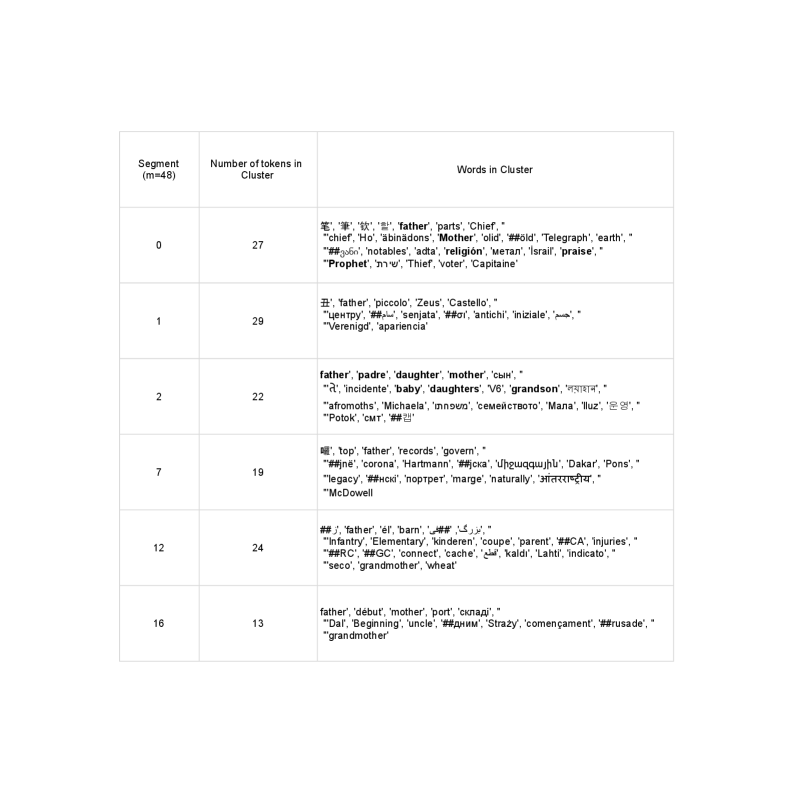
The image presents a data table displaying word clusters identified from a text corpus. The table has three columns: "Segment (m=48)", "Number of tokens in Cluster", and "Words in Cluster". Each row represents a different cluster of words, along with the number of tokens (words) in that cluster and the words themselves. The data appears to be related to familial terms and associated concepts.
### Components/Axes
* **Segment (m=48):** An integer identifier for each cluster, ranging from 0 to 16. The "(m=48)" likely indicates the total number of segments or the size of the model used for clustering.
* **Number of tokens in Cluster:** An integer representing the count of words within each cluster. Values range from 13 to 29.
* **Words in Cluster:** A string containing a comma-separated list of words associated with the cluster. These words include both English and non-English terms, often with special characters or hashtags.
### Detailed Analysis or Content Details
Here's a reconstruction of the data table content, cluster by cluster:
* **Segment 0:** Number of tokens: 27. Words: 'father', 'parts', 'Chief', 'chief', 'Ho', 'abinadons', 'Mother', 'old', '#old', 'Telegraph', 'earth', '#زمین', 'notables', 'adta', 'religion', 'wetran', 'Israel', 'praise', 'Prophet', 'שיר', 'Thief', 'voter', 'Capitaine'.
* **Segment 1:** Number of tokens: 29. Words: 'father', 'piccolo', 'Zeus', 'Castello', 'центр', '#рука', 'senjata', '#or', 'antichi', 'iniziale', 'صمم', 'Verenigd', 'apariencia'.
* **Segment 2:** Number of tokens: 22. Words: 'father', 'padre', 'daughter', 'mother', 'сын', 'd', 'incident', 'baby', 'daughters', 'V6', 'grandson', 'पराक्रम', 'afromoths', 'Michaela', 'тпэло', 'семейство', 'Mana', 'iluz', '호', 'Potok', 'смт', '#田'.
* **Segment 7:** Number of tokens: 19. Words: 'father', 'records', 'govern', '#fine', 'corona', 'Hartmann', '#icka', 'Uheuquqwh', 'Dakar', 'Pons', 'legacy', '#oxi', 'nortpert', 'marge', 'naturally', 'अतिसर्रानीय', 'McDowell'.
* **Segment 12:** Number of tokens: 24. Words: '#', 'father', 'ef', 'barn', '#', 'infantry', 'Elementary', 'kinderen', 'coupe', 'parent', '#BCA', 'injuries', '#RC', '#GC', 'connect', 'cache', 'علق', 'kaldi', 'Lahl', 'indicato', 'seco', 'grandmother', 'wheat'.
* **Segment 16:** Number of tokens: 13. Words: 'father', 'début', 'mother', 'port', 'склад', 'Daí', 'Beginning', 'uncle', '#дним', 'Strazy', 'començament', '#rusade', 'grandmother'.
### Key Observations
* The "Words in Cluster" column contains a mix of English words and words from other languages (Arabic, Russian, Spanish, etc.).
* Hashtags (#) are frequently present within the word lists, suggesting these words may have been extracted from social media or a similar platform.
* The clusters consistently contain the word "father" or related terms (padre, сын), indicating a strong thematic focus on familial relationships.
* The number of tokens per cluster varies, suggesting different levels of granularity or importance for each cluster.
### Interpretation
The data suggests an analysis of text related to the concept of "fatherhood" or family lineage. The presence of words in multiple languages indicates the source text is multilingual or deals with diverse cultural contexts. The hashtags suggest the data was likely scraped from a social media platform or a similar online source. The varying cluster sizes could reflect the frequency with which certain terms appear in relation to "father" or the degree to which they co-occur with it. The inclusion of seemingly unrelated words within some clusters (e.g., "Telegraph", "corona") might indicate noise in the clustering process or the presence of nuanced associations that require further investigation. The data could be used for sentiment analysis, topic modeling, or understanding cultural perceptions of fatherhood across different languages and communities.