## Table: Multilingual Word Clusters by Segment
### Overview
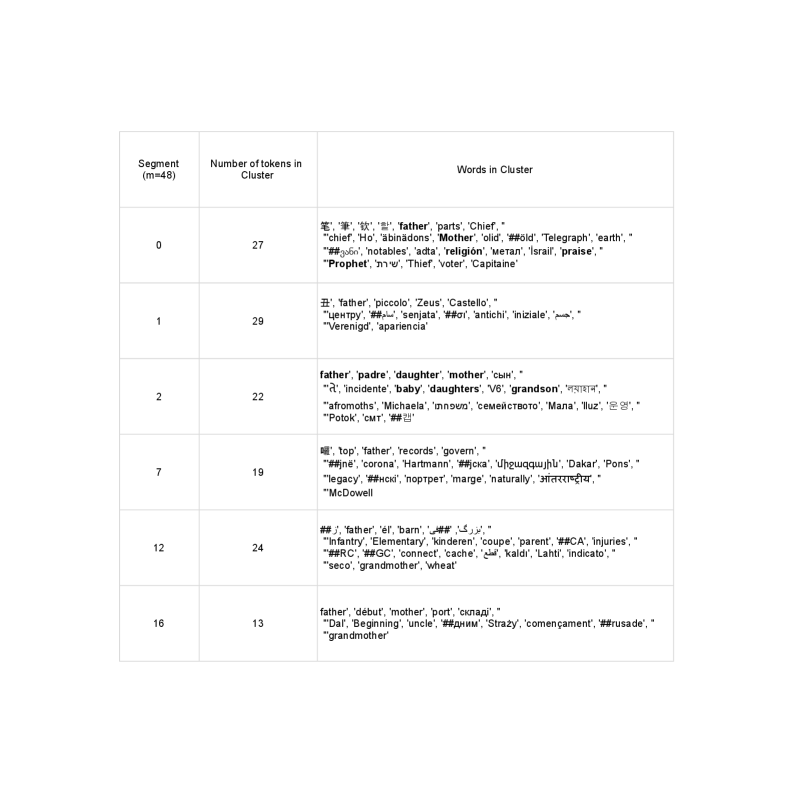
The image displays a data table with three columns, presenting information about word clusters grouped by segment. Each row represents a distinct segment, showing the number of tokens (words) in that cluster and a list of the specific words contained within it. The words are multilingual, appearing in scripts including Latin, Chinese, Japanese, Korean, Arabic, Hebrew, Devanagari, and others.
### Components/Axes
The table has three columns:
1. **Segment (m=48)**: The leftmost column. It lists segment identifiers, which are non-sequential integers: 0, 1, 2, 7, 12, 16. The header includes the notation "(m=48)", suggesting a parameter or total count related to the segmentation process.
2. **Number of tokens in Cluster**: The middle column. It provides a numerical count of the words (tokens) found in each segment's cluster.
3. **Words in Cluster**: The rightmost and widest column. It contains a comma-separated list of the actual words belonging to each cluster. The words are presented in their original scripts and are enclosed in single quotes.
### Detailed Analysis
The table contains six data rows. Below is a precise transcription of each row's content.
**Row 1 (Segment 0):**
* **Segment:** 0
* **Number of tokens:** 27
* **Words in Cluster:** `爹`, `爸`, `爹`, `father`, `paris`, `Chief`, `chief`, `Ho`, `abimóndos`, `Mother`, `old`, `##old`, `Telegraph`, `earth`, `##रू`, `notables`, `adta`, `religión`, `metan`, `Israel`, `praise`, `Prophet`, `יהוה`, `Thief`, `voter`, `Capitaine`
**Row 2 (Segment 1):**
* **Segment:** 1
* **Number of tokens:** 29
* **Words in Cluster:** `父`, `father`, `piccolo`, `Zeus`, `Castello`, `##нтр`, `##ов`, `senjata`, `##oi`, `antichi`, `iniziale`, `ىـ`, `Verenigd`, `apariencia`
**Row 3 (Segment 2):**
* **Segment:** 2
* **Number of tokens:** 22
* **Words in Cluster:** `father`, `padre`, `daughter`, `mother`, `смн`, `##ל`, `Incidente`, `baby`, `daughters`, `V6`, `grandson`, `पोता`, `afromoths`, `Michaela`, `ппопка`, `семейството`, `Mana`, `lluz`, `##म`, `Potok`, `смт`, `##ग`
**Row 4 (Segment 7):**
* **Segment:** 7
* **Number of tokens:** 19
* **Words in Cluster:** `爹`, `top`, `father`, `records`, `govern`, `##ने`, `corona`, `Hartmann`, `##čka`, `Учhuququjhú`, `Dakar`, `Pons`, `legacy`, `##čić`, `портер`, `marge`, `naturally`, `अत्याचारी`, `McDowell`
**Row 5 (Segment 12):**
* **Segment:** 12
* **Number of tokens:** 24
* **Words in Cluster:** `##ی`, `father`, `dad`, `barn`, `##ع`, `##ی`, `Infantry`, `Elementary`, `children`, `coupe`, `parent`, `##CA`, `Injuries`, `##RC`, `##GC`, `connect`, `cache`, `ك`, `kaloi`, `Lahti`, `indicato`, `seco`, `grandmother`, `wheat`
**Row 6 (Segment 16):**
* **Segment:** 16
* **Number of tokens:** 13
* **Words in Cluster:** `father`, `debut`, `mother`, `port`, `склад`, `##Dai`, `Beginning`, `uncle`, `##дим`, `Straży`, `comengament`, `##rusade`, `grandmother`
### Key Observations
1. **Multilingual Content:** The clusters contain words from numerous languages and scripts. Recognizable languages include English, Spanish (`padre`, `religión`), Italian (`piccolo`, `antichi`), Chinese (`爹`, `父`), Japanese (`ポ`), Korean (`##구`), Arabic (`ىـ`, `ك`), Hebrew (`יהוה`, `##ל`), Hindi/Devanagari (`पोता`, `अत्याचारी`), and several others using Cyrillic and Latin diacritics.
2. **Thematic Clustering:** There is a strong, recurring theme of **family and kinship terms** across multiple segments. Words like "father," "mother," "daughter," "son," "grandson," "uncle," "grandmother," "baby," "children," and "parent" appear frequently, often alongside their translations in other languages (e.g., `padre`, `爹`, `父`).
3. **Token Count Variation:** The number of tokens per cluster varies, ranging from a low of 13 (Segment 16) to a high of 29 (Segment 1).
4. **Non-Family Terms:** Each cluster also contains a mix of other, seemingly unrelated words (e.g., "Telegraph," "Zeus," "Infantry," "wheat," "cache"), suggesting the clustering algorithm may be grouping words based on contextual usage in a corpus rather than strict semantic similarity alone.
5. **Subword Tokens:** The presence of tokens starting with "##" (e.g., `##old`, `##нтр`, `##oi`) indicates these are likely subword units from a tokenization process (like Byte-Pair Encoding or WordPiece), commonly used in natural language processing models.
### Interpretation
This table appears to be an output from a natural language processing (NLP) analysis, specifically a **word clustering or embedding visualization task**. The "Segment (m=48)" likely refers to a cluster ID from an algorithm like k-means run with k=48, or a segment from a dimensionality reduction technique like UMAP or t-SNE.
The data demonstrates that the underlying model has grouped multilingual synonyms and related concepts together. The prominent family-term clusters suggest the model has learned cross-lingual semantic relationships for core vocabulary. The inclusion of subword tokens (`##...`) and a mix of thematic words indicates the clusters are based on distributional semantics—how words are used in context across a large, multilingual text corpus—rather than a simple dictionary lookup.
The variation in cluster size (token count) shows that some semantic concepts (like Segment 1's cluster) are more densely populated in the embedding space or the source data than others (like Segment 16's cluster). The presence of seemingly out-of-place words within a family-themed cluster (e.g., "wheat" in Segment 12) could be an artifact of the clustering algorithm, a reflection of metaphorical usage in the training data, or an indicator of a broader, more abstract conceptual grouping that isn't immediately obvious.