## Flowchart: Knowledge Correction Process
### Overview
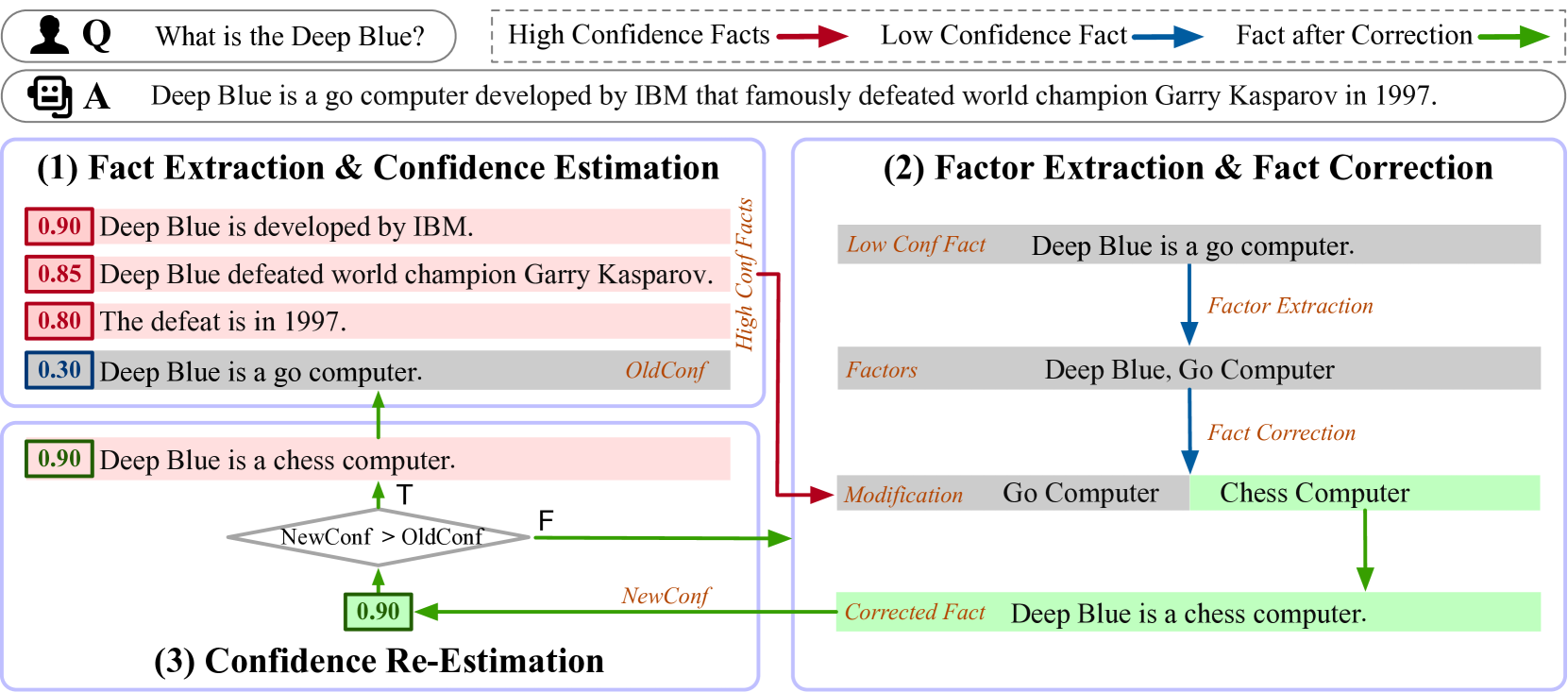
The diagram illustrates a multi-stage process for extracting, correcting, and re-estimating confidence in factual statements. It shows how initial answers are refined through confidence thresholds, factor analysis, and iterative corrections.
### Components/Axes
1. **Sections**:
- **(1) Fact Extraction & Confidence Estimation**: Initial fact identification with confidence scores (0.90, 0.85, 0.80, 0.30).
- **(2) Factor Extraction & Fact Correction**: Component analysis and modification (e.g., "Go Computer" → "Chess Computer").
- **(3) Confidence Re-Estimation**: Updated confidence scores post-correction.
2. **Color Coding**:
- **Pink**: High confidence facts (>0.85).
- **Blue**: Low confidence facts (<0.85).
- **Green**: Corrected facts with re-estimated confidence.
3. **Flow Arrows**:
- Red: High confidence facts → Low confidence facts.
- Blue: Factor extraction → Fact correction.
- Green: Confidence re-estimation.
### Detailed Analysis
1. **Section (1) Fact Extraction & Confidence Estimation**:
- High confidence facts (0.90, 0.85, 0.80):
- "Deep Blue is developed by IBM."
- "Deep Blue defeated world champion Garry Kasparov."
- "The defeat is in 1997."
- Low confidence fact (0.30):
- "Deep Blue is a go computer." (flagged for correction).
2. **Section (2) Factor Extraction & Fact Correction**:
- **Factor Extraction**: Identifies components ("Deep Blue, Go Computer").
- **Modification**: Changes "Go Computer" to "Chess Computer".
- **Corrected Fact**: "Deep Blue is a chess computer."
3. **Section (3) Confidence Re-Estimation**:
- New confidence score (0.90) assigned to the corrected fact.
- Final output: "Deep Blue is a chess computer." (high confidence).
### Key Observations
- **Thresholds**: Confidence scores above 0.85 are considered high confidence; below 0.85 are flagged for correction.
- **Component Isolation**: The system separates "Go Computer" (incorrect) from "Chess Computer" (correct) during factor extraction.
- **Iterative Refinement**: Confidence is re-estimated after correction, ensuring final outputs meet quality standards.
### Interpretation
This diagram demonstrates a systematic approach to handling uncertainty in knowledge extraction. By combining confidence thresholds with component analysis, the process ensures that only well-supported facts are presented as final answers. The correction of "Go Computer" to "Chess Computer" highlights the system's ability to address factual errors through structured analysis. The re-estimation of confidence (0.30 → 0.90) underscores the value of iterative refinement in improving accuracy.