## Dual-Panel Line Chart: Accuracy and Length vs. Training Steps
### Overview
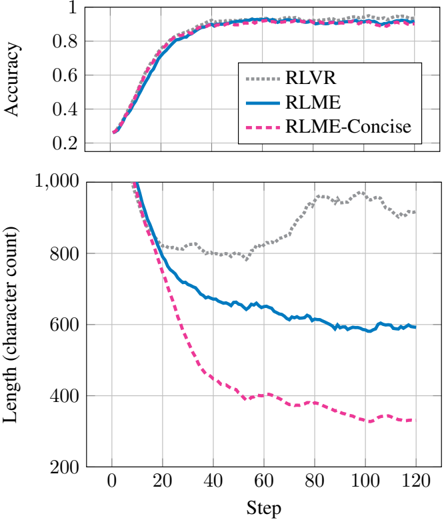
This image displays two vertically stacked line charts that share a common horizontal axis ("Step"). The top chart tracks model "Accuracy" (ranging from 0.2 to 1.0), while the bottom chart tracks "Length (character count)" (ranging from 200 to 1,000). The charts compare three different training methods: **RLVR** (grey dotted line), **RLME** (solid blue line), and **RLME-Concise** (pink dashed line).
### Components/Axes
* **Shared X-Axis:** Labeled "Step," ranging from 0 to 120, with major grid lines every 20 steps.
* **Top Y-Axis:** Labeled "Accuracy," ranging from 0.2 to 1.0, with major grid lines every 0.2 units.
* **Bottom Y-Axis:** Labeled "Length (character count)," ranging from 200 to 1,000, with major grid lines every 200 units.
* **Legend:** Located in the top-right quadrant of the top chart.
* **RLVR**: Grey dotted line.
* **RLME**: Solid blue line.
* **RLME-Concise**: Pink dashed line.
### Detailed Analysis
#### Top Panel: Accuracy
* **Trend:** All three methods exhibit a sharp, near-identical upward trend from Step 0 to Step 40.
* **Step 0:** All methods begin at an accuracy of approximately 0.25.
* **Step 0–40:** Rapid growth phase. By Step 40, all three lines converge at an accuracy of approximately 0.90.
* **Step 40–120:** Plateau phase. All three methods maintain high accuracy between 0.90 and 0.95. The lines fluctuate slightly but remain tightly clustered, indicating that all three methods achieve comparable performance in terms of accuracy.
#### Bottom Panel: Length (character count)
* **Trend:** All three methods start with high character counts (>1,000) and decrease over time, but they diverge significantly after Step 20.
* **RLVR (Grey Dotted):** Drops sharply to ~800 by Step 20. It remains relatively stable around 800 until Step 60, then trends upward, peaking at ~950 by Step 100, before dipping slightly to ~900 by Step 120.
* **RLME (Solid Blue):** Drops steadily throughout the training process. It reaches ~700 by Step 40, ~600 by Step 80, and stabilizes around 600 from Step 100 to 120.
* **RLME-Concise (Pink Dashed):** Shows the most aggressive reduction in length. It drops rapidly, reaching ~400 by Step 50. It continues a slow, steady decline, ending at approximately 330 characters by Step 120.
### Key Observations
* **Performance Parity:** All three methods are equally effective at optimizing for accuracy, reaching ~90% accuracy by Step 40.
* **Divergent Length Optimization:** While accuracy is similar, the methods differ drastically in their output length.
* **RLME-Concise Efficiency:** The "RLME-Concise" method is the most effective at reducing output length, achieving a final length of ~330 characters compared to ~600 for RLME and ~900 for RLVR.
* **RLVR Anomaly:** Unlike the other two methods, RLVR shows a trend of increasing length after Step 60, suggesting that as it optimizes for accuracy, it becomes more verbose.
### Interpretation
This data likely represents a Reinforcement Learning (RL) experiment in text generation or summarization. The objective appears to be a multi-objective optimization problem: maximizing accuracy while minimizing output length.
* **RLME-Concise** is clearly the superior method for this specific objective, as it maintains the same accuracy as the other models while producing significantly shorter outputs.
* **RLVR** appears to prioritize accuracy at the expense of brevity, as evidenced by the increasing character count in the latter half of the training.
* The convergence of accuracy across all models suggests that the "conciseness" constraint in RLME-Concise does not hinder the model's ability to learn the correct task, making it the most efficient model of the three.