\n
## Line Chart: Performance Metrics vs. Step
### Overview
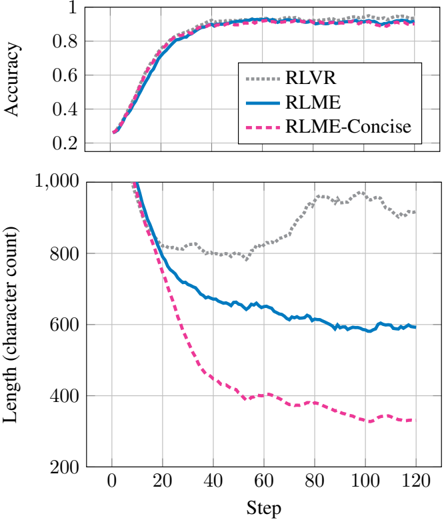
The image presents two line charts stacked vertically. The top chart displays Accuracy as a function of Step, while the bottom chart shows Length (character count) as a function of Step. Three different methods – RLVR, RLME, and RLME-Concise – are compared across both charts. The charts appear to track the performance of these methods during a process that iterates in steps.
### Components/Axes
* **X-axis (Both Charts):** Step, ranging from approximately 0 to 120.
* **Y-axis (Top Chart):** Accuracy, ranging from approximately 0.2 to 1.0.
* **Y-axis (Bottom Chart):** Length (character count), ranging from approximately 200 to 1000.
* **Legend (Top-Right of Top Chart):**
* RLVR (dotted grey line)
* RLME (solid blue line)
* RLME-Concise (dashed magenta line)
### Detailed Analysis or Content Details
**Top Chart (Accuracy vs. Step):**
* **RLVR (Grey, dotted):** The line starts at approximately 0.3 at Step 0, rises rapidly to around 0.75 by Step 20, plateaus around 0.85-0.9 for Steps 20-80, and then fluctuates slightly between 0.88 and 0.92 for Steps 80-120.
* **RLME (Blue, solid):** The line begins at approximately 0.3 at Step 0, increases quickly to around 0.8 by Step 20, and then stabilizes around 0.9 for Steps 20-120, with minor fluctuations.
* **RLME-Concise (Magenta, dashed):** The line starts at approximately 0.3 at Step 0, rises quickly to around 0.8 by Step 20, and then stabilizes around 0.9 for Steps 20-120, similar to RLME, but generally slightly lower than RLME.
**Bottom Chart (Length vs. Step):**
* **RLVR (Grey, dotted):** The line starts at approximately 950 at Step 0, decreases to around 750 by Step 20, and then fluctuates between approximately 850 and 950 for Steps 20-120.
* **RLME (Blue, solid):** The line begins at approximately 950 at Step 0, decreases to around 650 by Step 20, and then stabilizes around 600-700 for Steps 20-120.
* **RLME-Concise (Magenta, dashed):** The line starts at approximately 950 at Step 0, decreases rapidly to around 400 by Step 20, and then continues to decrease to approximately 300 by Step 120.
### Key Observations
* All three methods achieve high accuracy (around 0.9) after approximately 20 steps.
* RLME and RLME-Concise achieve higher accuracy than RLVR, particularly after Step 80.
* The length of the output decreases as the step number increases for all methods, indicating a convergence or refinement process.
* RLME-Concise consistently produces the shortest output length.
* RLVR maintains a higher output length compared to RLME and RLME-Concise.
### Interpretation
The data suggests that RLME and RLME-Concise are more effective than RLVR in achieving high accuracy with a shorter output length. The rapid initial decrease in length for all methods indicates a quick reduction in redundancy or complexity. The stabilization of accuracy after 20 steps suggests that the methods converge relatively quickly. The consistent difference in output length between RLME-Concise and the other methods suggests that the "Concise" version is specifically designed to minimize output size, potentially at a slight cost in accuracy (though the difference is minimal). The fluctuations in RLVR's length after Step 20 might indicate instability or continued refinement, but without further context, it's difficult to determine the cause. The charts demonstrate a trade-off between accuracy and length, with RLME-Concise offering the most concise output while maintaining high accuracy.