## Diagram: Transformer Model Architecture
### Overview
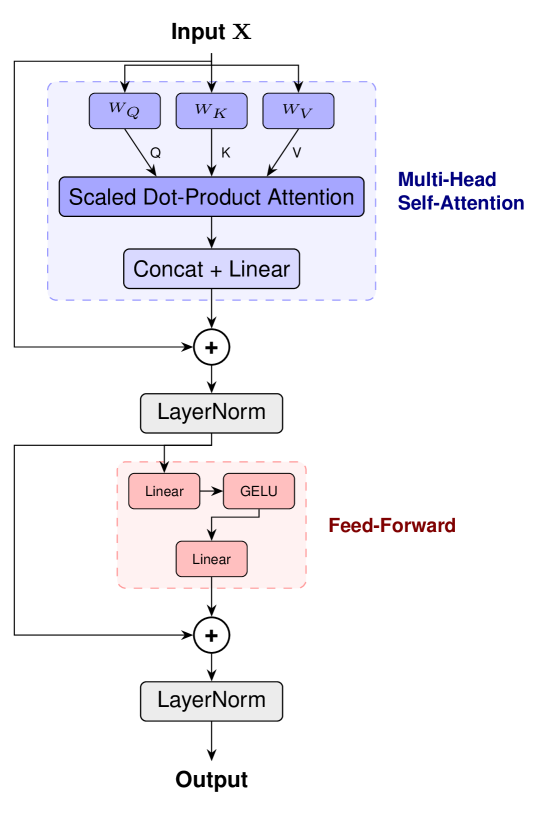
The diagram illustrates the architecture of a transformer model, highlighting two core components: **Multi-Head Self-Attention** (purple section) and **Feed-Forward** (pink section). Input `X` flows through the architecture, with residual connections and layer normalization applied at each stage.
### Components/Axes
- **Input**: Labeled as `Input X` at the top.
- **Multi-Head Self-Attention**:
- **Weight Matrices**: `W_Q`, `W_K`, `W_V` (purple blocks) generate query (`Q`), key (`K`), and value (`V`) vectors.
- **Scaled Dot-Product Attention**: Combines `Q`, `K`, and `V` (purple block).
- **Concat + Linear**: Merges attention outputs with a linear layer (purple block).
- **LayerNorm**: Normalizes the output (black block).
- **Residual Connection**: Adds the original input to the normalized output (black `+` symbol).
- **Feed-Forward**:
- **Linear → GELU → Linear**: Two linear layers with a GELU activation (pink blocks).
- **LayerNorm**: Normalizes the output (black block).
- **Residual Connection**: Adds the original input to the normalized output (black `+` symbol).
- **Output**: Final output at the bottom.
- **Legend**: Located on the right, with:
- **Purple**: Multi-Head Self-Attention components.
- **Pink**: Feed-Forward components.
- **Black**: Residual connections and layer normalization.
### Detailed Analysis
- **Multi-Head Self-Attention**:
- Input `X` is transformed into `Q`, `K`, and `V` via weight matrices `W_Q`, `W_K`, and `W_V`.
- The **Scaled Dot-Product Attention** computes attention scores between `Q` and `K`, scales them, and applies softmax to derive weights for `V`.
- The output is concatenated with a linear layer to produce a combined representation.
- **Feed-Forward**:
- The input passes through two linear layers with a GELU activation, introducing non-linearity.
- The output is normalized via **LayerNorm** and combined with the original input via a residual connection.
### Key Observations
- **Residual Connections**: Both the Multi-Head and Feed-Forward sections use residual connections (black `+` symbols), enabling gradient flow and mitigating vanishing gradients.
- **Layer Normalization**: Applied after each sub-layer (Multi-Head and Feed-Forward) to stabilize training.
- **Color Coding**: Purple and pink blocks visually separate the two core components, aiding in distinguishing their roles.
### Interpretation
The diagram represents a standard transformer block, emphasizing its modular design:
1. **Self-Attention**: Captures contextual relationships between input elements via `Q`, `K`, and `V`.
2. **Feed-Forward**: Processes the attended representation with non-linear transformations.
3. **Residual Connections**: Allow the model to learn incremental improvements while preserving input information.
4. **Layer Normalization**: Ensures stable training by normalizing activations.
This architecture underpins modern NLP models, enabling parallel processing and scalability. The absence of numerical data suggests this is a conceptual diagram, not a performance metric visualization.