## Diagram Type: Flowchart
### Overview
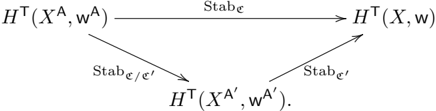
The image is a flowchart that illustrates a process or transformation involving three variables: \(X\), \(w\), and \(H\). The flowchart uses arrows to indicate the direction of the process and includes labels and descriptions for each step.
### Components/Axes
- **\(X\)**: This is the input variable, represented by the arrow pointing from the left.
- **\(w\)**: This is the variable being transformed, represented by the arrow pointing from the top.
- **\(H\)**: This is the output variable, represented by the arrow pointing to the right.
- **\(X^A\)**: This is a transformed version of \(X\), represented by the arrow pointing downwards from \(X\).
- **\(w^A\)**: This is a transformed version of \(w\), represented by the arrow pointing downwards from \(w\).
- **\(H^A\)**: This is the final output, represented by the arrow pointing to the right from \(H\).
- **\(Stab_{\epsilon/c'}\)**: This is a label indicating a stabilization process, represented by an arrow pointing from \(X^A\) to \(H^A\).
- **\(Stab_{\epsilon/c'}'\)**: This is another label indicating a stabilization process, represented by an arrow pointing from \(w^A\) to \(H^A\).
### Detailed Analysis or ### Content Details
The flowchart shows a process where \(X\) and \(w\) are transformed into \(X^A\) and \(w^A\) respectively, and then both are stabilized using \(Stab_{\epsilon/c'}\) and \(Stab_{\epsilon/c'}'\). The stabilized versions of \(X^A\) and \(w^A\) are then transformed into \(H^A\), which is the final output.
### Key Observations
- The flowchart indicates a two-step process involving transformation and stabilization.
- The stabilization processes are applied to both \(X^A\) and \(w^A\).
- The final output is \(H^A\), which is the result of both transformations and stabilizations.
### Interpretation
The flowchart suggests a method for processing or analyzing data involving two variables, \(X\) and \(w\). The process involves transforming these variables into \(X^A\) and \(w^A\) and then stabilizing them using two different methods. The stabilized versions are then transformed into the final output, \(H^A\). This could be a part of a larger data analysis or machine learning process where the goal is to stabilize and transform data to prepare it for further analysis or modeling. The interpretation of the data would depend on the specific context and the nature of the variables \(X\), \(w\), and \(H\).