## Line Chart: Performance Comparison of Attention Mechanisms vs Sequence Length
### Overview
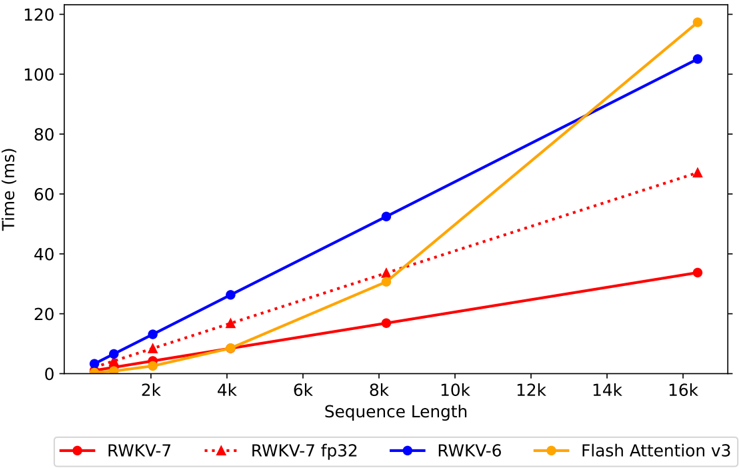
The chart compares the execution time (in milliseconds) of four different attention mechanisms (RWKV-7, RWKV-7 fp32, RWKV-6, and Flash Attention v3) as sequence length increases from 2k to 16k. All lines show upward trends, with varying slopes indicating differing computational efficiencies.
### Components/Axes
- **X-axis**: Sequence Length (2k, 4k, 6k, 8k, 10k, 12k, 14k, 16k)
- **Y-axis**: Time (ms) (0–120 ms)
- **Legend**:
- Solid red: RWKV-7
- Dotted red: RWKV-7 fp32
- Solid blue: RWKV-6
- Solid orange: Flash Attention v3
- **Legend Position**: Bottom center
### Detailed Analysis
1. **RWKV-7 (Solid Red)**:
- Starts at ~0 ms for 2k sequence length.
- Linear increase to ~35 ms at 16k.
- Steady, shallow slope.
2. **RWKV-7 fp32 (Dotted Red)**:
- Starts slightly above RWKV-7 (~5 ms at 2k).
- Steeper slope than RWKV-7, reaching ~65 ms at 16k.
- Dotted line indicates higher time complexity.
3. **RWKV-6 (Solid Blue)**:
- Starts at ~5 ms for 2k.
- Linear increase to ~105 ms at 16k.
- Steeper than RWKV-7 but shallower than Flash Attention v3.
4. **Flash Attention v3 (Solid Orange)**:
- Starts at ~0 ms for 2k.
- Sharp upward curve, surpassing RWKV-6 at ~12k.
- Reaches ~115 ms at 16k, the highest among all.
### Key Observations
- **Flash Attention v3** exhibits the steepest growth, becoming the slowest method at longer sequences.
- **RWKV-7** maintains the slowest growth rate, suggesting better scalability.
- **RWKV-7 fp32** shows intermediate performance, with a ~20 ms penalty over RWKV-7 at 16k.
- All methods show linear time complexity, but with distinct constants.
### Interpretation
The data suggests that **RWKV-7** is the most efficient attention mechanism for long sequences, while **Flash Attention v3** becomes increasingly inefficient as sequence length grows. The fp32 variant of RWKV-7 introduces a noticeable performance penalty, likely due to higher precision requirements. The divergence between Flash Attention v3 and RWKV-6 at 12k+ sequence lengths indicates a potential trade-off between theoretical efficiency and practical implementation costs. These trends align with known characteristics of attention mechanisms, where quadratic complexity in Flash Attention becomes prohibitive at scale, while RWKV's linear-time design offers better long-sequence performance.