## [Line Charts]: Pass Rate vs. Number of Patches (BF x TW)
### Overview
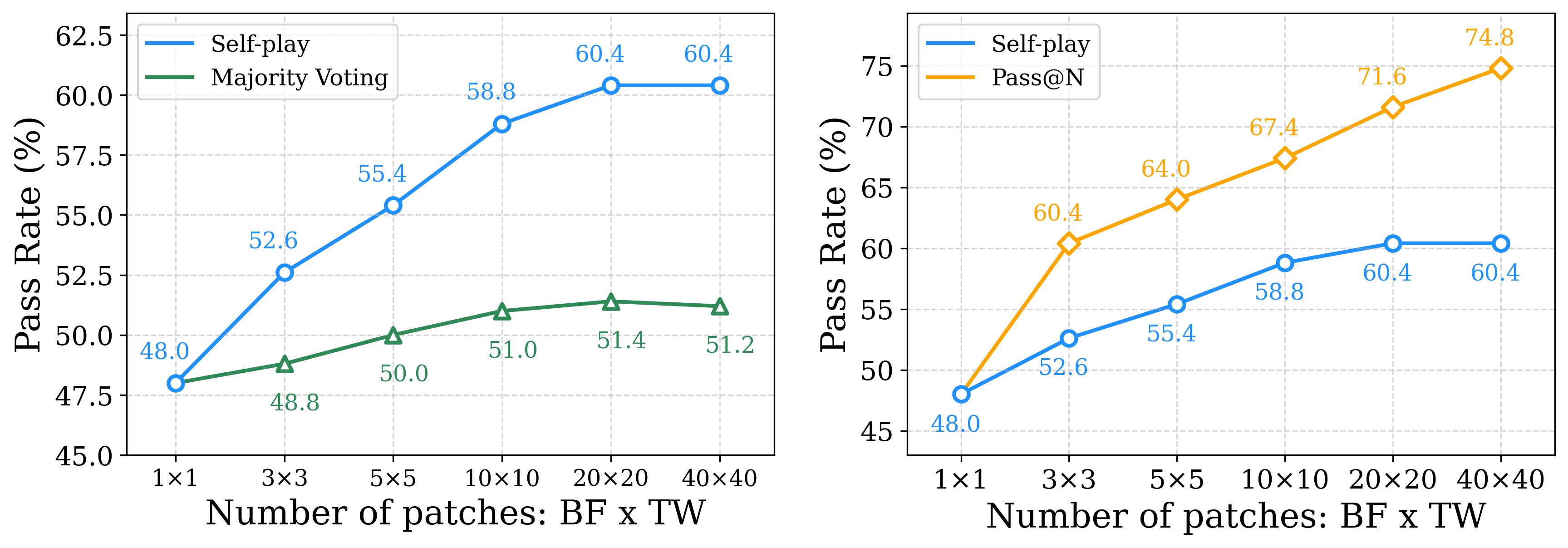
The image contains two side-by-side line charts comparing the performance (Pass Rate %) of different methods as the "Number of patches: BF x TW" increases. The left chart compares "Self-play" and "Majority Voting." The right chart compares "Self-play" and "Pass@N." Both charts share the same x-axis categories and the same "Self-play" data series, but have different y-axis scales and a different second data series.
### Components/Axes
**Common Elements:**
* **X-Axis (Both Charts):** Labeled "Number of patches: BF x TW". The categorical markers are: `1×1`, `3×3`, `5×5`, `10×10`, `20×20`, `40×40`.
* **Y-Axis (Both Charts):** Labeled "Pass Rate (%)".
* **Grid:** Both charts have a light gray, dashed grid.
**Left Chart Specifics:**
* **Y-Axis Scale:** Ranges from 45.0 to 62.5, with major ticks every 2.5 units.
* **Legend:** Located in the top-left corner.
* `Self-play`: Blue line with hollow circle markers.
* `Majority Voting`: Green line with hollow triangle markers.
**Right Chart Specifics:**
* **Y-Axis Scale:** Ranges from 45 to 75, with major ticks every 5 units.
* **Legend:** Located in the top-left corner.
* `Self-play`: Blue line with hollow circle markers (identical to left chart).
* `Pass@N`: Orange line with hollow diamond markers.
### Detailed Analysis
**Data Series: Self-play (Blue Line, Circle Markers)**
* **Trend:** Increases steadily from `1×1` to `20×20`, then plateaus.
* **Data Points:**
* `1×1`: 48.0%
* `3×3`: 52.6%
* `5×5`: 55.4%
* `10×10`: 58.8%
* `20×20`: 60.4%
* `40×40`: 60.4%
**Data Series: Majority Voting (Green Line, Triangle Markers) - Left Chart Only**
* **Trend:** Shows a modest, gradual increase, peaking at `20×20` before a slight decline.
* **Data Points:**
* `1×1`: 48.0%
* `3×3`: 48.8%
* `5×5`: 50.0%
* `10×10`: 51.0%
* `20×20`: 51.4%
* `40×40`: 51.2%
**Data Series: Pass@N (Orange Line, Diamond Markers) - Right Chart Only**
* **Trend:** Shows a strong, consistent upward trend across all patch numbers, with no sign of plateauing.
* **Data Points:**
* `1×1`: 48.0%
* `3×3`: 60.4%
* `5×5`: 64.0%
* `10×10`: 67.4%
* `20×20`: 71.6%
* `40×40`: 74.8%
### Key Observations
1. **Common Baseline:** All three methods start at the same performance (48.0%) for the `1×1` patch configuration.
2. **Diverging Performance:** As the number of patches increases, the performance of the three methods diverges significantly.
3. **Plateau vs. Growth:** "Self-play" performance plateaus after `20×20` patches. "Majority Voting" shows minimal gains overall. In contrast, "Pass@N" demonstrates continuous, strong improvement.
4. **Relative Performance:** At the highest patch count (`40×40`), "Pass@N" (74.8%) significantly outperforms "Self-play" (60.4%), which in turn outperforms "Majority Voting" (51.2%).
### Interpretation
The data demonstrates the impact of scaling the "Number of patches: BF x TW" on the pass rate for different evaluation or sampling strategies.
* **Self-play** benefits from increased patch count up to a point (`20×20`), after which its performance saturates. This suggests a limit to the effectiveness of self-play alone as the problem space (represented by patches) expands.
* **Majority Voting** provides only marginal improvements over the baseline, indicating it is not a highly effective strategy for leveraging increased patch counts in this context.
* **Pass@N** shows a strong, positive correlation between patch count and performance. This suggests that the Pass@N method is highly effective at utilizing the additional information or diversity provided by a larger number of patches, leading to substantially higher pass rates. The lack of a plateau within the tested range implies potential for further gains with even larger patch counts.
**Conclusion:** For the task measured by "Pass Rate," the Pass@N strategy scales most effectively with an increasing number of patches (BF x TW), followed by Self-play, while Majority Voting offers limited benefit. The choice of strategy becomes increasingly critical as the patch configuration grows larger.