## Image: Handwritten Digit Reconstruction with Varying Noise Levels
### Overview
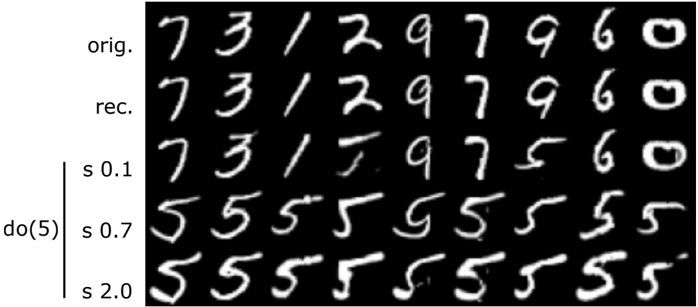
The image shows a grid of handwritten digits, comparing original digits, reconstructed digits, and digits generated with different levels of noise applied during the reconstruction process. The digits are displayed in a 5x8 grid, with each row representing a different condition: original, reconstructed, and three levels of noise (s 0.1, s 0.7, s 2.0).
### Components/Axes
* **Rows (from top to bottom):**
* orig. (Original digits)
* rec. (Reconstructed digits)
* s 0.1 (Digits generated with noise level 0.1)
* s 0.7 (Digits generated with noise level 0.7)
* s 2.0 (Digits generated with noise level 2.0)
* **Columns (from left to right):** Each column represents a different digit. The digits appear to be 7, 3, 1, 2, 9, 7, 9, 6, and 0.
* **Label on the left:** "do(5)" vertically aligned, indicating the digit being manipulated or the parameter being controlled.
### Detailed Analysis
The image displays a comparison of handwritten digit reconstruction under varying noise conditions.
* **Original Digits (orig.):** The first row shows the original handwritten digits. The digits are clear and easily recognizable. The sequence of digits is approximately: 7, 3, 1, 2, 9, 7, 9, 6, and 0.
* **Reconstructed Digits (rec.):** The second row shows the reconstructed digits. These digits are similar to the original digits, but with some slight variations and blurring, indicating the reconstruction process is not perfect. The sequence of digits is approximately: 7, 3, 1, 2, 9, 7, 9, 6, and 0.
* **Noise Level s 0.1:** The third row shows digits generated with a noise level of 0.1. These digits are still recognizable, but show more distortion compared to the reconstructed digits. The sequence of digits is approximately: 7, 3, 1, 2, 9, 7, 5, 6, and 0.
* **Noise Level s 0.7:** The fourth row shows digits generated with a noise level of 0.7. These digits are significantly distorted and some are difficult to recognize. The sequence of digits is approximately: 5, 5, 5, 5, 5, 5, 5, 5, and 5.
* **Noise Level s 2.0:** The fifth row shows digits generated with a noise level of 2.0. These digits are heavily distorted and barely resemble the original digits. The sequence of digits is approximately: 5, 5, 5, 5, 5, 5, 5, 5, and 5.
### Key Observations
* As the noise level increases, the reconstructed digits become increasingly distorted and less recognizable.
* At high noise levels (s 0.7 and s 2.0), the digits tend to converge towards a similar shape, which appears to be the digit "5".
* The reconstruction process introduces some level of distortion even without added noise (rec. row).
### Interpretation
The image demonstrates the impact of noise on the reconstruction of handwritten digits. As the noise level increases, the quality of the reconstructed digits deteriorates. The convergence towards the digit "5" at high noise levels suggests that the model might be biased towards this digit or that the noise is pushing the reconstructions towards a common, stable state. The "do(5)" label on the left suggests that the digit "5" might be the target digit for some manipulation or analysis related to the noise injection. The image highlights the challenges of robust reconstruction in the presence of noise and the importance of noise management in generative models.