## Chart/Diagram Type: Image Reconstruction Visualization
### Overview
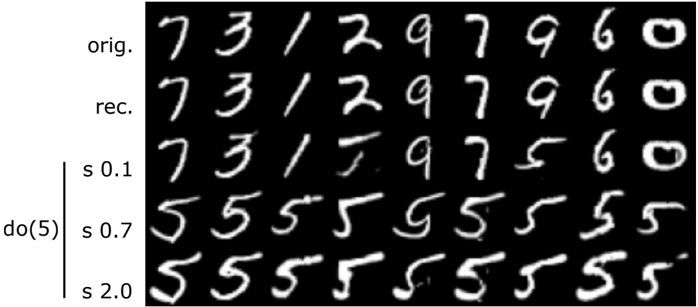
The image displays a grid of handwritten digits (0-9) under different reconstruction conditions. The left column contains labels indicating the original data ("orig."), reconstructed data ("rec."), and three noise levels ("do(5)" with σ=0.1, 0.7, 2.0). Each row shows how digit clarity degrades as noise increases.
### Components/Axes
- **Left Labels**:
- "orig." (Original digits)
- "rec." (Reconstructed digits)
- "do(5)" (Reconstruction with noise, σ=0.1, 0.7, 2.0)
- **Grid Structure**:
- 4 rows (labels) × 9 columns (digits)
- Digits are handwritten, varying in stroke thickness and style.
### Detailed Analysis
1. **Original Digits ("orig.")**:
- Sequence: `7 3 1 2 9 7 9 6 0`
- Handwritten style: Clear, consistent strokes.
2. **Reconstructed Digits ("rec.")**:
- Sequence: `7 3 1 2 9 7 9 6 0`
- Similar to original but with slight noise (e.g., minor smudges in "1" and "2").
3. **Noise Levels ("do(5)")**:
- **σ=0.1**:
- Sequence: `7 3 1 2 9 7 9 6 0`
- Minimal distortion; digits remain recognizable.
- **σ=0.7**:
- Sequence: `5 5 5 5 5 5 5 5 5`
- Heavy distortion; all digits collapse to "5".
- **σ=2.0**:
- Sequence: `5 5 5 5 5 5 5 5 5`
- Complete degradation; identical to σ=0.7.
### Key Observations
- **Noise Impact**: Higher σ values (0.7, 2.0) cause catastrophic loss of original digit information, replacing all digits with "5".
- **Reconstruction Fidelity**: The "rec." row preserves most original details but introduces minor artifacts.
- **Threshold Effect**: σ=0.7 acts as a critical threshold where digit identity is irreversibly lost.
### Interpretation
This visualization demonstrates the sensitivity of image reconstruction to noise levels. The original and reconstructed rows show that even small noise (σ=0.1) can be mitigated, but moderate noise (σ=0.7) destroys semantic meaning. The collapse to "5" suggests a failure mode where reconstruction algorithms prioritize dominant features (e.g., vertical strokes) over original structure. The data implies that noise suppression techniques must balance fidelity and robustness to avoid such failures.