## Word Cloud: Healthcare and Medical Research Terminology
### Overview
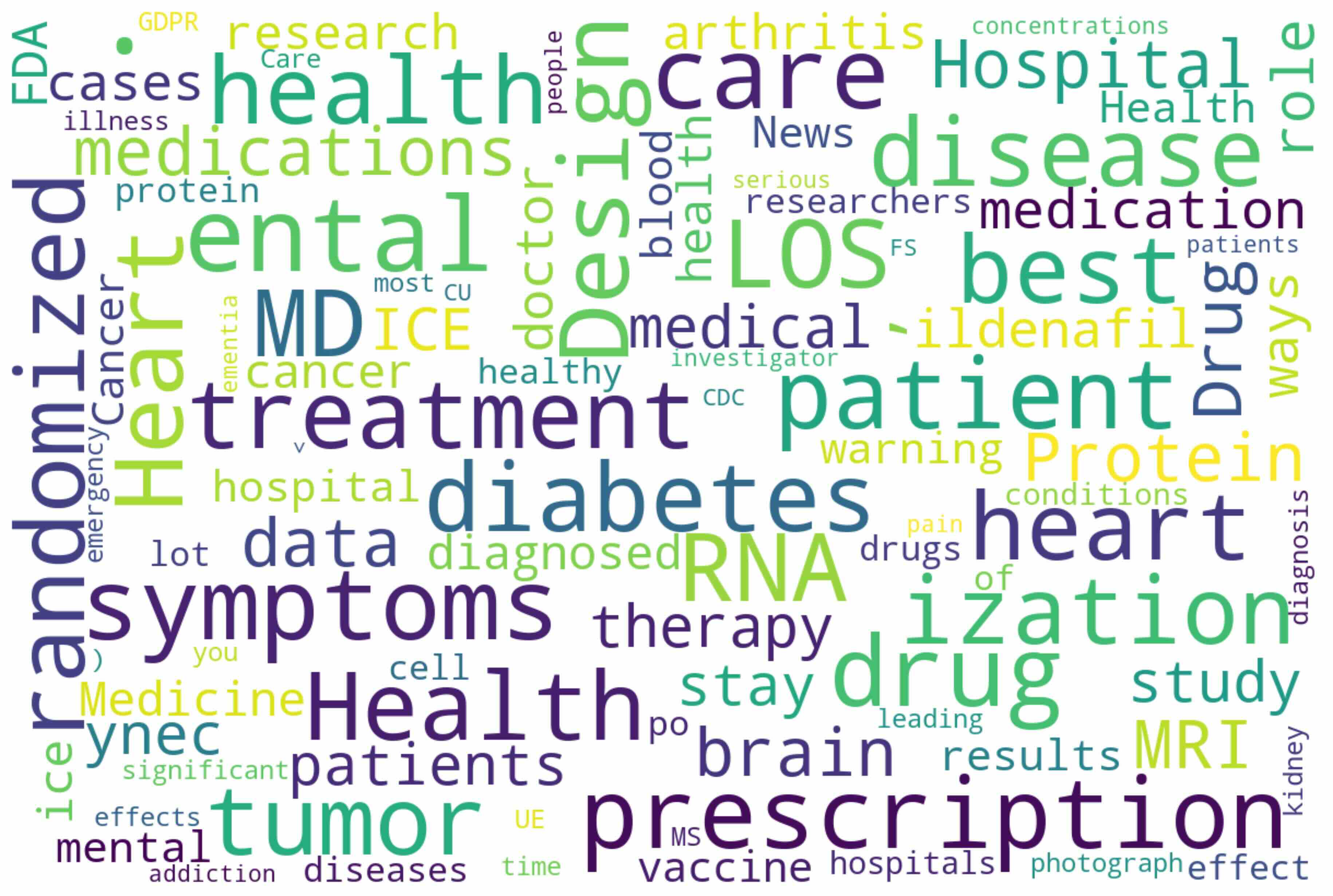
The image is a word cloud visualization. In a word cloud, the size of each word typically represents its frequency or importance within a source text or dataset. The words are presented in various colors (primarily shades of green, blue, purple, and yellow) and orientations (horizontal and vertical) against a white background. The overall theme is heavily focused on healthcare, medicine, clinical research, and patient care.
### Components/Axes
As a word cloud, there are no formal axes, legends, or data points. The primary components are the words themselves. Their relative size is the key visual variable conveying information.
### Detailed Analysis
The words can be categorized by their apparent visual prominence (size). Below is a comprehensive list, grouped by approximate size tier for clarity.
**Tier 1 - Largest/Prominent Words:**
* treatment
* patient
* diabetes
* symptoms
* Health
* prescription
* randomized
* disease
* care
* drug
* hospital
* data
* heart
* tumor
* RNA
* mental
* best
* medical
* ization (likely a suffix, e.g., from "hospitalization" or "randomization")
* Design
**Tier 2 - Medium-Sized Words:**
* health
* medications
* cancer
* protein
* therapy
* brain
* study
* patients
* doctor
* blood
* research
* cases
* medicine
* results
* MRI
* vaccine
* diseases
* effect
* role
* pain
* conditions
* warning
* diagnosis
* cell
* significant
* effects
* time
* hospitals
* photograph
* leading
* ways
* stay
* lot
* diagnosed
* healthy
* investigator
* serious
* researchers
* News
* concentrations
* arthritis
* people
* illness
* emergency
* dementia
* CU (likely an abbreviation)
* most
* v (likely an abbreviation)
* CDC
* FS (likely an abbreviation)
* MS (likely an abbreviation)
* UE (likely an abbreviation)
* po (medical abbreviation for "by mouth")
* y nec (likely a fragment, e.g., from "gynecology")
* ice (likely a fragment, e.g., from "device" or "practice")
* drugs
* of
* you
* ild enafil (likely a fragment of "sildenafil")
**Tier 3 - Smaller Words:**
* FDA
* GDPR
* Care
* Cancer
* kidney
### Key Observations
1. **Dominant Themes:** The largest words form the core themes: `treatment`, `patient`, `diabetes`, `symptoms`, `Health`, `prescription`, `randomized`, `disease`, `care`, `drug`, `hospital`, `data`, `heart`, `tumor`, `RNA`, `mental`. This strongly suggests the source data is related to clinical studies, patient outcomes, and therapeutic interventions.
2. **Research Context:** The prominence of `randomized`, `data`, `study`, `research`, `results`, and `investigator` indicates a focus on clinical trial methodology and evidence-based medicine.
3. **Specific Conditions:** Key medical conditions highlighted include `diabetes`, `heart` (disease), `cancer`, `tumor`, `arthritis`, `mental` (health), and `dementia`.
4. **Medical Interventions:** Terms like `treatment`, `drug`, `prescription`, `medications`, `therapy`, `vaccine`, and `MRI` point to diagnostic and therapeutic procedures.
5. **Institutional & Regulatory:** Words such as `hospital`, `FDA`, `GDPR`, `CDC`, and `doctor` reference the healthcare system and its regulatory environment.
6. **Visual Design:** The color palette (greens, blues, purples) is common in medical and scientific visualizations. The mix of horizontal and vertical text increases density but can reduce readability for some words.
### Interpretation
This word cloud visually synthesizes a large body of text, likely from medical literature, clinical trial reports, or healthcare news. The data suggests a primary focus on **managing chronic and serious diseases** (diabetes, heart disease, cancer) through **evidence-based treatments** (`randomized` trials, `drug` therapies, `prescription` management) within the **hospital and clinical care** system.
The equal prominence of `patient`, `symptoms`, and `data` underscores a modern healthcare paradigm that balances patient-centered care with quantitative analysis. The presence of `RNA` and `protein` alongside `tumor` and `cancer` hints at discussions around targeted therapies or biomarkers. The inclusion of `mental` health and `dementia` reflects an expanding scope of medical research beyond purely physical ailments.
**Notable Anomaly/Observation:** The word `ization` appears very large but is a suffix. This is a common artifact in automated word cloud generation from raw text, where word stemming or splitting is imperfect. Its size suggests that words ending in "-ization" (e.g., hospitalization, randomization, immunization) are extremely frequent in the source material, reinforcing the themes of clinical processes and procedures.
In essence, the cloud depicts the interconnected lexicon of modern clinical research and practice, where patient care, specific diseases, therapeutic drugs, and rigorous data collection are the central, interlocking components.