## Line Chart: Training Batch Accuracy (%)
### Overview
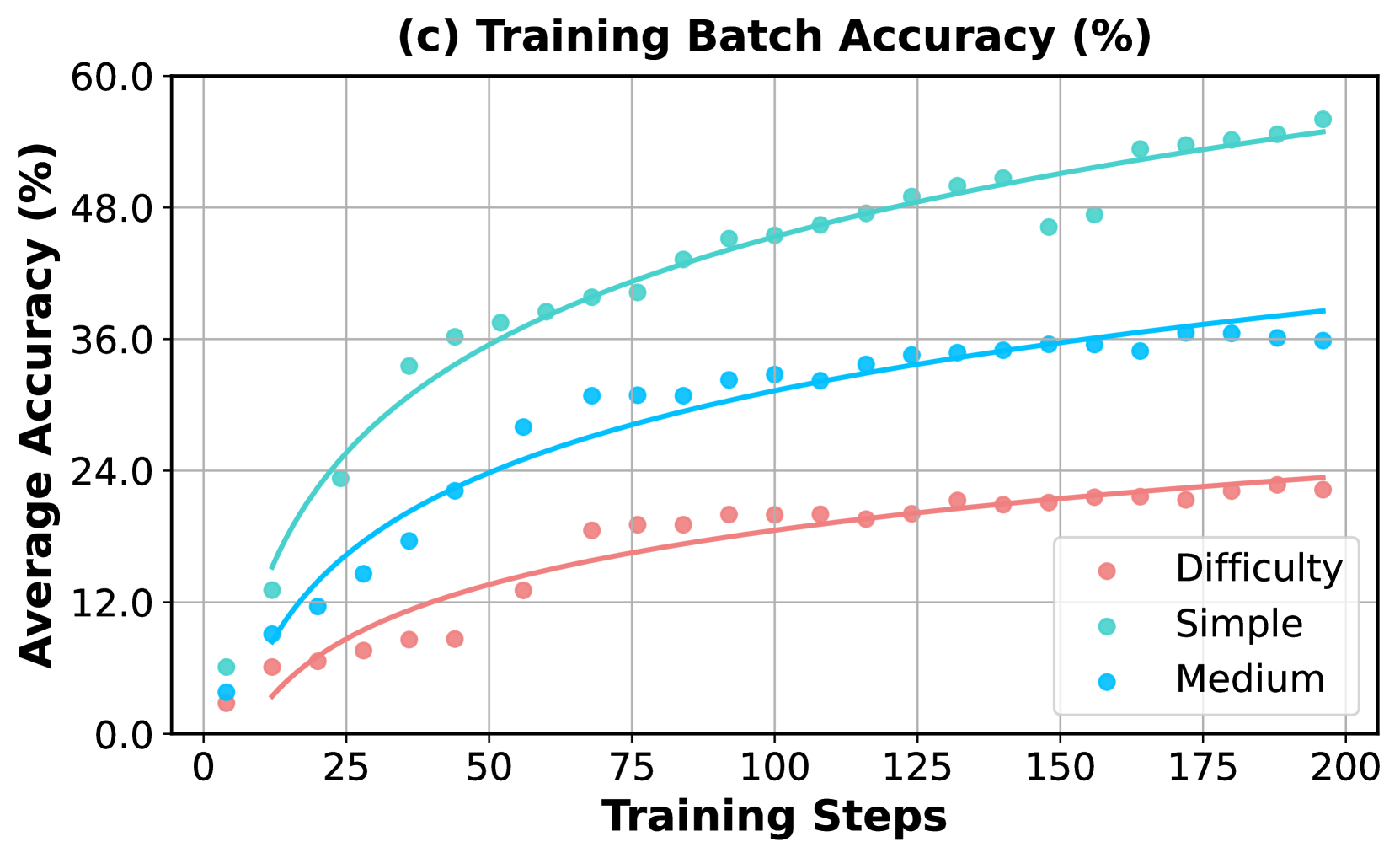
The chart visualizes the relationship between training steps and average accuracy for three categories: "Difficulty," "Simple," and "Medium." Accuracy is plotted on the y-axis (0–60%) against training steps (0–200) on the x-axis. Three colored lines (red, teal, blue) represent the categories, with data points marked along each line.
### Components/Axes
- **Title**: "Training Batch Accuracy (%)" (top-center).
- **X-axis**: "Training Steps" (0–200, linear scale).
- **Y-axis**: "Average Accuracy (%)" (0–60, linear scale).
- **Legend**: Located in the bottom-right corner, with:
- Red: "Difficulty"
- Teal: "Simple"
- Blue: "Medium"
### Detailed Analysis
1. **Difficulty (Red Line)**:
- Starts at ~2% accuracy at 0 steps.
- Gradually increases to ~22% at 200 steps.
- Slope: Gentle upward trend with minimal curvature.
- Data points: Consistent spacing along the line.
2. **Simple (Teal Line)**:
- Starts at ~8% accuracy at 0 steps.
- Rises sharply to ~54% at 200 steps.
- Slope: Steeper than other lines, with slight curvature.
- Data points: Densely packed in early steps, spacing increases later.
3. **Medium (Blue Line)**:
- Starts at ~4% accuracy at 0 steps.
- Increases to ~36% at 200 steps.
- Slope: Moderate upward trend, smoother than "Simple."
- Data points: Evenly distributed along the line.
### Key Observations
- **Trend Verification**:
- All lines show upward trends, confirming improved accuracy with more training steps.
- "Simple" outperforms "Medium" and "Difficulty" across all steps.
- "Difficulty" has the slowest growth rate.
- **Notable Patterns**:
- "Simple" achieves ~54% accuracy by 200 steps, nearly double the "Medium" line (~36%).
- "Difficulty" remains the lowest-performing category throughout.
### Interpretation
The data suggests that "Simple" tasks or models achieve higher training efficiency, reaching near-peak accuracy faster than "Medium" or "Difficulty." The steep slope of the "Simple" line implies rapid learning in early stages, while "Difficulty" struggles to improve even after 200 steps. This could reflect inherent complexity in "Difficulty" tasks or suboptimal training strategies for those cases. The "Medium" category balances performance and complexity, showing moderate gains. No outliers are observed, indicating consistent training dynamics across all categories.