## Chart/Diagram Type: Graph and Text Analysis
### Overview
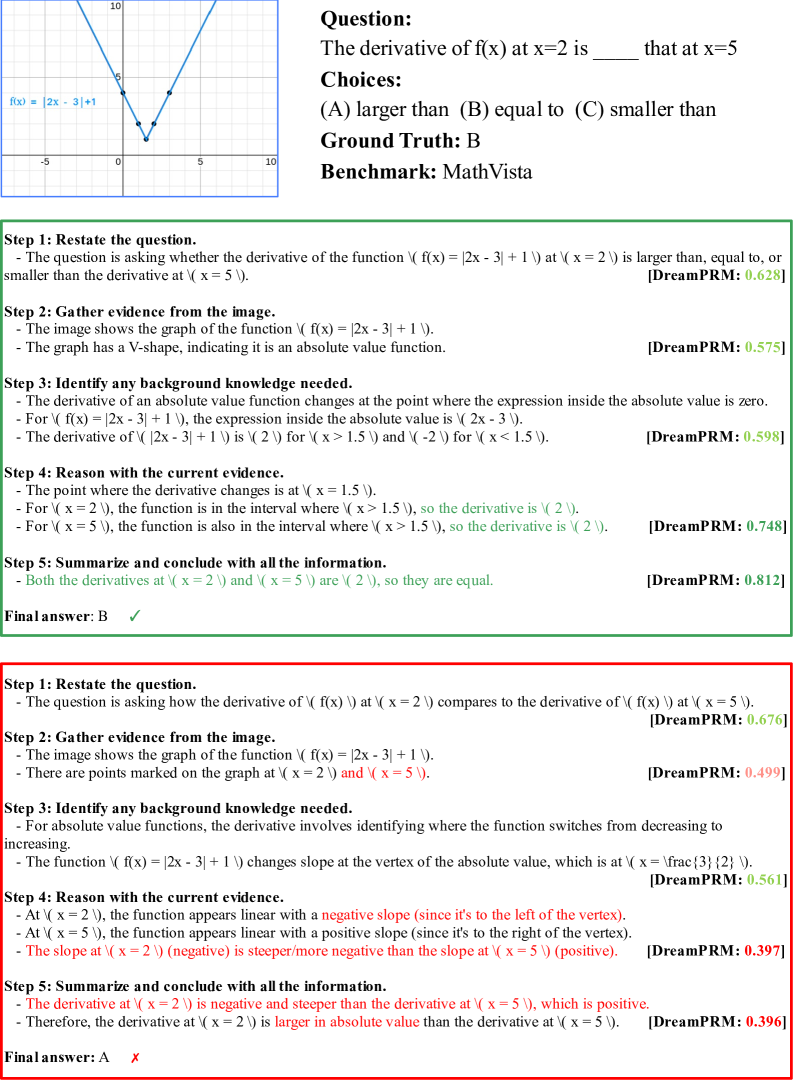
The image presents a graph of the function f(x) = |2x - 3| + 1, along with a question about the derivative of the function at x=2 compared to x=5. It also includes two different reasoning processes, one leading to the correct answer and one leading to an incorrect answer, along with DreamPRM scores for each step.
### Components/Axes
**Graph:**
* **Function:** f(x) = |2x - 3| + 1 (located on the top-left of the graph)
* **X-axis:** Ranges from approximately -5 to 10, with tick marks at intervals of 5.
* **Y-axis:** Ranges from approximately -5 to 10, with tick marks at intervals of 5.
* **Shape:** The graph is a V-shaped absolute value function. The vertex of the V is at x = 1.5.
* **Points:** There are several points marked on the graph.
**Textual Elements:**
* **Question:** "The derivative of f(x) at x=2 is ____ that at x=5"
* **Choices:** (A) larger than (B) equal to (C) smaller than
* **Ground Truth:** B
* **Benchmark:** MathVista
* **Reasoning Processes:** Two separate "Step 1" to "Step 5" sequences, one marked with a green background and a checkmark indicating a correct answer (B), and the other marked with a red background and an X indicating an incorrect answer (A). Each step includes a statement and a DreamPRM score.
### Detailed Analysis or Content Details
**Graph Data:**
* The V-shape of the graph indicates an absolute value function.
* The vertex of the V is at x = 1.5, y = 1.
* For x < 1.5, the slope of the line is negative.
* For x > 1.5, the slope of the line is positive.
* At x = 2, the function is on the decreasing side of the V.
* At x = 5, the function is on the increasing side of the V.
**Reasoning Process 1 (Green Background - Correct):**
* **Step 1:** Restates the question. [DreamPRM: 0.628]
* **Step 2:** Gathers evidence from the image, noting the function and the V-shape. [DreamPRM: 0.575]
* **Step 3:** Identifies background knowledge about absolute value function derivatives. [DreamPRM: 0.598]
* **Step 4:** Reasons with the current evidence, noting the derivative is 2 for x > 1.5. [DreamPRM: 0.748]
* **Step 5:** Summarizes and concludes that the derivatives at x=2 and x=5 are both 2, so they are equal. [DreamPRM: 0.812]
* **Final Answer:** B (Equal) - Correct.
**Reasoning Process 2 (Red Background - Incorrect):**
* **Step 1:** Restates the question. [DreamPRM: 0.676]
* **Step 2:** Gathers evidence from the image, noting the function and the points at x=2 and x=5. [DreamPRM: 0.499]
* **Step 3:** Identifies background knowledge about absolute value function derivatives. [DreamPRM: 0.561]
* **Step 4:** Reasons with the current evidence, noting the negative slope at x=2 and the positive slope at x=5, and incorrectly concludes the slope at x=2 is steeper/more negative. [DreamPRM: 0.397]
* **Step 5:** Summarizes and concludes that the derivative at x=2 is negative and steeper, therefore larger in absolute value. [DreamPRM: 0.396]
* **Final Answer:** A (Larger than) - Incorrect.
### Key Observations
* The graph visually represents the absolute value function.
* The correct reasoning process identifies that the derivative is constant (2) for x > 1.5.
* The incorrect reasoning process focuses on the negative and positive slopes without considering the absolute value.
* The DreamPRM scores vary across the steps in both reasoning processes.
### Interpretation
The image illustrates a problem-solving scenario involving the derivative of an absolute value function. It highlights the importance of understanding the properties of absolute value functions and their derivatives. The two reasoning processes demonstrate how different approaches can lead to correct or incorrect conclusions. The DreamPRM scores provide a measure of confidence or accuracy for each step in the reasoning process, although their precise meaning is not defined within the image. The incorrect reasoning fails to account for the fact that the derivative of |2x-3| is -2 for x < 1.5 and 2 for x > 1.5. Therefore, at x=2, the derivative is -2, and at x=5, the derivative is 2. The question asks about the value of the derivative, not the absolute value.