## Line Graph: Absolute Value Function f(x) = |2x - 3| + 1
### Overview
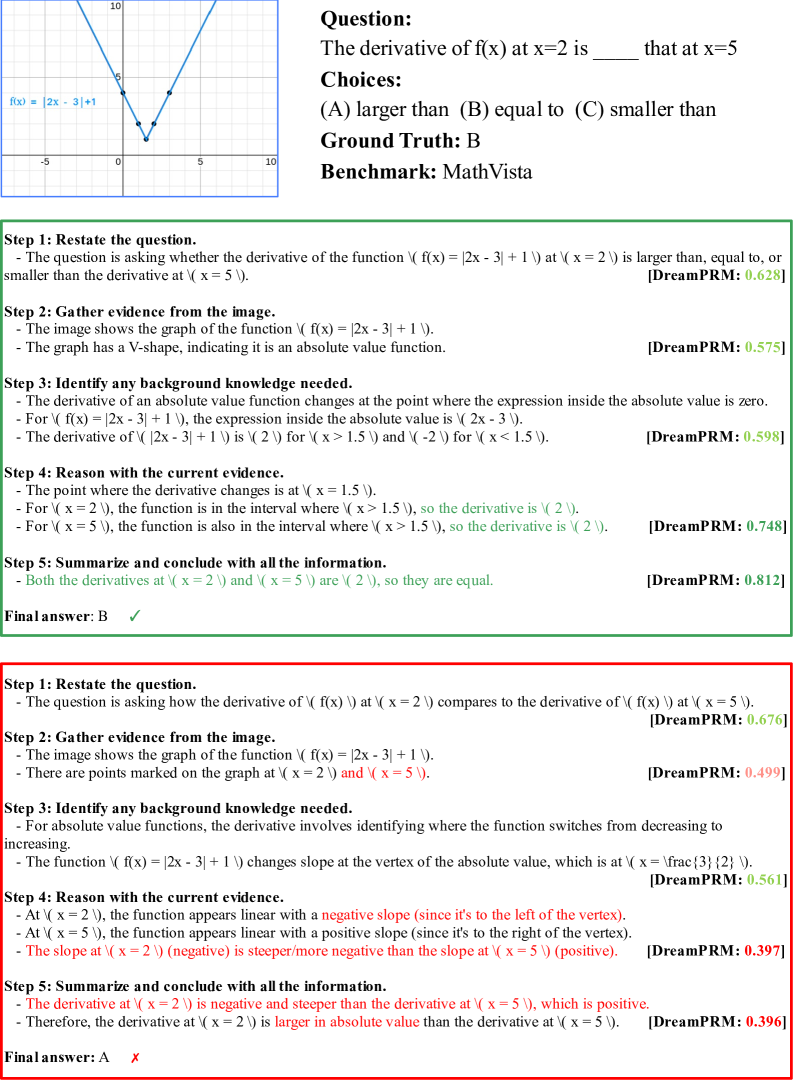
The image shows a line graph of the absolute value function f(x) = |2x - 3| + 1. The graph has a V-shape with a vertex at x = 1.5. Two points are marked on the graph: one at x = 2 and another at x = 5. The question asks whether the derivative of f(x) at x = 2 is larger than, equal to, or smaller than the derivative at x = 5.
### Components/Axes
- **X-axis**: Labeled "x", ranging from -5 to 10 in increments of 1.
- **Y-axis**: Labeled "f(x)", ranging from 0 to 10 in increments of 1.
- **Legend**: Text "f(x) = |2x - 3| + 1" in blue, positioned near the top-left of the graph.
- **Grid**: Light gray grid lines span the entire graph area.
- **Question Text**: Positioned to the right of the graph, with choices (A) larger than, (B) equal to, (C) smaller than.
- **Ground Truth**: "B" (equal to) is explicitly stated as the correct answer.
### Detailed Analysis
1. **Function Behavior**:
- The function f(x) = |2x - 3| + 1 has a vertex at x = 1.5 (where 2x - 3 = 0).
- For x > 1.5, the function simplifies to f(x) = 2x - 2 (slope = 2).
- For x < 1.5, the function simplifies to f(x) = -2x + 4 (slope = -2).
2. **Marked Points**:
- At x = 2: The function value is f(2) = |2(2) - 3| + 1 = 2. The derivative is 2 (since x > 1.5).
- At x = 5: The function value is f(5) = |2(5) - 3| + 1 = 8. The derivative is also 2 (since x > 1.5).
3. **Derivative Comparison**:
- Both x = 2 and x = 5 lie in the region x > 1.5, where the derivative is constant at 2.
### Key Observations
- The graph is symmetric about x = 1.5, with equal slopes of ±2 on either side of the vertex.
- The derivatives at x = 2 and x = 5 are identical because both points are in the same linear region (x > 1.5).
- The red-box reasoning incorrectly assumes the derivative at x = 2 is "steeper" (larger in absolute value) than at x = 5, but this ignores the absolute value function's piecewise linearity.
### Interpretation
The absolute value function's derivative is piecewise constant, changing only at the vertex (x = 1.5). Since both x = 2 and x = 5 are in the same linear segment (right side of the vertex), their derivatives are equal. The red-box reasoning misinterprets the slope's sign (negative vs. positive) as a comparison of magnitude, but the question explicitly asks about the derivative's value, not its absolute value. The correct answer (B) reflects the mathematical reality of the function's behavior.