## Flowchart: Foundation Model Architecture and Applications
### Overview
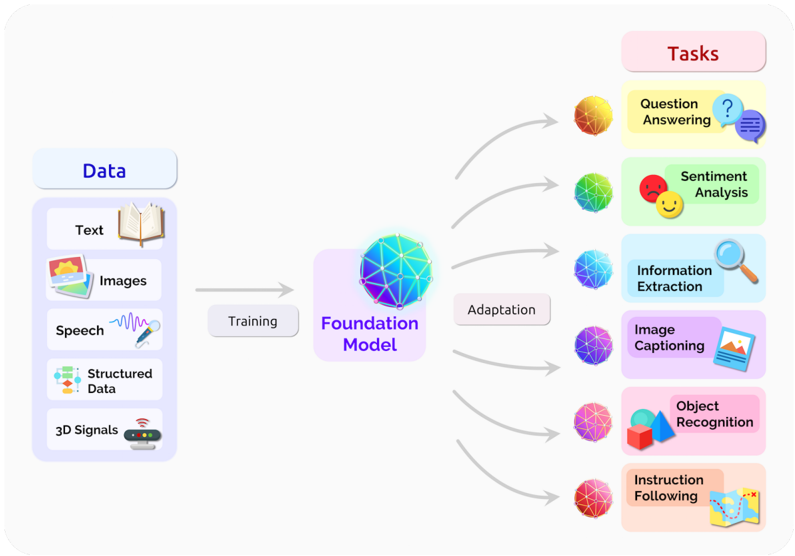
The diagram illustrates the architecture of a foundation model, its training data sources, and downstream task applications. It uses a central "Foundation Model" node connected to data inputs on the left and task outputs on the right via directional arrows. Color-coded nodes represent different data types and tasks, with spatial grounding emphasizing the flow from raw data to specialized applications.
### Components/Axes
- **Left Panel (Data Sources)**:
- **Text**: Icon of an open book.
- **Images**: Icon of a photo with a mountain.
- **Speech**: Icon of a microphone with waveform.
- **Structured Data**: Icon of interconnected nodes.
- **3D Signals**: Icon of a sensor with RGB lights.
- **Center Node**:
- **Foundation Model**: Labeled with a 3D geometric network icon.
- **Training**: Arrow pointing from data sources to the model.
- **Adaptation**: Arrow pointing from the model to task outputs.
- **Right Panel (Tasks)**:
- **Question Answering**: Icon of a speech bubble with a question mark.
- **Sentiment Analysis**: Icon of happy/sad faces.
- **Information Extraction**: Icon of a magnifying glass.
- **Image Captioning**: Icon of a photo with mountains.
- **Object Recognition**: Icon of geometric shapes.
- **Instruction Following**: Icon of a map with a route.
### Detailed Analysis
- **Data Flow**:
- All data types (text, images, speech, structured data, 3D signals) feed into the foundation model during training.
- The adapted foundation model then branches to six specialized tasks, each represented by a distinct color-coded node.
- **Color Coding**:
- Data types: Purple (#9370db), Blue (#87ceeb), Green (#20b2aa), Pink (#ff69b4), Orange (#ff8c00).
- Tasks: Yellow (#ffd700), Green (#228b22), Blue (#0000ff), Purple (#800080), Pink (#ffc0cb), Orange (#ff8c00).
- **Spatial Relationships**:
- Data sources are left-aligned, tasks are right-aligned, and the foundation model is centrally positioned.
- Arrows create a unidirectional flow from data → model → tasks.
### Key Observations
1. **Modularity**: The foundation model acts as a central hub, decoupling data ingestion from task execution.
2. **Task Diversity**: Tasks span NLP (question answering, sentiment analysis), vision (image captioning, object recognition), and multimodal instruction following.
3. **Adaptation Layer**: The "Adaptation" step suggests fine-tuning or prompt engineering to specialize the model for specific tasks.
### Interpretation
This diagram emphasizes the versatility of foundation models in handling heterogeneous data and performing diverse tasks through adaptation. The absence of explicit numerical values suggests a conceptual rather than empirical representation. The color-coding implies a taxonomy of data/task types, though no quantitative relationships are depicted. The architecture highlights the importance of robust training data diversity for generalizable models, while the task-specific branches underscore the need for domain adaptation in real-world deployment.