## Diagram: Machine Learning Paradigms Comparison
### Overview
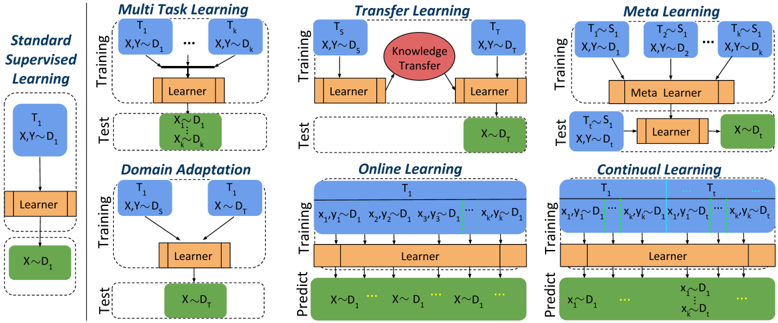
The diagram illustrates six machine learning paradigms (Standard Supervised Learning, Domain Adaptation, Online Learning, Multi-Task Learning, Transfer Learning, and Meta Learning) through a structured layout of training, test, and learner components. Arrows indicate data flow, knowledge transfer, and task relationships.
### Components/Axes
- **Left Column**:
- **Standard Supervised Learning**: Single task `T₁` with training data `X,Y ~ D₁` and test data `X ~ D₁`.
- **Domain Adaptation**: Training on `T₁` with source domain `X,Y ~ Dₛ` and target domain `X ~ Dₜ`.
- **Online Learning**: Continuous training on `T₁` with sequential data `X₁,Y₁ ~ D₁` to `Xₖ,Yₖ ~ D₁`, predicting `X ~ D₁`.
- **Right Column**:
- **Multi-Task Learning**: Shared learner for tasks `T₁` to `Tₖ` with data `X,Y ~ D₁` to `X,Y ~ Dₖ`.
- **Transfer Learning**: Knowledge transfer (red oval) from source task `Tₛ` (`X,Y ~ Dₛ`) to target task `Tₜ` (`X,Y ~ Dₜ`).
- **Meta Learning**: Meta learner handling tasks `T₁` to `Tₖ` with shared structure `X,Y ~ D₁` to `X,Y ~ Dₖ`, testing on `X ~ Dₜ`.
- **Color Coding**:
- Blue: Training data (`X,Y ~ D`).
- Green: Test data (`X ~ D`).
- Orange: Learner component.
- Red: Knowledge transfer (Transfer Learning only).
### Detailed Analysis
1. **Standard Supervised Learning**:
- Simple pipeline: Training (`T₁`) → Learner → Test (`X ~ D₁`).
- No adaptation or transfer; assumes static, task-specific data.
2. **Domain Adaptation**:
- Addresses domain shift: Training on source domain `Dₛ` → Learner → Test on target domain `Dₜ`.
3. **Online Learning**:
- Sequential data ingestion: `X₁,Y₁ ~ D₁` to `Xₖ,Yₖ ~ D₁` → Learner → Predictions on `X ~ D₁`.
- Emphasizes real-time adaptation to streaming data.
4. **Multi-Task Learning**:
- Shared learner across tasks `T₁` to `Tₖ` with distinct datasets `D₁` to `Dₖ`.
- Leverages cross-task knowledge for improved generalization.
5. **Transfer Learning**:
- Explicit knowledge transfer (red oval) from source task `Tₛ` to target task `Tₜ`.
- Source task `Tₛ` trains on `Dₛ`; target task `Tₜ` tests on `Dₜ`.
6. **Meta Learning**:
- Meta learner generalizes across tasks `T₁` to `Tₖ` with shared structure.
- Tests on unseen task `Tₜ` with data `X ~ Dₜ`.
### Key Observations
- **Hierarchy of Complexity**: Paradigms progress from simple (Standard Supervised) to complex (Meta Learning).
- **Knowledge Reuse**: Transfer Learning and Meta Learning explicitly model knowledge reuse across tasks/domains.
- **Dynamic Data Handling**: Online Learning and Domain Adaptation address non-stationary or domain-shifted data.
- **Shared Learners**: Multi-Task and Meta Learning use shared architectures for efficiency.
### Interpretation
The diagram highlights the evolution of machine learning from task-specific models to adaptive, generalizable frameworks. Transfer Learning and Meta Learning emphasize leveraging prior knowledge, while Domain Adaptation and Online Learning focus on real-world data challenges. The red "Knowledge Transfer" oval in Transfer Learning underscores its role as a bridge between source and target tasks. Meta Learning’s "Meta Learner" abstracts task-specific patterns, enabling rapid adaptation to new tasks. This progression reflects the field’s shift toward robustness, efficiency, and scalability in dynamic environments.