## Bar Chart: Mean Accuracy Across Mathematical Concepts
### Overview
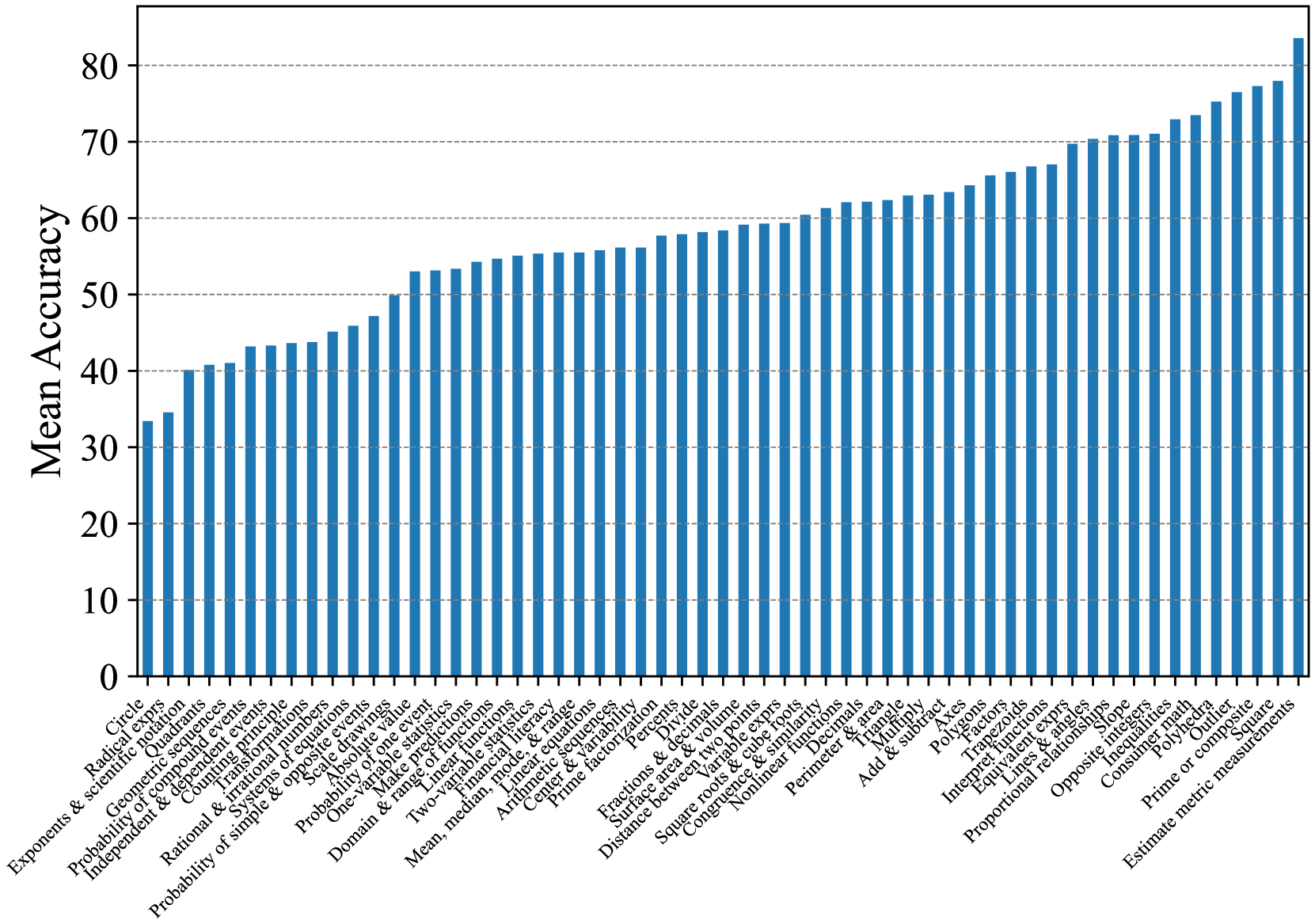
The chart displays mean accuracy scores for 48 mathematical concepts, ranging from basic arithmetic to advanced applied mathematics. Bars are uniformly blue, with heights corresponding to accuracy percentages. The tallest bar ("Estimate metric measurements") exceeds the y-axis maximum of 80, reaching approximately 85.
### Components/Axes
- **X-axis**: Mathematical concepts (e.g., "Circle," "Radical notation," "Exponents & scientific notation," ..., "Estimate metric measurements"). Labels are left-aligned, with multi-word terms hyphenated (e.g., "One-variable statistics").
- **Y-axis**: "Mean Accuracy" (0–80, increments of 10). The axis extends visually beyond 80 to accommodate the tallest bar.
- **Legend**: Single entry for blue bars, positioned in the top-right corner. No explicit labels for data series beyond color.
### Detailed Analysis
1. **Early Categories (Low Accuracy)**:
- "Circle" (~35), "Radical notation" (~38), "Exponents & scientific notation" (~40).
- Gradual increase to ~45–50 by "Independent & dependent events" and "Rational & irrational numbers."
2. **Mid-Range Categories**:
- "Probability of simple operations" (~47) to "Prime factorization" (~60).
- Steady climb to ~65 by "Congruence & similarity."
3. **High-Accuracy Categories**:
- "Nonlinear functions" (~62) and "Interpret function expressions" (~63) show slight dips.
- Applied topics dominate the top: "Consumer math" (~80), "Polyhedra" (~81), "Outlier" (~82), "Composite" (~83), "Square" (~84), and "Estimate metric measurements" (~85).
### Key Observations
- **Steady Progression**: Accuracy increases from ~35 to ~85 across categories, suggesting a learning curve where foundational concepts build toward mastery of applied topics.
- **Dips in Complexity**: "Nonlinear functions" and "Interpret function expressions" deviate slightly downward (~62–63), possibly indicating challenges with abstract concepts.
- **Applied Topics Excel**: The highest accuracies (>80) cluster in practical applications (e.g., "Consumer math," "Polyhedra"), implying real-world relevance enhances comprehension.
- **Axis Limitation**: The y-axis max (80) underrepresents the tallest bar ("Estimate metric measurements" at ~85), requiring visual extrapolation.
### Interpretation
The data reflects a pedagogical progression: basic concepts (e.g., "Circle," "Radical notation") have lower accuracy, while applied topics (e.g., "Estimate metric measurements") achieve near-perfect scores. This suggests that:
1. **Foundational Knowledge**: Early topics are harder to master, possibly due to abstract notation or conceptual complexity.
2. **Applied Learning**: Practical applications (e.g., "Consumer math") reinforce understanding, leading to higher accuracy.
3. **Outliers**: Dips in "Nonlinear functions" and "Interpret function expressions" may highlight areas where students struggle with abstraction or contextual application.
The chart underscores the importance of scaffolding mathematical education, where incremental mastery of basics enables success in advanced, applied domains. The outlier dips suggest targeted interventions could improve comprehension in abstract topics.