\n
## Image: 3D City Model Comparison
### Overview
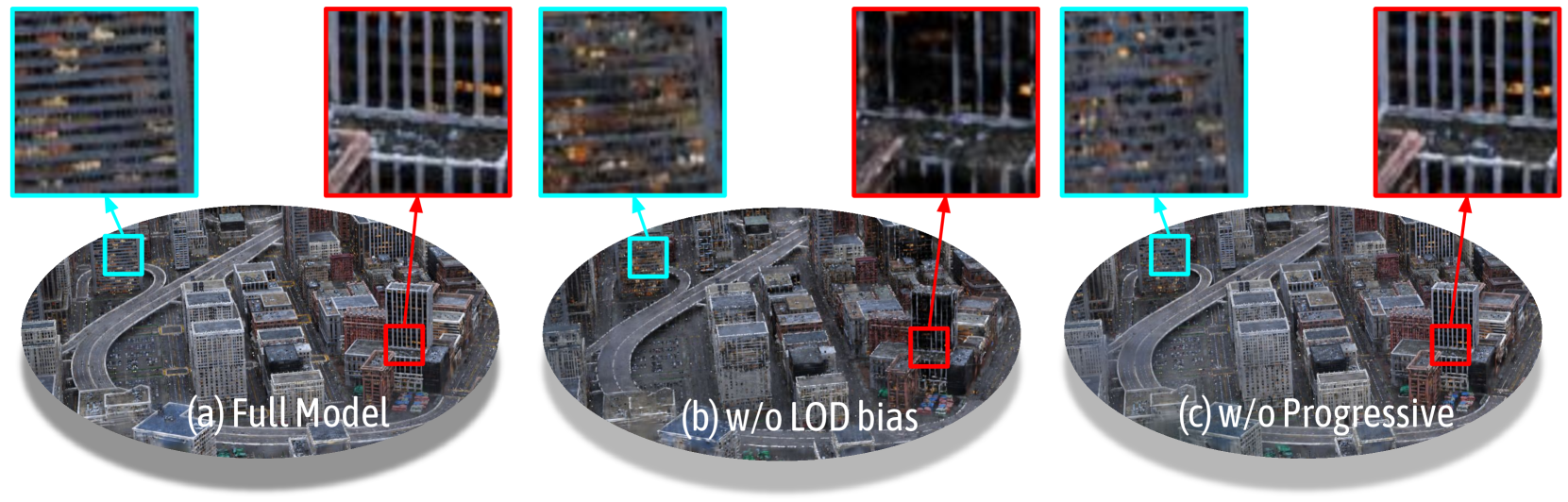
The image presents a comparison of three different renderings of a 3D city model, likely for visualization or simulation purposes. Each rendering is accompanied by a zoomed-in inset showing the detail of the building structures. The three renderings are labeled "(a) Full Model", "(b) w/o LOD bias", and "(c) w/o Progressive". Each rendering is presented within a circular frame.
### Components/Axes
There are no explicit axes or scales in this image. The comparison is visual, relying on the observer to assess differences in detail and quality. The labels indicate the rendering method used for each image.
### Detailed Analysis or Content Details
The image consists of three main sections, each displaying a 3D city model and a zoomed-in inset.
* **(a) Full Model:** This rendering appears to have the highest level of detail. The buildings are well-defined, with visible textures and individual structures. The inset shows a close-up of the buildings, revealing intricate details like windows and architectural features.
* **(b) w/o LOD bias:** This rendering shows a noticeable reduction in detail compared to the "Full Model". Buildings appear more simplified, and some textures are less distinct. The inset shows a similar reduction in detail, with buildings appearing blockier.
* **(c) w/o Progressive:** This rendering exhibits a level of detail similar to "(b)", but with some differences in the appearance of the buildings. The inset shows a comparable level of simplification as in "(b)".
All three renderings depict a city with a highway running through it, and a waterfront area. The zoomed-in insets are positioned in the top-center of each rendering, with a light blue arrow pointing from the inset to the corresponding section of the main rendering. The insets focus on a cluster of high-rise buildings.
### Key Observations
The primary difference between the renderings lies in the level of detail. The "Full Model" provides the most realistic and detailed representation, while the other two renderings exhibit varying degrees of simplification. The labels suggest that the differences are related to the use of Level of Detail (LOD) techniques and progressive rendering.
### Interpretation
The image demonstrates the impact of different rendering techniques on the visual quality of a 3D city model.
* **"Full Model"** likely represents the highest-quality rendering, using all available detail. This approach is computationally expensive and may not be suitable for real-time applications.
* **"w/o LOD bias"** suggests that the rendering is using Level of Detail (LOD) techniques, but without a bias towards higher detail. LOD techniques reduce the complexity of objects based on their distance from the viewer, improving performance. The absence of a bias might result in a more uniform level of simplification across the scene.
* **"w/o Progressive"** indicates that the rendering is not using progressive rendering. Progressive rendering gradually refines the image over time, starting with a low-resolution version and adding detail iteratively. Without progressive rendering, the image may appear less smooth or detailed initially.
The image highlights the trade-off between visual quality and performance in 3D rendering. By using LOD techniques and progressive rendering, it is possible to achieve a balance between realism and efficiency. The image suggests that the "Full Model" is the most visually appealing, but the other two renderings may be more practical for applications where performance is critical. The zoomed-in insets are crucial for highlighting the differences in detail between the renderings, allowing for a direct comparison of the building structures. The consistent focus on the same cluster of buildings in the insets ensures a fair comparison.