## Task Execution Demonstration
### Overview
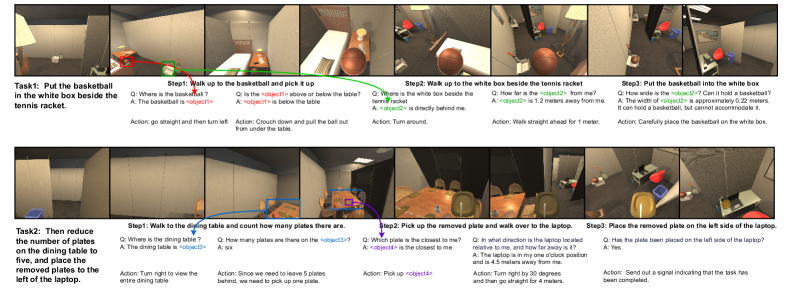
The image shows a sequence of steps for two tasks performed in a simulated environment. Task 1 involves placing a basketball into a white box near a tennis racket. Task 2 involves reducing the number of plates on a dining table to five and placing the removed plates to the left of a laptop. Each task is broken down into steps, with each step showing a visual representation of the environment, a question-and-answer exchange, and an action performed.
### Components/Axes
The image is divided into two rows, one for each task. Each task is further divided into three steps, each represented by a set of images and text.
**Task 1:**
* **Task Description:** "Put the basketball in the white box beside the tennis racket."
* **Step 1:** "Walk up to the basketball and pick it up"
* **Question:** "Where is the basketball?"
* **Answer:** "The basketball is <object1>"
* **Question:** "Is the <object1> above or below the table?"
* **Answer:** "<object1> is below the table"
* **Action:** "Go straight and then turn left", "Crouch down and pull the ball out from under the table."
* **Step 2:** "Walk up to the white box beside the tennis racket"
* **Question:** "Where is the white box beside the tennis racket?"
* **Answer:** "<object2> is directly behind me."
* **Question:** "How far is the <object2> from me?"
* **Answer:** "<object2> is 1.2 meters away from me."
* **Action:** "Turn around.", "Walk straight ahead for 1 meter."
* **Step 3:** "Put the basketball into the white box"
* **Question:** "How wide is the <object2>? Can it hold a basketball?"
* **Answer:** "The width of <object2> is approximately 0.22 meters. It can hold a basketball, but cannot accommodate it."
* **Action:** "Carefully place the basketball on the white box."
**Task 2:**
* **Task Description:** "Then reduce the number of plates on the dining table to five, and place the removed plates to the left of the laptop."
* **Step 1:** "Walk to the dining table and count how many plates there are."
* **Question:** "Where is the dining table?"
* **Answer:** "The dining table is <object3>"
* **Question:** "How many plates are there on the <object3>?"
* **Answer:** "Six"
* **Action:** "Turn right to view the entire dining table", "Since we need to leave 5 plates behind, we need to pick up one plate."
* **Step 2:** "Pick up the removed plate and walk over to the laptop."
* **Question:** "Which plate is the closest to me?"
* **Answer:** "<object4> is the closest to me"
* **Question:** "In what direction is the laptop located relative to me, and how far away is it?"
* **Answer:** "The laptop is in my one o'clock position and is 4.5 meters away from me."
* **Action:** "Pick up <object4>", "Turn right by 30 degrees and then go straight for 4 meters."
* **Step 3:** "Place the removed plate on the left side of the laptop."
* **Question:** "Has the plate been placed on the left side of the laptop?"
* **Answer:** "Yes"
* **Action:** "Send out a signal indicating that the task has been completed."
### Detailed Analysis or Content Details
The image provides a visual and textual representation of an agent performing tasks in a simulated environment. Each step includes a question-and-answer interaction, providing context and reasoning for the actions taken. The actions are described in text and visually demonstrated in the images.
### Key Observations
* The agent successfully completes both tasks.
* The agent uses a question-and-answer system to guide its actions.
* The actions are described in a clear and concise manner.
* The visual representations provide a clear understanding of the environment and the agent's actions.
### Interpretation
The image demonstrates the ability of an agent to perform tasks in a simulated environment. The question-and-answer system allows the agent to reason about its actions and make informed decisions. The visual representations provide a clear understanding of the environment and the agent's actions, making it easy to follow the task execution. The tasks are simple, but they demonstrate the potential for more complex tasks to be performed in a similar manner. The use of <object> tags suggests that the agent is able to identify and interact with specific objects in the environment. The distances provided in the answers suggest that the agent has a sense of spatial awareness.