## Diagram: Contrastive Learning System for Music-Text Embeddings
### Overview
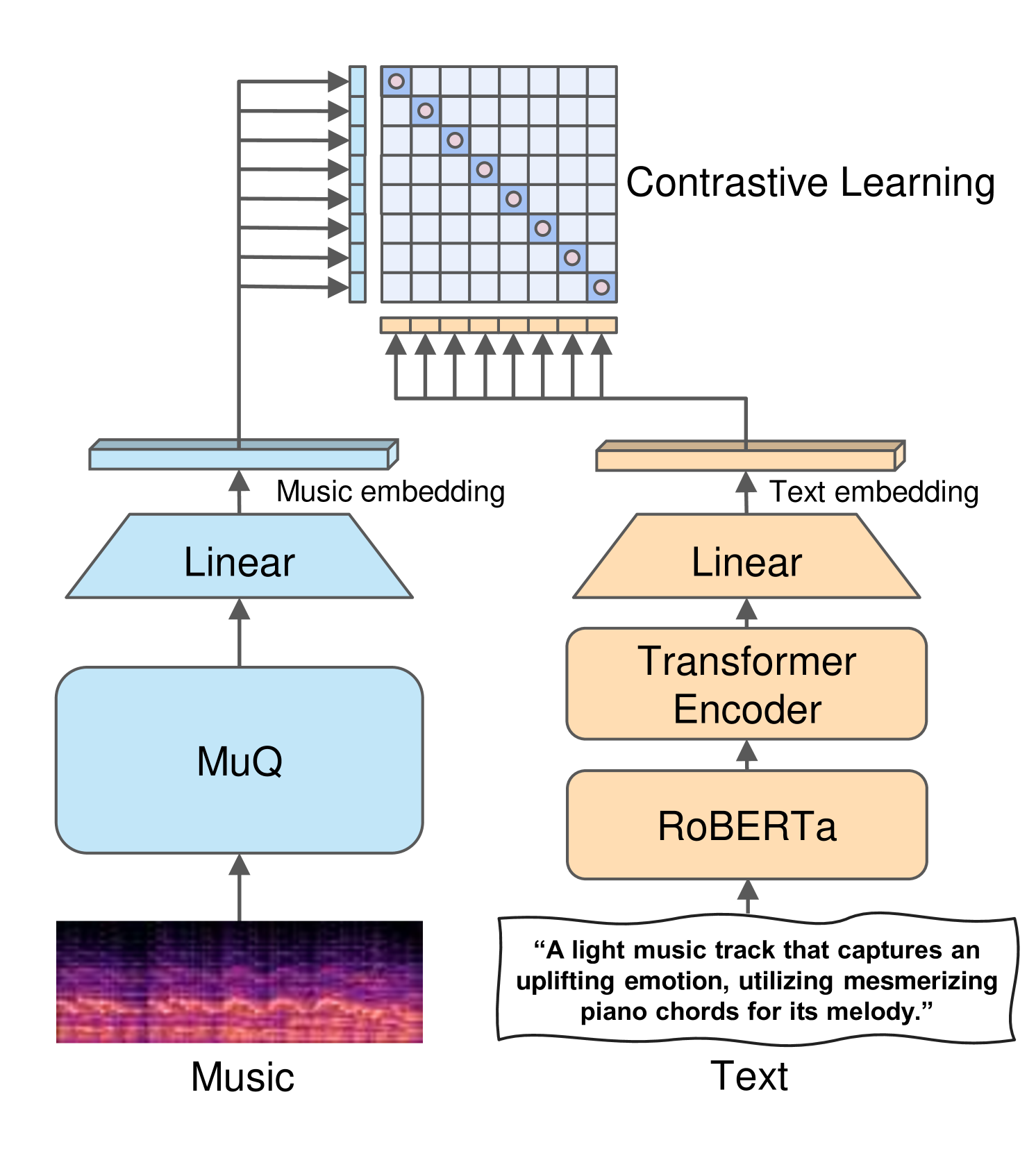
The diagram illustrates a contrastive learning framework that aligns embeddings from music and text modalities. It shows two parallel processing pipelines (music and text) converging into a contrastive learning module, represented by a grid of interconnected nodes.
### Components/Axes
1. **Music Pipeline**:
- **Input**: Music (represented as a spectrogram with purple-to-red gradients).
- **MuQ**: A dedicated music encoder (blue box).
- **Linear Layer**: Transforms MuQ output into a music embedding (blue arrow).
2. **Text Pipeline**:
- **Input**: Text example:
> “A light music track that captures an uplifting emotion, utilizing mesmerizing piano chords for its melody.”
- **RoBERTa**: A text encoder (orange box).
- **Transformer Encoder**: Processes RoBERTa output (orange box).
- **Linear Layer**: Transforms text encoder output into a text embedding (orange arrow).
3. **Contrastive Learning Module**:
- **Grid of Nodes**: Represents alignment/comparison of music and text embeddings (blue squares with pink dots).
- **Arrows**: Indicate directional flow between embeddings and the grid.
### Detailed Analysis
- **Music Embedding**: Derived from raw audio via MuQ and a linear layer.
- **Text Embedding**: Generated through RoBERTa, a transformer encoder, and a linear layer.
- **Contrastive Learning**: The grid symbolizes a mechanism to minimize distance between semantically related music-text pairs while maximizing separation for unrelated pairs.
### Key Observations
- **Modality-Specific Encoders**: MuQ (music) and RoBERTa (text) are domain-specific encoders.
- **Alignment Objective**: The contrastive learning grid suggests a Siamese network architecture for joint embedding space optimization.
- **Example Text**: The provided text emphasizes emotional and melodic attributes, likely used as a training example for text-music alignment.
### Interpretation
This system aims to bridge the semantic gap between music and text by learning shared representations. The contrastive learning module implies a self-supervised approach where the model learns to associate text descriptions (e.g., "uplifting emotion") with corresponding musical features (e.g., piano chords). The use of RoBERTa and MuQ highlights the integration of pre-trained models for efficient feature extraction. The diagram does not include numerical data but emphasizes architectural design for cross-modal tasks like music captioning or emotion recognition.