## Screenshot: Mathematical Problem-Solving Demonstration
### Overview
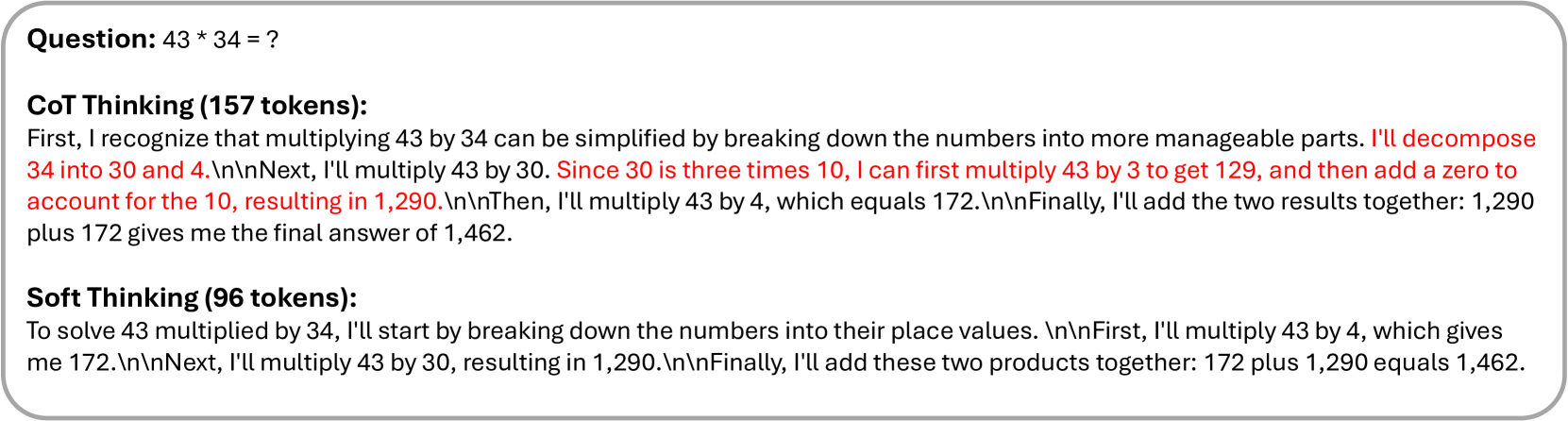
The image is a screenshot displaying a mathematical multiplication problem (43 * 34) and two distinct, step-by-step reasoning methods for solving it. The text is presented in a clean, digital format with a light gray border. The primary language is English.
### Components/Axes
The content is organized into three distinct text blocks:
1. **Question Header:** A bolded line stating the problem.
2. **CoT Thinking Section:** A labeled block with a token count, containing a detailed reasoning process. Certain phrases within this text are highlighted in red.
3. **Soft Thinking Section:** A second labeled block with a token count, containing an alternative reasoning process.
### Detailed Analysis
**Question:**
`43 * 34 = ?`
**CoT Thinking (157 tokens):**
The text describes a decomposition strategy. Key steps and transcribed text:
* "First, I recognize that multiplying 43 by 34 can be simplified by breaking down the numbers into more manageable parts. I'll **decompose 34 into 30 and 4**." (The phrase "decompose 34 into 30 and 4" is in red text).
* "Next, I'll multiply 43 by 30. **Since 30 is three times 10, I can first multiply 43 by 3 to get 129, and then add a zero to account for the 10, resulting in 1,290**." (The entire sentence from "Since 30..." to "...1,290" is in red text).
* "Then, I'll multiply 43 by 4, which equals 172."
* "Finally, I'll add the two results together: 1,290 plus 172 gives me the final answer of 1,462."
**Soft Thinking (96 tokens):**
The text describes a place-value strategy. Key steps and transcribed text:
* "To solve 43 multiplied by 34, I'll start by breaking down the numbers into their place values."
* "First, I'll multiply 43 by 4, which gives me 172."
* "Next, I'll multiply 43 by 30, resulting in 1,290."
* "Finally, I'll add these two products together: 172 plus 1,290 equals 1,462."
### Key Observations
1. **Identical Outcome:** Both reasoning methods, despite different narrative approaches and token counts (157 vs. 96), arrive at the same correct final answer: **1,462**.
2. **Methodological Difference:**
* The **CoT (Chain-of-Thought)** method explicitly verbalizes the intermediate step of multiplying by 3 and then scaling by 10 ("multiply 43 by 3 to get 129, and then add a zero").
* The **Soft Thinking** method states the multiplication by 30 directly as a single step ("multiply 43 by 30, resulting in 1,290").
3. **Visual Emphasis:** The CoT section uses red text to highlight the core decomposition logic and the key intermediate calculation, drawing visual attention to the reasoning pivot points.
### Interpretation
This image serves as a comparative demonstration of two AI or cognitive reasoning pathways for solving an arithmetic problem. It illustrates how the same underlying mathematical logic (distributive property: 43 * (30 + 4) = (43 * 30) + (43 * 4)) can be articulated with varying levels of granularity and narrative style.
The "CoT Thinking" appears more verbose and explanatory, breaking down the multiplication by 30 into a more elementary step (multiply by 3, then by 10). The "Soft Thinking" is more concise, assuming the reader can handle the "multiply by 30" step directly. The token count difference quantifies this verbosity gap.
The red highlighting in the CoT section suggests an instructional or debugging focus, pinpointing the critical reasoning steps. This format is likely used to analyze, compare, or train models on different "thinking" styles, emphasizing that the path to a solution can vary in explicitness without affecting the correctness of the final output. The image itself provides no data beyond this single example; its value is in showcasing methodological contrast.