## Diagram: Structural Comparison of G and Ĝ
### Overview
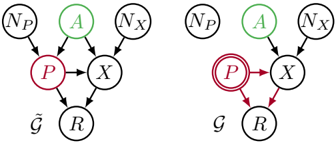
The image presents two side-by-side diagrams labeled **G** (left) and **Ĝ** (right), depicting interconnected nodes with directional arrows. Both diagrams share identical node labels but differ in annotations (red circles and arrows) and structural emphasis.
### Components/Axes
- **Nodes**:
- **NP** (top-left), **A** (top-center, green circle), **NX** (top-right)
- **P** (center-left, red circle in both diagrams), **X** (center-right), **R** (bottom-center)
- **Arrows**:
- Black arrows indicate directional relationships between nodes.
- **Ĝ** includes an additional red arrow from **P** to **X** (absent in **G**).
- **Annotations**:
- Red circles highlight **P** in both diagrams.
- Red arrow in **Ĝ** emphasizes the **P→X** connection.
- **Labels**:
- All node labels are in black text except **A**, which is in green.
- Diagrams are labeled **G** (left) and **Ĝ** (right) in black text.
### Detailed Analysis
1. **Diagram G**:
- Arrows flow from **NP** and **NX** to **A**, then to **X**, and finally to **R**.
- **P** is connected to **X** via a black arrow.
- **P** is circled in red, suggesting it is a focal point.
2. **Diagram Ĝ**:
- Identical node structure to **G**, but with an added red arrow from **P** to **X**.
- **P** remains circled in red, reinforcing its significance.
- The red arrow in **Ĝ** implies a modified or emphasized relationship between **P** and **X**.
### Key Observations
- **Structural Consistency**: Both diagrams share the same node labels and primary connections (e.g., **NP→A→X→R**, **NX→A→X→R**).
- **Annotations as Emphasis**:
- Red circles on **P** in both diagrams highlight its central role.
- The red arrow in **Ĝ** suggests a revised or prioritized interaction between **P** and **X**.
- **Color Coding**:
- Green **A** may denote a distinct category (e.g., "active" or "primary" node).
- Red annotations (circles/arrows) likely signify modifications or critical elements.
### Interpretation
The diagrams appear to compare an original structure (**G**) with a modified version (**Ĝ**). The red annotations in **Ĝ** (circle on **P**, arrow from **P→X**) imply:
1. **P** is a critical node in both contexts, possibly representing a "primary process" or "key variable."
2. The added arrow in **Ĝ** suggests a strengthened or direct relationship between **P** and **X**, potentially altering the system’s behavior or hierarchy.
3. The green **A** might represent an intermediary or stabilizing node, as it connects inputs (**NP**, **NX**) to outputs (**X**, **R**).
This structural comparison could model changes in a system (e.g., workflow, data flow, or logical dependencies), where annotations denote updates or optimizations. The absence of numerical data limits quantitative analysis, but the visual emphasis on **P** and **P→X** in **Ĝ** underscores their functional importance.