# Technical Document Extraction: Attention Forward Speed Benchmark
## 1. Header Information
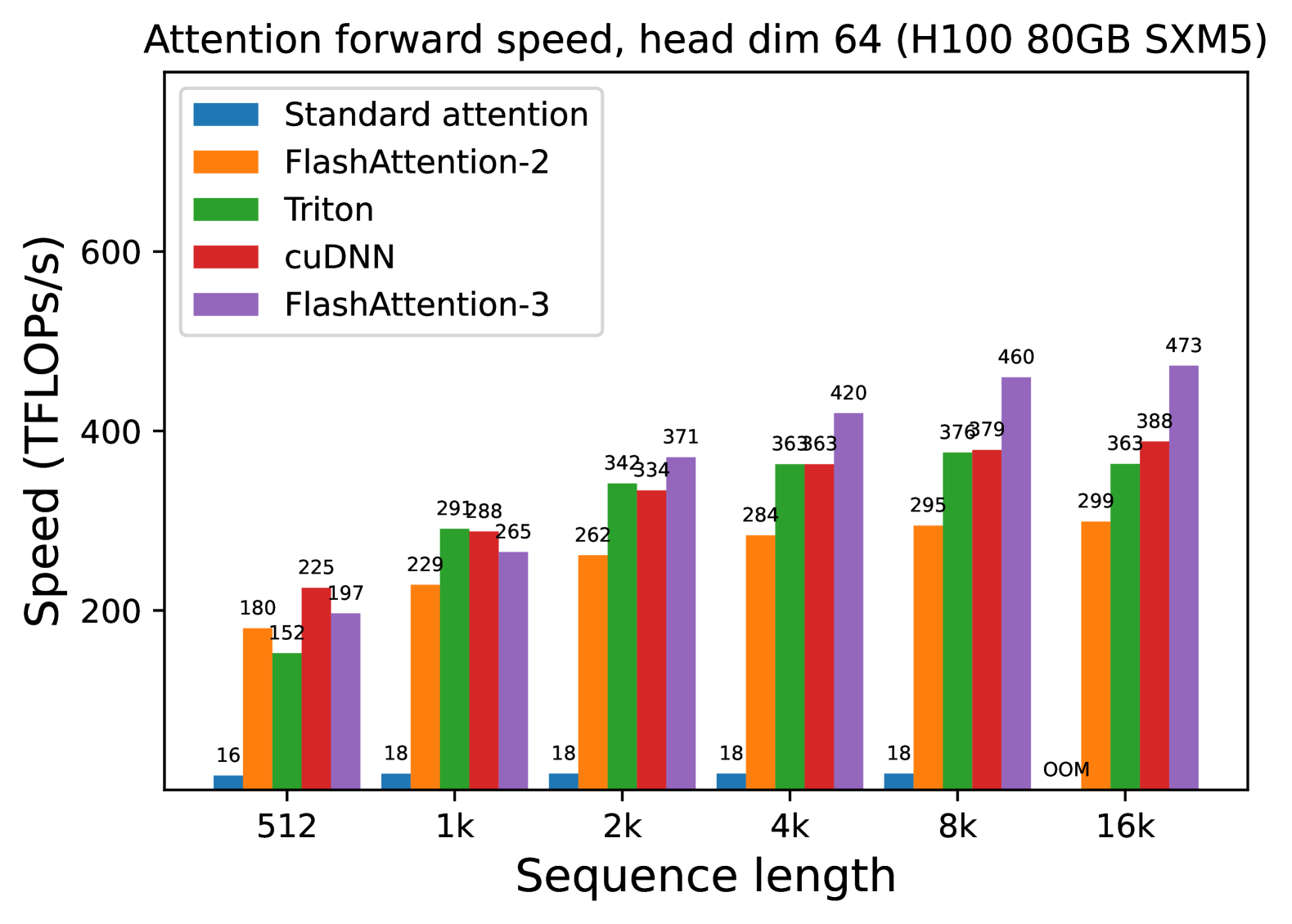
* **Title:** Attention forward speed, head dim 64 (H100 80GB SXM5)
* **Hardware Context:** NVIDIA H100 80GB SXM5 GPU.
* **Parameter Configuration:** Head dimension is fixed at 64.
## 2. Chart Metadata
* **Type:** Grouped Bar Chart.
* **X-Axis Label:** Sequence length
* **X-Axis Categories:** 512, 1k, 2k, 4k, 8k, 16k.
* **Y-Axis Label:** Speed (TFLOPS/s)
* **Y-Axis Scale:** 0 to 600 (increments of 200 labeled).
* **Legend Location:** Top-left [x: ~0.15, y: ~0.85].
## 3. Legend and Series Identification
The chart compares five different attention implementations, color-coded as follows:
1. **Standard attention** (Blue): Represents the baseline implementation.
2. **FlashAttention-2** (Orange): An optimized attention mechanism.
3. **Triton** (Green): Implementation using the Triton language/compiler.
4. **cuDNN** (Red): NVIDIA's deep neural network library implementation.
5. **FlashAttention-3** (Purple): The latest iteration of the FlashAttention algorithm.
## 4. Data Table Reconstruction
The following table transcribes the numerical values (TFLOPS/s) displayed above each bar in the chart.
| Sequence Length | Standard attention (Blue) | FlashAttention-2 (Orange) | Triton (Green) | cuDNN (Red) | FlashAttention-3 (Purple) |
| :--- | :---: | :---: | :---: | :---: | :---: |
| **512** | 16 | 180 | 152 | 225 | 197 |
| **1k** | 18 | 229 | 291 | 288 | 265 |
| **2k** | 18 | 262 | 342 | 334 | 371 |
| **4k** | 18 | 284 | 363 | 363 | 420 |
| **8k** | 18 | 295 | 376 | 379 | 460 |
| **16k** | OOM* | 299 | 363 | 388 | 473 |
*\*OOM: Out of Memory*
## 5. Trend Analysis and Component Observations
### Standard attention (Blue)
* **Trend:** Extremely low and flat performance.
* **Observation:** Maintains a near-constant speed of 16-18 TFLOPS/s until it fails at 16k sequence length due to memory constraints (OOM).
### FlashAttention-2 (Orange)
* **Trend:** Steady upward slope that plateaus as sequence length increases.
* **Observation:** Performance grows from 180 to 299 TFLOPS/s, showing significant improvement over standard attention but trailing behind the other optimized methods at higher sequence lengths.
### Triton (Green)
* **Trend:** Rapid initial growth, leveling off after 4k.
* **Observation:** Performance jumps significantly between 512 (152 TFLOPS/s) and 2k (342 TFLOPS/s), eventually stabilizing around 363-376 TFLOPS/s.
### cuDNN (Red)
* **Trend:** Consistent upward slope.
* **Observation:** Starts as the fastest method at the shortest sequence length (225 TFLOPS/s at 512). It maintains a very similar performance profile to Triton from 1k to 8k, ending slightly higher at 388 TFLOPS/s for 16k.
### FlashAttention-3 (Purple)
* **Trend:** Strong, continuous upward slope with the highest ceiling.
* **Observation:** While it starts in the middle of the pack at 512 (197 TFLOPS/s), it scales the best of all tested methods. It becomes the clear leader at sequence lengths of 2k and above, reaching a peak of 473 TFLOPS/s at 16k.
## 6. Summary of Findings
FlashAttention-3 demonstrates superior scaling for long sequences on H100 hardware, outperforming FlashAttention-2 by approximately 58% and cuDNN by approximately 22% at a sequence length of 16k. Standard attention is non-viable for these workloads due to both extremely low throughput and memory inefficiency.