## Clinical Reasoning Diagram: Stroke Diagnosis
### Overview
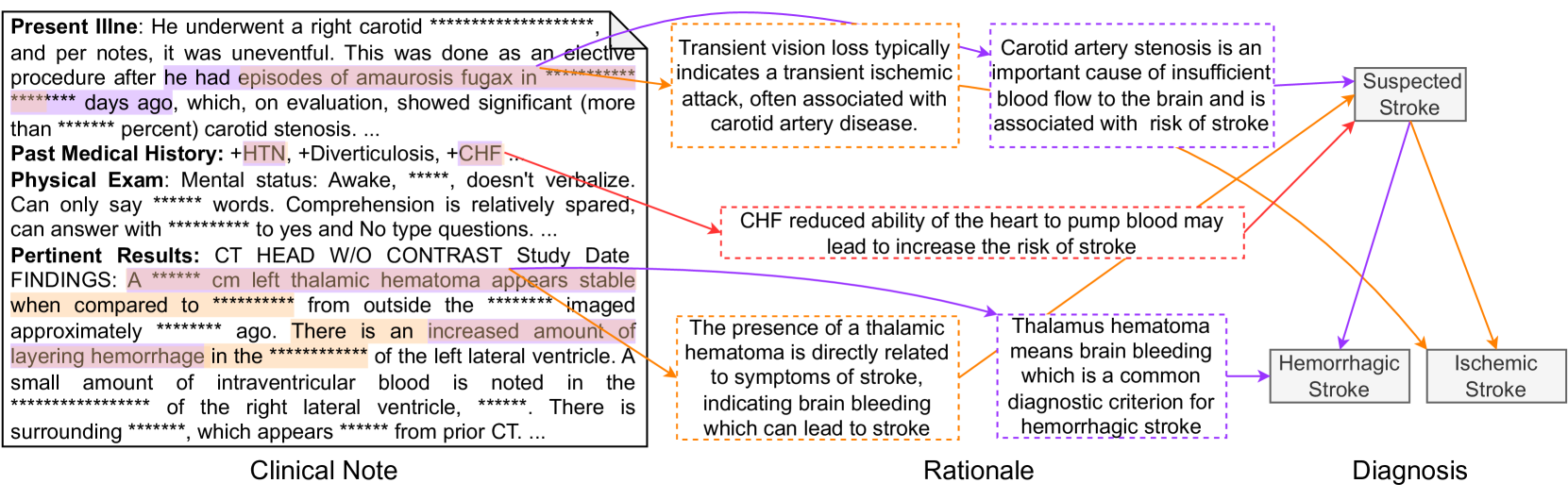
The image presents a clinical reasoning diagram that connects a clinical note with potential diagnoses of stroke (hemorrhagic or ischemic). It links findings from the clinical note to rationales, which then lead to a suspected stroke diagnosis. The diagram uses arrows to show the relationships between the clinical observations, the rationale behind them, and the final diagnosis.
### Components/Axes
* **Clinical Note:** A block of text containing patient history, physical exam findings, and pertinent results from a CT scan.
* **Rationale:** A series of text boxes explaining the medical reasoning behind linking clinical findings to potential diagnoses.
* **Diagnosis:** Two possible diagnoses: Hemorrhagic Stroke and Ischemic Stroke.
* **Suspected Stroke:** An intermediate diagnosis node.
* **Arrows:** Purple and orange arrows indicate the flow of reasoning from clinical findings to rationales and then to diagnoses. Red arrows also connect clinical findings to rationales.
### Detailed Analysis or ### Content Details
**Clinical Note:**
* **Present Illness:** The patient underwent a right carotid procedure and per notes, it was uneventful. This was done as an elective procedure after he had episodes of amaurosis fugax.
* **Past Medical History:** +HTN (Hypertension), +Diverticulosis, +CHF (Congestive Heart Failure).
* **Physical Exam:** Mental status: Awake, doesn't verbalize. Can only say words. Comprehension is relatively spared, can answer with to yes and No type questions.
* **Pertinent Results:** CT HEAD W/O CONTRAST. FINDINGS: A cm left thalamic hematoma appears stable when compared to from outside the imaged approximately ago. There is an increased amount of layering hemorrhage in the of the left lateral ventricle. A small amount of intraventricular blood is noted in the of the right lateral ventricle. There is surrounding , which appears from prior CT.
**Rationale:**
* **Transient vision loss typically indicates a transient ischemic attack, often associated with carotid artery disease.** (Connected to "episodes of amaurosis fugax" with an orange arrow)
* **Carotid artery stenosis is an important cause of insufficient blood flow to the brain and is associated with risk of stroke.** (Connected to "carotid stenosis" with a purple arrow)
* **CHF reduced ability of the heart to pump blood may lead to increase the risk of stroke.** (Connected to "+CHF" with a red arrow)
* **The presence of a thalamic hematoma is directly related to symptoms of stroke, indicating brain bleeding which can lead to stroke.** (Connected to "thalamic hematoma" and "layering hemorrhage" with orange arrows)
* **Thalamus hematoma means brain bleeding which is a common diagnostic criterion for hemorrhagic stroke.** (Connected to "thalamic hematoma" with a purple arrow)
**Diagnosis:**
* **Suspected Stroke:** A central node that both Hemorrhagic Stroke and Ischemic Stroke connect to.
* **Hemorrhagic Stroke:** One of the two possible diagnoses.
* **Ischemic Stroke:** The other possible diagnosis.
**Connections:**
* "episodes of amaurosis fugax" (Clinical Note) -> "Transient vision loss typically indicates a transient ischemic attack, often associated with carotid artery disease." (Rationale) -> "Suspected Stroke" (Diagnosis) - Orange Arrows
* "carotid stenosis" (Clinical Note) -> "Carotid artery stenosis is an important cause of insufficient blood flow to the brain and is associated with risk of stroke." (Rationale) -> "Suspected Stroke" (Diagnosis) - Purple Arrows
* "+CHF" (Clinical Note) -> "CHF reduced ability of the heart to pump blood may lead to increase the risk of stroke." (Rationale) -> "Suspected Stroke" (Diagnosis) - Red Arrows
* "thalamic hematoma" and "layering hemorrhage" (Clinical Note) -> "The presence of a thalamic hematoma is directly related to symptoms of stroke, indicating brain bleeding which can lead to stroke." (Rationale) -> "Suspected Stroke" (Diagnosis) - Orange Arrows
* "thalamic hematoma" (Clinical Note) -> "Thalamus hematoma means brain bleeding which is a common diagnostic criterion for hemorrhagic stroke." (Rationale) -> "Hemorrhagic Stroke" (Diagnosis) - Purple Arrows
### Key Observations
* The diagram connects clinical findings to potential stroke diagnoses through a series of rationales.
* The presence of a thalamic hematoma is strongly linked to a diagnosis of hemorrhagic stroke.
* Episodes of amaurosis fugax and carotid stenosis are linked to a general "Suspected Stroke" diagnosis, which could be either hemorrhagic or ischemic.
* CHF is also linked to a general "Suspected Stroke" diagnosis.
### Interpretation
The diagram illustrates the clinical reasoning process in diagnosing a stroke. It shows how specific findings from a patient's history, physical exam, and CT scan can be used to arrive at a diagnosis. The presence of a thalamic hematoma is a key indicator of hemorrhagic stroke, while other factors like amaurosis fugax, carotid stenosis, and CHF contribute to a general suspicion of stroke, which could be either hemorrhagic or ischemic. The diagram highlights the importance of considering multiple factors and their relationships when making a clinical diagnosis. The diagram is useful for understanding the thought process behind diagnosing a stroke and how different clinical findings can point to different types of stroke.