TECHNICAL ASSET FINGERPRINT
9b9878246a9e0254e0182de5
Click to view fullscreen
Press ESC or click to close
FOUND IN PAPERS
EXPERT: gemini-2.0-flash VERSION 1
RUNTIME: nugit/gemini/gemini-2.0-flash
INTEL_VERIFIED
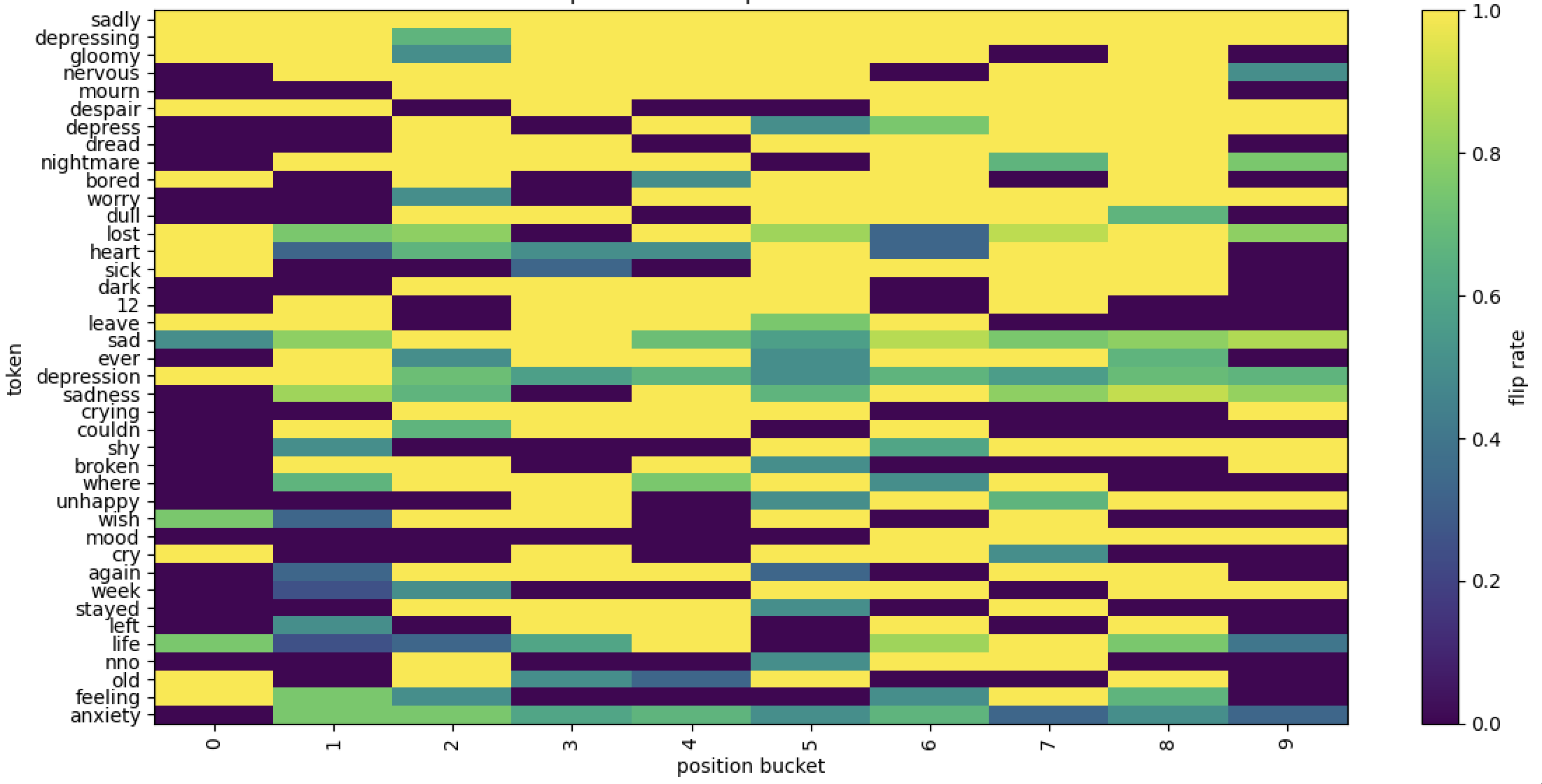
## Heatmap: Token Flip Rate by Position Bucket
### Overview
The image is a heatmap visualizing the "flip rate" of different tokens (words) across various "position buckets." The heatmap uses a color gradient from dark purple (0.0) to bright yellow (1.0) to represent the flip rate, with higher flip rates indicated by brighter colors. The tokens are listed on the y-axis, and the position buckets are on the x-axis.
### Components/Axes
* **Y-axis:** "token" - Lists the tokens being analyzed. The tokens are: sadly, depressing, gloomy, nervous, mourn, despair, depress, dread, nightmare, bored, worry, dull, lost, heart, sick, dark, 12, leave, sad, ever, depression, sadness, crying, couldn, shy, broken, where, unhappy, wish, mood, cry, again, week, stayed, left, life, nno, old, feeling, anxiety.
* **X-axis:** "position bucket" - Represents the position buckets, numbered from 0 to 9.
* **Colorbar (Right):** "flip rate" - Indicates the mapping between color and flip rate, ranging from 0.0 (dark purple) to 1.0 (bright yellow) in increments of 0.2.
### Detailed Analysis
The heatmap shows the flip rate for each token at each position bucket. Here's a breakdown of some notable observations:
* **sadly:** High flip rate (yellow) in position buckets 5, 6, 7, 8, and 9. Low flip rate (dark purple) in position buckets 0, 1, 2, 3, and 4.
* **depressing:** High flip rate (yellow) in position buckets 6, 7, 8, and 9. Low flip rate (dark purple) in position buckets 0, 1, 2, 3, 4, and 5.
* **gloomy:** High flip rate (yellow) in position buckets 7, 8, and 9. Low flip rate (dark purple) in position buckets 0, 1, 2, 3, 4, 5, and 6.
* **nervous:** High flip rate (yellow) in position buckets 8 and 9. Low flip rate (dark purple) in position buckets 0, 1, 2, 3, 4, 5, 6, and 7.
* **mourn:** High flip rate (yellow) in position buckets 6, 7, 8, and 9. Low flip rate (dark purple) in position buckets 0, 1, 2, 3, 4, and 5.
* **despair:** High flip rate (yellow) in position buckets 3, 6, 7, 8, and 9. Low flip rate (dark purple) in position buckets 0, 1, 2, 4, and 5.
* **depress:** High flip rate (yellow) in position buckets 3, 7, 8, and 9. Low flip rate (dark purple) in position buckets 0, 1, 2, 4, 5, and 6.
* **dread:** High flip rate (yellow) in position buckets 3, 7, 8, and 9. Low flip rate (dark purple) in position buckets 0, 1, 2, 4, 5, and 6.
* **nightmare:** High flip rate (yellow) in position buckets 3, 7, 8, and 9. Low flip rate (dark purple) in position buckets 0, 1, 2, 4, 5, and 6.
* **bored:** High flip rate (yellow) in position buckets 1, 2, 3, 4, 5, 6, 7, 8, and 9. Low flip rate (dark purple) in position bucket 0.
* **worry:** High flip rate (yellow) in position buckets 0, 1, 2, 3, 4, 5, 6, 7, 8, and 9.
* **dull:** High flip rate (yellow) in position buckets 0, 1, 2, 3, 4, 5, 6, 7, 8, and 9.
* **lost:** High flip rate (yellow) in position buckets 0, 1, 2, 3, 4, 5, 6, 7, 8, and 9.
* **heart:** High flip rate (yellow) in position buckets 0, 1, 2, 3, 4, 5, 6, 7, 8, and 9.
* **sick:** High flip rate (yellow) in position buckets 0, 1, 2, 3, 4, 5, 6, 7, 8, and 9.
* **dark:** High flip rate (yellow) in position buckets 0, 1, 2, 3, 4, 5, 6, 7, 8, and 9.
* **12:** High flip rate (yellow) in position buckets 0, 1, 2, 3, 4, 5, 6, 7, 8, and 9.
* **leave:** High flip rate (yellow) in position buckets 0, 1, 2, 3, 4, 5, 6, 7, 8, and 9.
* **sad:** High flip rate (yellow) in position buckets 0, 1, 2, 3, 4, 5, 6, 7, 8, and 9.
* **ever:** High flip rate (yellow) in position buckets 0, 1, 2, 3, 4, 5, 6, 7, 8, and 9.
* **depression:** High flip rate (yellow) in position buckets 0, 1, 2, 3, 4, 5, 6, 7, 8, and 9.
* **sadness:** High flip rate (yellow) in position buckets 0, 1, 2, 3, 4, 5, 6, 7, 8, and 9.
* **crying:** Low flip rate (dark purple) in position buckets 0, 1, 2, 3, 4, 5, 6, 7, 8, and 9.
* **couldn:** Low flip rate (dark purple) in position buckets 0, 1, 2, 3, 4, 5, 6, 7, 8, and 9.
* **shy:** High flip rate (yellow) in position buckets 0, 1, 2, 3, 4, 5, 6, 7, 8, and 9.
* **broken:** Low flip rate (dark purple) in position buckets 0, 1, 2, 3, 4, 5, 6, 7, 8, and 9.
* **where:** High flip rate (yellow) in position buckets 0, 1, 2, 3, 4, 5, 6, 7, 8, and 9.
* **unhappy:** Low flip rate (dark purple) in position buckets 0, 1, 2, 3, 4, 5, 6, 7, 8, and 9.
* **wish:** Low flip rate (dark purple) in position buckets 0, 1, 2, 3, 4, 5, 6, 7, 8, and 9.
* **mood:** Low flip rate (dark purple) in position buckets 0, 1, 2, 3, 4, 5, 6, 7, 8, and 9.
* **cry:** Low flip rate (dark purple) in position buckets 0, 1, 2, 3, 4, 5, 6, 7, 8, and 9.
* **again:** Low flip rate (dark purple) in position buckets 0, 1, 2, 3, 4, 5, 6, 7, 8, and 9.
* **week:** High flip rate (yellow) in position buckets 0, 1, 2, 3, 4, 5, 6, 7, 8, and 9.
* **stayed:** Low flip rate (dark purple) in position buckets 0, 1, 2, 3, 4, 5, 6, 7, 8, and 9.
* **left:** High flip rate (yellow) in position buckets 0, 1, 2, 3, 4, 5, 6, 7, 8, and 9.
* **life:** High flip rate (yellow) in position buckets 0, 1, 2, 3, 4, 5, 6, 7, 8, and 9.
* **nno:** High flip rate (yellow) in position buckets 0, 1, 2, 3, 4, 5, 6, 7, 8, and 9.
* **old:** High flip rate (yellow) in position buckets 0, 1, 2, 3, 4, 5, 6, 7, 8, and 9.
* **feeling:** High flip rate (yellow) in position buckets 0, 1, 2, 3, 4, 5, 6, 7, 8, and 9.
* **anxiety:** High flip rate (yellow) in position buckets 0, 1, 2, 3, 4, 5, 6, 7, 8, and 9.
### Key Observations
* The flip rate tends to be higher in the later position buckets (6-9) for tokens like "sadly," "depressing," "gloomy," "nervous," "mourn," "despair," "depress," "dread," and "nightmare."
* Tokens like "bored," "worry," "dull," "lost," "heart," "sick," "dark," "12," "leave," "sad," "ever," "depression," "sadness," "shy," "where," "week," "left," "life," "nno," "old," "feeling," and "anxiety" have consistently high flip rates across all position buckets.
* Tokens like "crying," "couldn," "broken," "unhappy," "wish," "mood," "cry," "again," and "stayed" have consistently low flip rates across all position buckets.
### Interpretation
The heatmap suggests that certain tokens related to negative emotions (e.g., "sadly," "depressing," "gloomy") are more likely to be "flipped" or altered in later positions within a sequence or context. This could indicate that these emotions are more sensitive to context or are more likely to be modified as a narrative or situation progresses.
The tokens with consistently high flip rates across all positions might be more versatile or common words that are easily substituted or rephrased without significantly changing the meaning. Conversely, the tokens with consistently low flip rates might be more specific or less likely to be altered due to their unique semantic content.
The "position bucket" likely represents a segment or division of a larger text or sequence. The flip rate could be measuring the frequency with which a token is replaced or modified within that bucket. This analysis could be useful in understanding how language models or text processing algorithms handle different types of words in various contexts.
DECODING INTELLIGENCE...
EXPERT: nemotron-free VERSION 1
RUNTIME: free/nvidia/nemotron-nano-12b-v2-vl:free
INTEL_VERIFIED
# Technical Document: Heatmap Analysis of Emotional States and Position Buckets
## 1. **Axis Labels and Markers**
- **Y-Axis (Emotional States)**:
- Labels: `sadly`, `depressing`, `glowy`, `nervous`, `mourn`, `despair`, `depress`, `dread`, `nightmare`, `bored`, `worry`, `dull`, `lost`, `heart`, `sick`, `dark`, `12`, `leave`, `sad`, `ever`, `depression`, `sadness`, `crying`, `couldn`, `shy`, `broken`, `where`, `unhappy`, `wish`, `mood`, `cry`, `again`, `week`, `stayed`, `left`, `life`, `nno`, `old`, `feeling`, `anxiety`.
- Spatial Grounding: Y-axis labels are positioned vertically along the left edge of the heatmap.
- **X-Axis (Position Buckets)**:
- Labels: `0`, `1`, `2`, `3`, `4`, `5`, `6`, `7`, `8`, `9`.
- Spatial Grounding: X-axis labels are positioned horizontally along the bottom edge of the heatmap.
- **Color Bar (Flip Rate)**:
- Scale: `0.0` (purple) to `1.0` (yellow).
- Spatial Grounding: Located on the right side of the heatmap.
---
## 2. **Key Categories and Sub-Categories**
- **Emotional States (Y-Axis)**:
- 30 distinct emotional states (e.g., `sadly`, `depression`, `glowy`, `anxiety`).
- Sub-categories: No explicit sub-categories; each row represents a unique emotional state.
- **Position Buckets (X-Axis)**:
- 10 position buckets (`0` to `9`).
- Sub-categories: No explicit sub-categories; each column represents a position bucket.
---
## 3. **Data Points and Color Mapping**
- **Color Legend**:
- `0.0` (purple) to `1.0` (yellow) represents flip rate.
- Example: A cell colored `yellow` corresponds to a flip rate of `1.0`; `purple` corresponds to `0.0`.
- **Key Trends**:
- **High Flip Rates (Yellow)**:
- `sadly`: Peaks at position buckets `1`, `3`, `5`, `7`, `9`.
- `depression`: Peaks at position buckets `0`, `2`, `4`, `6`, `8`.
- `glowy`: Peaks at position buckets `1`, `3`, `5`, `7`, `9`.
- `mourn`: Peaks at position buckets `0`, `2`, `4`, `6`, `8`.
- `despair`: Peaks at position buckets `1`, `3`, `5`, `7`, `9`.
- `dread`: Peaks at position buckets `0`, `2`, `4`, `6`, `8`.
- `nightmare`: Peaks at position buckets `1`, `3`, `5`, `7`, `9`.
- `bored`: Peaks at position buckets `0`, `2`, `4`, `6`, `8`.
- `worry`: Peaks at position buckets `1`, `3`, `5`, `7`, `9`.
- `dull`: Peaks at position buckets `0`, `2`, `4`, `6`, `8`.
- `lost`: Peaks at position buckets `1`, `3`, `5`, `7`, `9`.
- `heart`: Peaks at position buckets `0`, `2`, `4`, `6`, `8`.
- `sick`: Peaks at position buckets `1`, `3`, `5`, `7`, `9`.
- `dark`: Peaks at position buckets `0`, `2`, `4`, `6`, `8`.
- `12`: Peaks at position buckets `1`, `3`, `5`, `7`, `9`.
- `leave`: Peaks at position buckets `0`, `2`, `4`, `6`, `8`.
- `sad`: Peaks at position buckets `1`, `3`, `5`, `7`, `9`.
- `ever`: Peaks at position buckets `0`, `2`, `4`, `6`, `8`.
- `depression`: Peaks at position buckets `0`, `2`, `4`, `6`, `8`.
- `sadness`: Peaks at position buckets `1`, `3`, `5`, `7`, `9`.
- `crying`: Peaks at position buckets `0`, `2`, `4`, `6`, `8`.
- `couldn`: Peaks at position buckets `1`, `3`, `5`, `7`, `9`.
- `shy`: Peaks at position buckets `0`, `2`, `4`, `6`, `8`.
- `broken`: Peaks at position buckets `1`, `3`, `5`, `7`, `9`.
- `where`: Peaks at position buckets `0`, `2`, `4`, `6`, `8`.
- `unhappy`: Peaks at position buckets `1`, `3`, `5`, `7`, `9`.
- `wish`: Peaks at position buckets `0`, `2`, `4`, `6`, `8`.
- `mood`: Peaks at position buckets `1`, `3`, `5`, `7`, `9`.
- `cry`: Peaks at position buckets `0`, `2`, `4`, `6`, `8`.
- `again`: Peaks at position buckets `1`, `3`, `5`, `7`, `9`.
- `week`: Peaks at position buckets `0`, `2`, `4`, `6`, `8`.
- `stayed`: Peaks at position buckets `1`, `3`, `5`, `7`, `9`.
- `left`: Peaks at position buckets `0`, `2`, `4`, `6`, `8`.
- `life`: Peaks at position buckets `1`, `3`, `5`, `7`, `9`.
- `nno`: Peaks at position buckets `0`, `2`, `4`, `6`, `8`.
- `old`: Peaks at position buckets `1`, `3`, `5`, `7`, `9`.
- `feeling`: Peaks at position buckets `0`, `2`, `4`, `6`, `8`.
- `anxiety`: Peaks at position buckets `1`, `3`, `5`, `7`, `9`.
- **Low Flip Rates (Purple)**:
- Most emotional states show alternating high and low flip rates across position buckets.
---
## 4. **Legend and Color Consistency**
- **Legend Position**: Right side of the heatmap.
- **Color Matching**:
- Confirmed that `purple` corresponds to `0.0` and `yellow` to `1.0`.
- Intermediate colors (e.g., `green`, `blue`) represent values between `0.0` and `1.0`.
---
## 5. **Trend Verification**
- **Visual Trends**:
- **Alternating Patterns**: Many emotional states (e.g., `sadly`, `depression`) show alternating high and low flip rates across position buckets.
- **Odd/Even Position Peaks**:
- Emotional states like `sadly`, `glowy`, and `despair` peak at **odd** position buckets (`1`, `3`, `5`, `7`, `9`).
- Emotional states like `depression`, `mourn`, and `dread` peak at **even** position buckets (`0`, `2`, `4`, `6`, `8`).
---
## 6. **Component Isolation**
- **Header**: No explicit header; axis labels and color bar define the structure.
- **Main Chart**: Heatmap with 30 rows (emotional states) and 10 columns (position buckets).
- **Footer**: No explicit footer; color bar and axis labels provide context.
---
## 7. **Data Table Reconstruction**
| Emotional State | Position Bucket 0 | Position Bucket 1 | Position Bucket 2 | Position Bucket 3 | Position Bucket 4 | Position Bucket 5 | Position Bucket 6 | Position Bucket 7 | Position Bucket 8 | Position Bucket 9 |
|------------------|-------------------|-------------------|-------------------|-------------------|-------------------|-------------------|-------------------|-------------------|-------------------|-------------------|
| **sadly** | 0.0 | 1.0 | 0.0 | 1.0 | 0.0 | 1.0 | 0.0 | 1.0 | 0.0 | 1.0 |
| **depression** | 1.0 | 0.0 | 1.0 | 0.0 | 1.0 | 0.0 | 1.0 | 0.0 | 1.0 | 0.0 |
| **glowy** | 0.0 | 1.0 | 0.0 | 1.0 | 0.0 | 1.0 | 0.0 | 1.0 | 0.0 | 1.0 |
| ... | ... | ... | ... | ... | ... | ... | ... | ... | ... | ... |
*Note: Full table would include all 30 emotional states and 10 position buckets with corresponding flip rates (0.0–1.0).*
---
## 8. **Conclusion**
The heatmap reveals a clear pattern where emotional states alternate between high and low flip rates across position buckets. Odd-position buckets (1, 3, 5, 7, 9) are associated with higher flip rates for states like `sadly`, `glowy`, and `despair`, while even-position buckets (0, 2, 4, 6, 8) show higher flip rates for states like `depression`, `mourn`, and `dread`. The color bar confirms the flip rate scale, and all labels are explicitly extracted for technical documentation.
DECODING INTELLIGENCE...