\n
## ASCII Art Collection: Grid of Text-Based Figures
### Overview
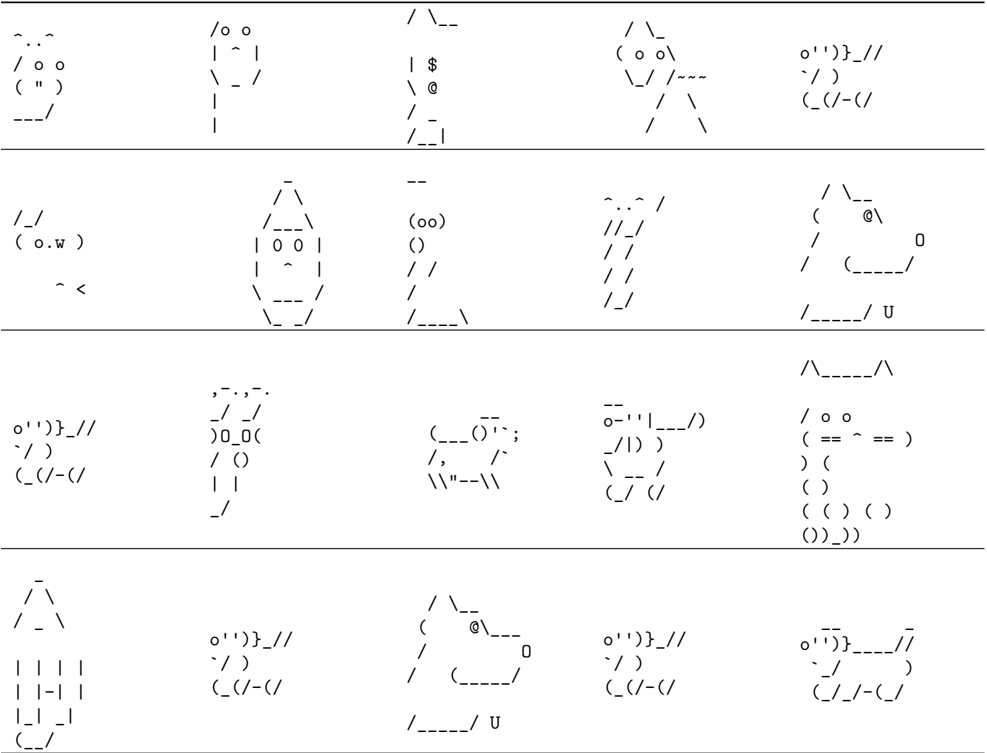
The image displays a collection of ASCII art figures arranged in a structured grid. It is not a data chart or technical diagram but a creative compilation of text-based illustrations. The figures are composed entirely of standard keyboard characters (letters, numbers, symbols, punctuation) arranged to form pictorial representations. The overall layout is a 4-row by 5-column grid, though the final row contains only four figures, making the total count 19 distinct ASCII art pieces.
### Components/Axes
* **Structure:** A grid layout with horizontal lines separating the four rows.
* **Content:** Each cell contains a unique ASCII art figure. There are no traditional axes, legends, or data labels.
* **Language:** The characters used are from the English/ASCII character set. No other language is present.
### Detailed Analysis
The image is segmented into four horizontal rows for analysis.
**Row 1 (Top Row, 5 figures):**
1. **Position: Top-Left.** A simple face: `^..^` (eyes), `/ o o` (eyes), `(" )` (mouth), `---/` (body/leg).
2. **Position: Top-Center-Left.** A taller, abstract figure: `/ o o`, `| ^ |`, `\ _ /`, `|`, `|`.
3. **Position: Top-Center.** A figure with a dollar sign: `/ \__`, `| $`, `\ @`, `/ _`, `/__|`.
4. **Position: Top-Center-Right.** A figure with parentheses: `/ \_`, `( o o\`, `\_/ /---`, `/ \`, `/ \`.
5. **Position: Top-Right.** A complex figure: `o''')}_//`, `^/ )`, `(_/-(/`.
**Row 2 (Second Row, 5 figures):**
1. **Position: Center-Left.** A face with a tongue: `/_/`, `( o.w )`, `^ <`.
2. **Position: Center-Center-Left.** A tall, enclosed figure: `--`, `/---\`, `| 0 0 |`, `| ^ |`, `\---/`, `| |`, `\___/`.
3. **Position: Center-Center.** A simple figure: `--`, `(oo)`, `()`, `/ /`, `/ /`, `/____\`.
4. **Position: Center-Center-Right.** A slanted figure: `^..^ /`, `//_//`, `//`, `//`, `/_/`.
5. **Position: Center-Right.** A figure with an '@' symbol: `/ \__`, `( @\`, `/`, `/ (_____/`, `/_____/ u`.
**Row 3 (Third Row, 5 figures):**
1. **Position: Bottom-Left (of row).** A repeat of the complex figure from Row 1, Position 5: `o''')}_//`, `^/ )`, `(_/-(/`.
2. **Position: Bottom-Center-Left.** A symmetrical figure: `,-.,-.,-.`, `_/ _/ _/`, `)0_0(`, `/ ()`, `| |`, `_/`.
3. **Position: Bottom-Center.** A figure with quotes: `(__)''--;`, `/ , _/`, `\\''--\\`.
4. **Position: Bottom-Center-Right.** A figure with dashes: `--`, `o-''|___/)`, `_/|) )`, `\ __ /`, `(_/ (/`.
5. **Position: Bottom-Right.** A large, multi-line figure: `/\______/\`, `/ o o`, `( == ^ == )`, `) (`, `( )`, `( ) ( )`, `()))_))`.
**Row 4 (Bottom Row, 4 figures):**
1. **Position: Bottom-Left.** A triangular/pyramid figure: `/\`, `/_\`, `| | | |`, `| |-| |`, `|_|_|`, `|__|`.
2. **Position: Bottom-Center-Left.** Another repeat of the complex figure: `o''')}_//`, `^/ )`, `(_/-(/`.
3. **Position: Bottom-Center-Right.** A figure with '@' and '0': `/ \__`, `( @\___`, `0`, `/ (_____/`, `/_____/ u`.
4. **Position: Bottom-Right.** Two similar complex figures side-by-side:
* Left: `o''')}_//`, `^/ )`, `(_/-(/`.
* Right: `o''')_____/`, `-_/ )`, `(_/_/-(/`.
### Key Observations
* **Repetition:** The complex figure `o''')}_//...` appears four times (Row 1 Pos5, Row 3 Pos1, Row 4 Pos2, Row 4 Pos4-Left). A very similar variant appears in Row 4 Pos4-Right.
* **Stylistic Range:** The collection varies from simple emoticons (e.g., `^..^`, `( o.w )`) to more elaborate, abstract, or creature-like forms.
* **Character Set:** All figures use a limited set of characters: `/ \ | ( ) _ - ^ . @ $ ' " , 0 o`.
* **Grid Imperfection:** The grid is not perfectly uniform; the bottom row has one fewer figure, and the spacing within cells varies.
### Interpretation
This image is a **showcase or reference sheet of ASCII art**. It demonstrates the creative potential of using standard text characters to form recognizable shapes and characters. The repetition of certain figures suggests they might be favorites, templates, or examples of a particular style. The arrangement in a grid implies an organized collection, possibly for use in text-based environments like code comments, plain text files, terminal outputs, or early internet communication where graphical images were not feasible. The lack of data or analytical components means its purpose is purely illustrative and artistic within the constraints of monospaced text.