## ASCII Art Grid: Technical Structure and Components
### Overview
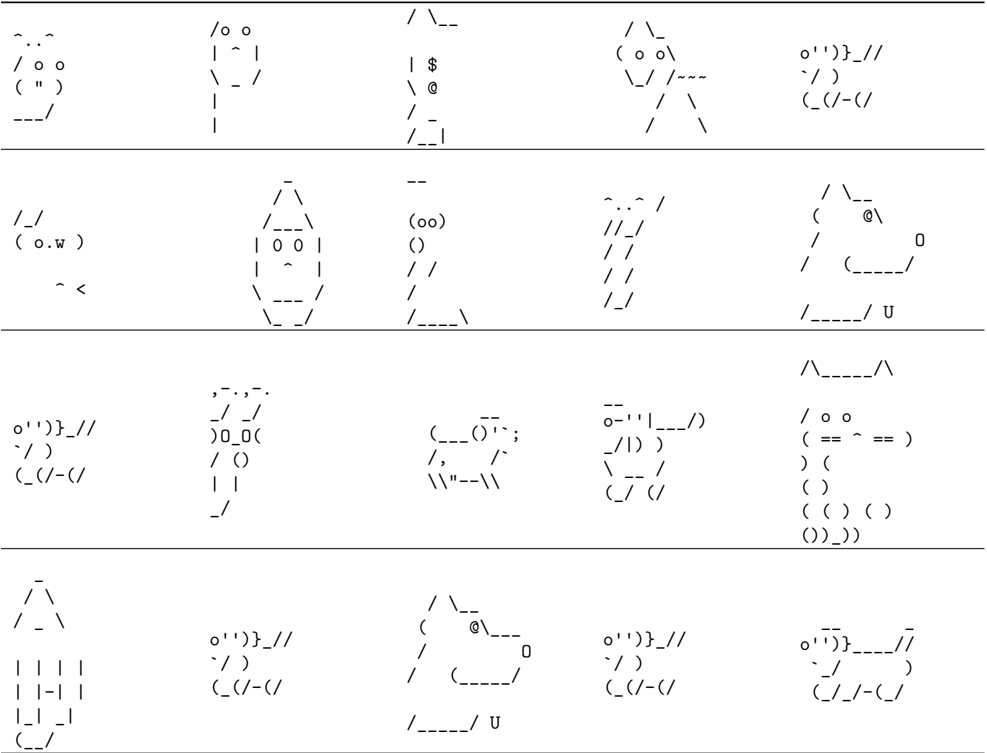
The image is a 5x5 grid of ASCII art, with each cell containing a unique combination of symbols, characters, and patterns. The art includes repeated elements (e.g., `o''})_//`, `/`, `\`, `^`, `_`, `o`, and `//`), suggesting a structured or symbolic representation. No numerical data or explicit labels are present, but the repetition of specific patterns implies a potential diagram or flowchart.
---
### Components/Axes
- **Grid Structure**:
- 5 rows × 5 columns.
- Each cell contains a distinct ASCII art snippet.
- **Key Symbols**:
- `/` and `\`: Likely represent directional flow or connections.
- `o`: May denote nodes or entities.
- `^` and `_`: Could indicate anchors, connectors, or structural elements.
- `//` and `\\`: Possibly separators or directional markers.
- `o''})_//`: A recurring pattern, potentially a label or identifier.
- `( o.w )`: A node with a label or descriptor.
- `//` and `\\`: May indicate flow direction or boundaries.
---
### Detailed Analysis
#### Row 1:
- `^..^`: A triangular shape, possibly a header or directional marker.
- `/o o`: A node with two `o` symbols, possibly a connection point.
- `/__`: A horizontal line, potentially a boundary or separator.
- `/_`: A diagonal line, suggesting a connection or flow.
- `o''})_//`: A repeated pattern, likely a key label or identifier.
#### Row 2:
- `/ o o`: A node with two `o` symbols, similar to Row 1.
- `\ ^ |`: A vertical line with a `^`, possibly a connector or anchor.
- `| $`: A vertical line with a `$`, potentially a value or marker.
- `( o o\ \_/`: A node with two `o` symbols and a `\\_/`, suggesting a complex connection.
- `o''})_//`: Repeated pattern, reinforcing its significance.
#### Row 3:
- `/_/ ( o.w )`: A node labeled `( o.w )`, possibly a key component.
- `| o o |`: A node with two `o` symbols, enclosed in vertical lines.
- `| ^ |`: A vertical line with a `^`, indicating a connector.
- `/ /`: A diagonal line, possibly a flow or connection.
- `/ (_____/`: A horizontal line with a `_____`, suggesting a boundary or path.
#### Row 4:
- `o''})_//`: Repeated pattern, likely a label or identifier.
- `/ )0_0(`: A node with `0_0`, possibly a face or symbolic representation.
- `/, /`: A diagonal line with a comma, indicating a separator or flow.
- `\\"---\\`: A horizontal line with dashes, possibly a boundary or path.
- `/ o o`: A node with two `o` symbols, similar to earlier rows.
#### Row 5:
- `/_ \ o''})_//`: A node with `o''})_//`, reinforcing its role as a label.
- `/ )0_0(`: Repeated node, suggesting a central or recurring element.
- `/ (_____/`: A horizontal line with `_____`, similar to Row 3.
- `o''})_//`: Repeated pattern, emphasizing its importance.
- `/ )`: A vertical line with a `)`, possibly a closing bracket or marker.
---
### Key Observations
1. **Repetition of `o''})_//`**: This pattern appears in multiple cells, suggesting it is a critical label or identifier.
2. **Directional Flow**: The use of `/` and `\` implies a directional or hierarchical structure, potentially a flowchart or network.
3. **Nodes and Connectors**: The `o` symbols and `^`/`_` anchors indicate nodes and connections, respectively.
4. **Complex Patterns**: The `( o.w )` and `//`/`\\` suggest layered or nested relationships.
---
### Interpretation
The grid likely represents a **symbolic diagram** or **flowchart** with the following characteristics:
- **Nodes**: Represented by `o` and `( o.w )`, possibly entities or components.
- **Connections**: Indicated by `/`, `\`, and `//`, suggesting directional or hierarchical relationships.
- **Labels**: The repeated `o''})_//` may denote a key identifier or category.
- **Boundaries**: The `_____` and `//` patterns could mark edges or separators.
The structure implies a **networked system** or **process flow**, where nodes are interconnected via directional markers. The repetition of `o''})_//` suggests it is a central or recurring element, possibly a root node or a critical component. The absence of numerical data limits quantitative analysis, but the symbolic repetition and directional cues point to a **logical or conceptual framework**.
---
**Note**: No numerical data or explicit labels are present. The interpretation is based on symbolic patterns and structural repetition.