## Diagram: Causal Diagrams
### Overview
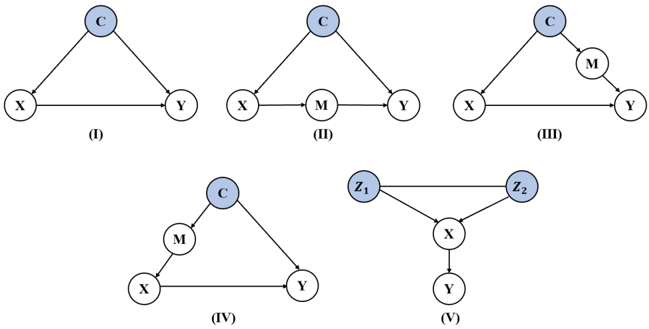
The image presents five different causal diagrams, each depicting relationships between variables represented by circles and directed edges (arrows). The diagrams are labeled (I) through (V). Some nodes are shaded light blue.
### Components/Axes
* **Nodes:** Represented by circles, labeled with letters (X, Y, C, M, Z1, Z2).
* **Edges:** Represented by arrows, indicating the direction of causal influence.
* **Shading:** Some nodes are shaded light blue, indicating a specific type of variable (likely a confounder or instrumental variable).
* **Labels:** Each diagram is labeled with a Roman numeral (I, II, III, IV, V) below the diagram.
### Detailed Analysis
**Diagram (I):**
* Nodes: X, Y, C
* Edges: C -> X, C -> Y, X -> Y
* C is shaded light blue.
* Description: C influences both X and Y, and X influences Y.
**Diagram (II):**
* Nodes: X, Y, C, M
* Edges: C -> X, C -> Y, X -> M, M -> Y
* C is shaded light blue.
* Description: C influences both X and Y, X influences M, and M influences Y.
**Diagram (III):**
* Nodes: X, Y, C, M
* Edges: C -> X, C -> M, X -> Y, M -> Y
* C is shaded light blue.
* Description: C influences X and M, and both X and M influence Y.
**Diagram (IV):**
* Nodes: X, Y, C, M
* Edges: C -> M, C -> Y, M -> X, X -> Y
* C is shaded light blue.
* Description: C influences M and Y, M influences X, and X influences Y.
**Diagram (V):**
* Nodes: X, Y, Z1, Z2
* Edges: Z1 -> X, Z2 -> X, X -> Y
* Z1 and Z2 are shaded light blue.
* Description: Z1 and Z2 both influence X, and X influences Y.
### Key Observations
* The diagrams illustrate different causal structures involving variables X, Y, and other variables (C, M, Z1, Z2).
* The shaded nodes (C, Z1, Z2) likely represent confounding variables or instrumental variables.
* The arrows indicate the direction of causal influence between the variables.
### Interpretation
The diagrams represent different causal models, which are used to understand the relationships between variables and to make predictions about the effects of interventions. The different diagrams illustrate how the inclusion of additional variables (M, C, Z1, Z2) can change the causal relationships between X and Y. The shaded nodes likely represent variables that need to be controlled for in order to estimate the causal effect of X on Y. Diagram (V) shows a case where two variables (Z1, Z2) influence X, which in turn influences Y. This could represent a situation where Z1 and Z2 are instrumental variables for the effect of X on Y.