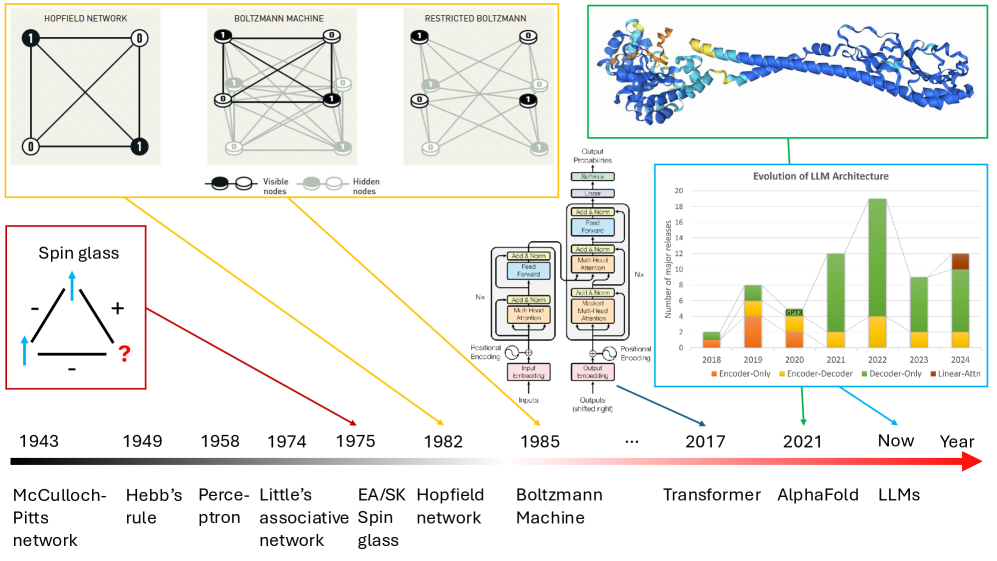
## Timeline and Bar Chart: Evolution of Computational Models and LLM Architectures
### Overview
The image presents a dual visualization: a historical timeline of computational models (left) and a bar chart showing the evolution of LLM architectures (right). The timeline traces key milestones from 1943 to 2024, while the bar chart quantifies publication trends in LLM research from 2018–2024. A Spin Glass diagram (bottom-left) connects to the Hopfield Network (1982) via a red arrow.
---
### Components/Axes
#### Timeline (Left)
- **X-axis**: Years (1943–2024), marked at intervals (1943, 1949, 1958, 1974, 1975, 1982, 1985, 2017, 2021, "Now", "Year").
- **Y-axis**: Unlabeled, but represents vertical placement of models/diagrams.
- **Key Elements**:
- **Spin Glass Diagram**: Bottom-left, triangular structure with "+", "-", and "?" labels, connected by arrows.
- **Model Diagrams**:
- **Hopfield Network** (1982): Grid of nodes with visible (black) and hidden (gray) nodes.
- **Boltzmann Machine** (1985): Dense network with visible (black) and hidden (gray) nodes.
- **Restricted Boltzmann Machine** (1985): Sparse connections between visible and hidden nodes.
- **Text Labels**: Model names and years (e.g., "McCulloch-Pitts network" at 1943, "Transformer" at 2017).
#### Bar Chart (Right)
- **X-axis**: Years (2018–2024), labeled sequentially.
- **Y-axis**: "Number of major publications" (0–20), with gridlines.
- **Legend**: Right-side, color-coded categories:
- **Encoder-Only**: Orange
- **Encoder-Decoder**: Yellow
- **Decoder-Only**: Green
- **Linear-Attention**: Brown
- **Data**: Stacked bars for each year, showing cumulative contributions per category.
---
### Detailed Analysis
#### Timeline
1. **1943**: McCulloch-Pitts network (first neural network model).
2. **1949**: Hebb’s rule (learning mechanism for synaptic weights).
3. **1958**: Perceptron (early single-layer neural network).
4. **1974**: Little’s associative network (early associative memory model).
5. **1975**: EA/SK Spin Glass (theoretical model linking physics and computation).
6. **1982**: Hopfield Network (energy-based associative memory).
7. **1985**: Boltzmann Machine (stochastic neural network with hidden layers).
8. **2017**: Transformer (self-attention architecture).
9. **2020**: AlphaFold (protein structure prediction).
10. **2021–2024**: LLMs (large language models, e.g., GPT, BERT).
#### Bar Chart
- **2018**:
- Encoder-Only: 2 publications
- Encoder-Decoder: 5
- Decoder-Only: 3
- Linear-Attention: 0
- **2019**:
- Encoder-Only: 4
- Encoder-Decoder: 6
- Decoder-Only: 2
- Linear-Attention: 0
- **2020**:
- Encoder-Only: 3
- Encoder-Decoder: 4
- Decoder-Only: 5
- Linear-Attention: 0
- **2021**:
- Encoder-Only: 2
- Encoder-Decoder: 3
- Decoder-Only: 8
- Linear-Attention: 0
- **2022**:
- Encoder-Only: 1
- Encoder-Decoder: 2
- Decoder-Only: 12
- Linear-Attention: 0
- **2023**:
- Encoder-Only: 0
- Encoder-Decoder: 1
- Decoder-Only: 9
- Linear-Attention: 3
- **2024**:
- Encoder-Only: 0
- Encoder-Decoder: 0
- Decoder-Only: 6
- Linear-Attention: 4
---
### Key Observations
1. **Timeline**:
- The Spin Glass (1975) is explicitly linked to the Hopfield Network (1982) via a red arrow, suggesting a conceptual bridge between physics-inspired models and neural networks.
- The "?" in the Spin Glass diagram (1943) implies unresolved questions about its role in later architectures.
2. **Bar Chart**:
- **Peak in 2022**: Decoder-Only models dominate (12 publications), reflecting the rise of architectures like GPT-3.
- **Linear-Attention Emergence**: First appears in 2023, growing to 4 publications by 2024.
- **Encoder-Decoder Decline**: Drops from 6 (2019) to 1 (2023), indicating shifting research focus.
---
### Interpretation
1. **Historical Progression**:
- Early models (1943–1985) laid foundational principles (e.g., Hebb’s rule, Boltzmann Machines) that influenced later architectures.
- The Spin Glass (1975) represents an interdisciplinary link between physics and computation, later formalized in the Hopfield Network.
2. **LLM Evolution**:
- The 2022 peak aligns with breakthroughs like GPT-3, which popularized Decoder-Only models.
- Linear-Attention’s rise (2023–2024) suggests growing interest in efficiency improvements for long-sequence tasks.
3. **Unresolved Questions**:
- The Spin Glass’s "?" (1943) highlights gaps in understanding its direct impact on modern architectures.
- The timeline’s abrupt end at "Year" (2024) leaves future trends speculative.
---
### Spatial Grounding
- **Legend**: Right-aligned, colors match bar chart categories (orange=Encoder-Only, green=Decoder-Only).
- **Spin Glass Diagram**: Bottom-left, isolated from the timeline but connected via the red arrow to the Hopfield Network.
- **Bar Chart**: Right-side, stacked bars with clear color coding; legend positioned adjacent to data.
---
### Conclusion
The image illustrates the trajectory from early computational models to modern LLMs, emphasizing the Spin Glass’s theoretical role and the dominance of Decoder-Only architectures in recent years. The 2022 publication peak underscores rapid innovation, while Linear-Attention’s emergence hints at future directions. The Spin Glass’s unresolved status invites further interdisciplinary exploration.