## Process Diagram: Deep Blue Evaluation Framework
### Overview
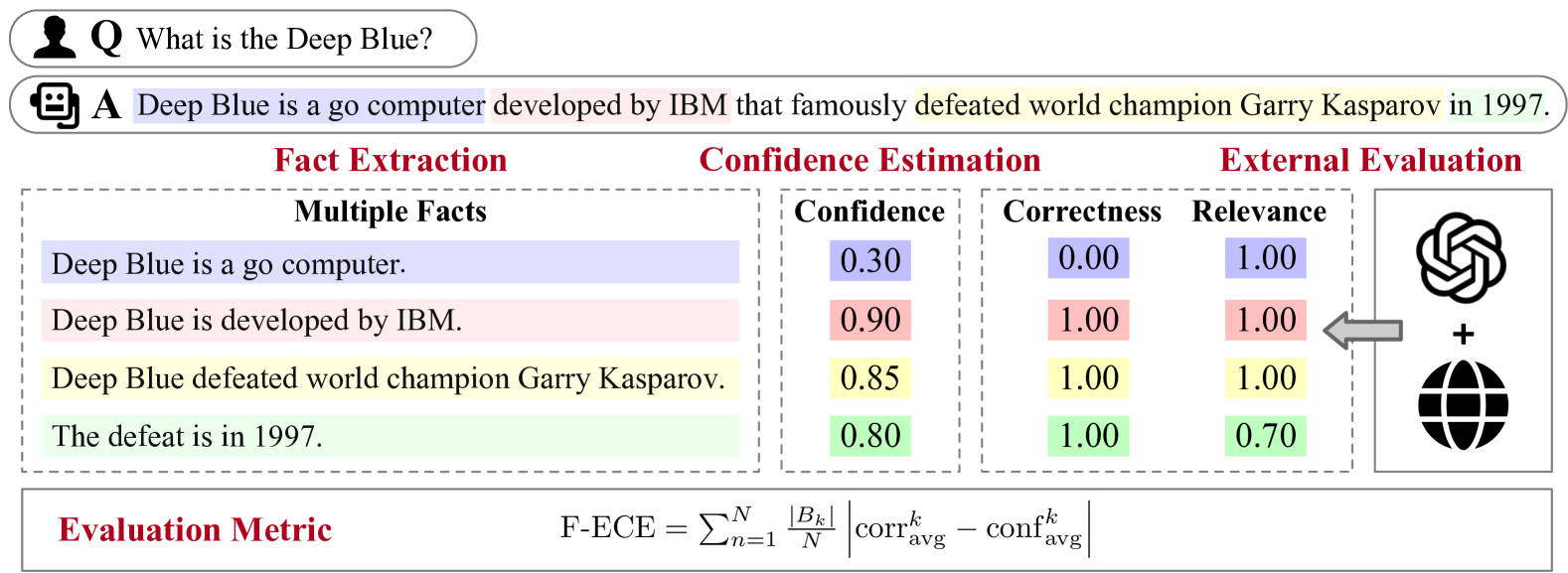
The diagram illustrates a multi-stage evaluation framework for assessing the accuracy and relevance of factual claims about Deep Blue, a chess-playing computer developed by IBM. It includes fact extraction, confidence estimation, external evaluation, and a mathematical metric for overall performance.
### Components/Axes
1. **Fact Extraction**
- Lists four factual claims about Deep Blue, each color-coded:
- **Blue**: "Deep Blue is a go computer." (Confidence: 0.30)
- **Pink**: "Deep Blue is developed by IBM." (Confidence: 0.90)
- **Yellow**: "Deep Blue defeated world champion Garry Kasparov." (Confidence: 0.85)
- **Green**: "The defeat is in 1997." (Confidence: 0.80)
2. **Confidence Estimation**
- Subdivided into **Correctness** and **Relevance** scores for each fact:
- **Correctness**:
- Blue: 0.00 (incorrect)
- Pink: 1.00 (correct)
- Yellow: 1.00 (correct)
- Green: 1.00 (correct)
- **Relevance**:
- Blue: 1.00 (irrelevant)
- Pink: 1.00 (relevant)
- Yellow: 1.00 (relevant)
- Green: 0.70 (partially relevant)
3. **External Evaluation**
- Symbols: A globe (global context) and a puzzle piece (external data integration), connected by a "+" sign.
4. **Evaluation Metric**
- Formula:
$$
\text{F-ECE} = \sum_{n=1}^N \frac{|B_k|}{N} \left| \text{corr}_{\text{avg}} - \text{conf}_{\text{avg}}^k \right|
$$
- Aggregates confidence, correctness, and relevance scores into a single metric.
### Detailed Analysis
- **Fact Extraction**:
- The first claim ("go computer") is factually incorrect (correctness = 0.00) but marked as relevant (relevance = 1.00).
- The remaining claims are correct (correctness = 1.00) and relevant, except the year claim (relevance = 0.70).
- **Confidence Estimation**:
- Confidence scores (0.30–0.90) reflect uncertainty in fact validity. Higher confidence correlates with higher correctness (e.g., IBM development: 0.90 confidence, 1.00 correctness).
- **External Evaluation**:
- The globe and puzzle piece suggest incorporating external validation (e.g., historical records, domain expertise).
### Key Observations
1. **Mismatch in Relevance**: The "go computer" claim is irrelevant despite high confidence.
2. **Year Relevance**: The 1997 defeat claim has lower relevance (0.70), possibly due to contextual ambiguity.
3. **Formula Complexity**: The F-ECE metric balances confidence gaps between correctness and relevance, penalizing overconfident incorrect claims.
### Interpretation
The framework prioritizes factual accuracy while accounting for contextual relevance. The "go computer" claim highlights the risk of overconfidence in incorrect facts, while the year claim’s partial relevance suggests nuanced historical context. The F-ECE metric quantifies this balance, emphasizing the need for external validation (symbolized by the globe and puzzle piece) to refine evaluations. This approach ensures robustness in AI systems handling ambiguous or domain-specific queries.