## Mathematical Equation: Minimization Problem Decomposition
### Overview
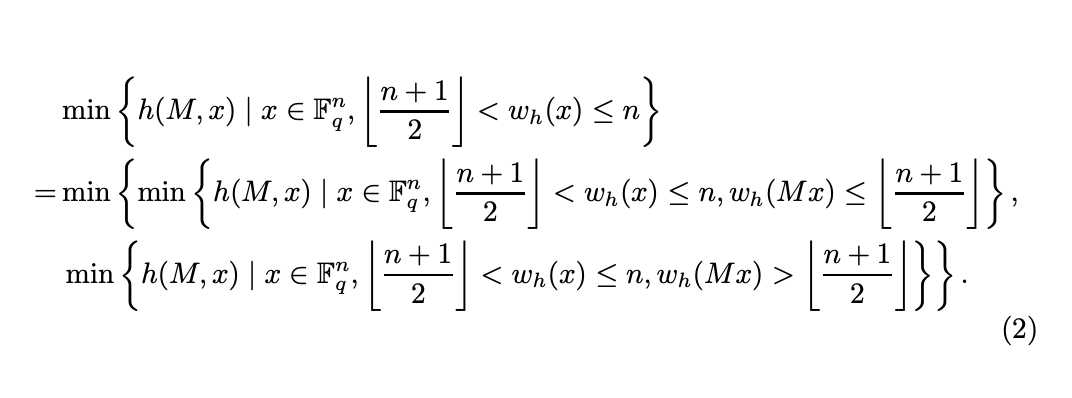
The image presents a mathematical equation that decomposes a minimization problem into two sub-problems based on the weight of a transformed vector. The equation aims to find the minimum value of a function h(M, x) under certain constraints.
### Components/Axes
* **min**: Minimization operator.
* **h(M, x)**: A function to be minimized, where M is a matrix and x is a vector.
* **x ∈ F<sub>q</sub><sup>n</sup>**: x is a vector belonging to the vector space F<sub>q</sub><sup>n</sup>.
* **⌊(n+1)/2⌋**: Floor function of (n+1)/2.
* **w<sub>h</sub>(x)**: Hamming weight of vector x.
* **n**: An integer.
* **M**: A matrix.
* **(2)**: Equation number.
### Detailed Analysis or ### Content Details
The equation is as follows:
```
min {h(M, x) | x ∈ F<sub>q</sub><sup>n</sup>, ⌊(n+1)/2⌋ < w<sub>h</sub>(x) ≤ n}
= min {min {h(M, x) | x ∈ F<sub>q</sub><sup>n</sup>, ⌊(n+1)/2⌋ < w<sub>h</sub>(x) ≤ n, w<sub>h</sub>(Mx) ≤ ⌊(n+1)/2⌋},
min {h(M, x) | x ∈ F<sub>q</sub><sup>n</sup>, ⌊(n+1)/2⌋ < w<sub>h</sub>(x) ≤ n, w<sub>h</sub>(Mx) > ⌊(n+1)/2⌋}}.
```
The equation states that minimizing h(M, x) subject to x being in F<sub>q</sub><sup>n</sup> and its Hamming weight w<sub>h</sub>(x) being greater than ⌊(n+1)/2⌋ but less than or equal to n, is equivalent to minimizing h(M, x) over two separate cases:
1. Where the Hamming weight of Mx, w<sub>h</sub>(Mx), is less than or equal to ⌊(n+1)/2⌋.
2. Where the Hamming weight of Mx, w<sub>h</sub>(Mx), is greater than ⌊(n+1)/2⌋.
### Key Observations
* The original minimization problem is split into two sub-problems based on the Hamming weight of the transformed vector Mx.
* The floor function ⌊(n+1)/2⌋ acts as a threshold for the Hamming weight of both x and Mx.
### Interpretation
The equation decomposes the original minimization problem into two smaller minimization problems. This decomposition is based on whether the Hamming weight of the transformed vector Mx is above or below a certain threshold (⌊(n+1)/2⌋). This approach might be useful for simplifying the optimization process or for analyzing the problem in different scenarios based on the properties of the transformed vector. The decomposition suggests a divide-and-conquer strategy where the original problem is broken down into smaller, more manageable sub-problems.