\n
## Mathematical Equation: Optimization Problem
### Overview
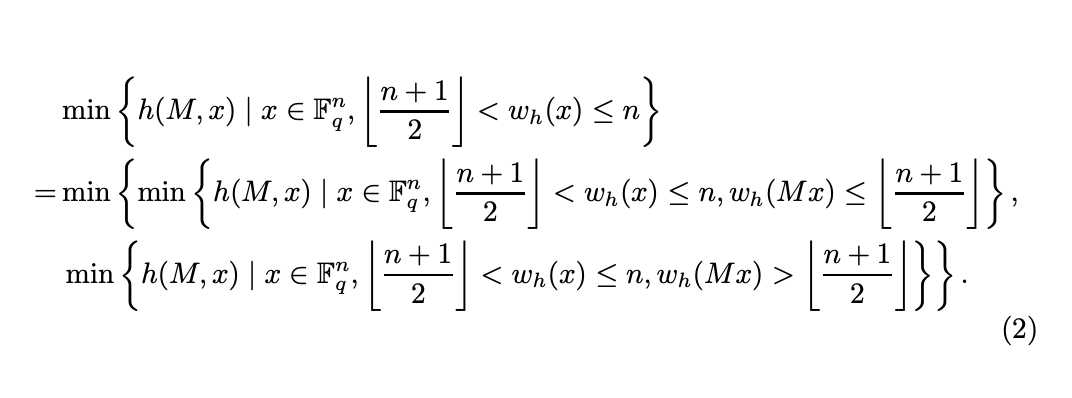
The image presents a series of mathematical equations representing an optimization problem. It appears to be a minimization problem involving a function *h(M, x)* subject to constraints related to variables *x*, *M*, and *w_h(x)*. The equations are presented in a step-by-step manner, showing equivalent formulations.
### Components/Axes
The image contains only mathematical notation and symbols. There are no axes, legends, or traditional chart components. The key elements are:
* **min:** Represents the minimization operator.
* **h(M, x):** A function of variables *M* and *x*.
* **x ∈ F<sup>n</sup><sub>q</sub>:** Indicates that *x* belongs to the set F<sup>n</sup><sub>q</sub>.
* **w<sub>h</sub>(x):** A function of *x*.
* **n:** A numerical parameter.
* **q:** A numerical parameter.
* **≤:** Less than or equal to operator.
* **=:** Equality operator.
* **[n + 1 / 2]:** Represents the floor function of (n + 1)/2.
* **(2):** An equation number, indicating this is equation number 2.
### Detailed Analysis or Content Details
The equations can be transcribed as follows:
1. `min { h(M, x) | x ∈ F<sup>n</sup><sub>q</sub>, [n + 1 / 2] < w<sub>h</sub>(x) ≤ n }`
2. `= min { min { h(M, x) | x ∈ F<sup>n</sup><sub>q</sub>, [n + 1 / 2] < w<sub>h</sub>(x) ≤ n, w<sub>h</sub>(M x) ≤ [n + 1 / 2] } }`
3. `min { h(M, x) | x ∈ F<sup>n</sup><sub>q</sub>, [n + 1 / 2] < w<sub>h</sub>(x) ≤ n, w<sub>h</sub>(M x) > [n + 1 / 2] }`
The first equation defines the initial minimization problem. The second and third equations appear to be refinements or decompositions of the original problem, introducing additional constraints involving *w<sub>h</sub>(M x)*. The floor function `[n + 1 / 2]` is used to constrain the values of *w<sub>h</sub>(x)* and *w<sub>h</sub>(M x)*.
### Key Observations
The equations demonstrate a process of refining an optimization problem by adding constraints. The use of the floor function suggests a discrete or integer-related aspect to the problem. The constraints involving *w<sub>h</sub>(x)* and *w<sub>h</sub>(M x)* seem to be partitioning the solution space based on the values of these functions.
### Interpretation
The equations likely represent a step in solving a complex optimization problem, potentially in a field like machine learning, signal processing, or control theory. The function *h(M, x)* could represent a cost or error function, and the goal is to find the value of *x* that minimizes this function while satisfying the given constraints. The constraints involving *w<sub>h</sub>(x)* and *w<sub>h</sub>(M x)* might be related to regularization, stability, or other desirable properties of the solution. The use of the floor function suggests that the problem may involve discrete variables or a quantization process. Without further context, it is difficult to determine the specific meaning of the variables and functions, but the equations provide a clear mathematical formulation of an optimization problem.