## Line Graphs: Signal Level Over Time
### Overview
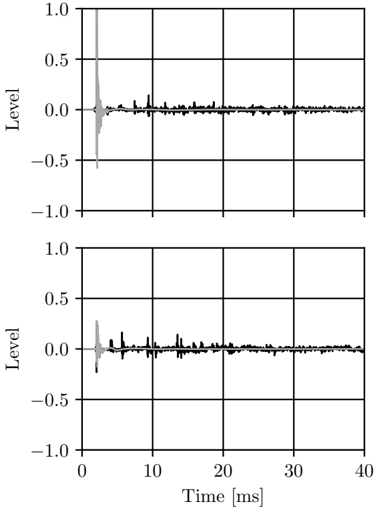
The image contains two vertically stacked line graphs depicting signal level variations over time. Both graphs share identical axes but represent distinct data series. The top graph shows a pronounced initial spike followed by stabilization, while the bottom graph exhibits a smaller initial spike with persistent low-amplitude fluctuations.
### Components/Axes
- **Y-Axis (Level):**
- Range: -1.0 to 1.0
- Markers: -1.0, -0.5, 0.0, 0.5, 1.0
- Units: Dimensionless (unitless "Level" metric)
- **X-Axis (Time):**
- Range: 0 to 40 ms
- Markers: 0, 10, 20, 30, 40 ms
- Units: Milliseconds
- **Graph Structure:**
- Two independent line plots (no shared legend or color coding)
- Top graph: Sharp vertical spike at 0 ms
- Bottom graph: Smaller initial spike with sustained oscillations
### Detailed Analysis
1. **Top Graph (Upper Plot):**
- **Initial Spike:**
- Occurs at 0 ms
- Peaks at approximately 1.0 level
- Duration: <1 ms (exact width indeterminate due to resolution)
- **Post-Spike Behavior:**
- Rapid decay to -0.5 level
- Stabilizes near 0.0 level with minor noise (<0.1 level fluctuations)
- **Key Data Points:**
- (0 ms, 1.0)
- (1 ms, -0.5)
- (40 ms, ~0.0)
2. **Bottom Graph (Lower Plot):**
- **Initial Spike:**
- Occurs at 0 ms
- Peaks at approximately 0.2 level
- Duration: ~2 ms
- **Post-Spike Behavior:**
- Sustained oscillations between -0.5 and 0.5
- Amplitude: ~0.1-0.2 level
- Frequency: ~5-10 Hz (estimated from 40 ms span)
- **Key Data Points:**
- (0 ms, 0.2)
- (2 ms, -0.3)
- (40 ms, ~0.1)
### Key Observations
1. Both graphs exhibit transient spikes at t=0 ms, suggesting a shared triggering event.
2. The top graph's spike is 5× more intense than the bottom graph's.
3. Post-spike behavior differs significantly:
- Top graph stabilizes
- Bottom graph maintains persistent oscillations
4. No correlation between the two data series after t=2 ms.
### Interpretation
The data suggests two distinct signal responses to an initial stimulus:
1. **Top Graph:** Represents a high-amplitude, short-duration impulse response with rapid damping. This could indicate a system with strong initial reactivity but fast stabilization (e.g., mechanical shock absorption).
2. **Bottom Graph:** Shows a lower-amplitude, longer-duration oscillatory response. This might represent a resonant system or ongoing feedback mechanism (e.g., electrical circuit with LC oscillations).
3. The absence of shared color coding or legend prevents direct correlation between the two signals, though their temporal alignment at t=0 ms implies a common cause.
4. The persistent noise in both graphs after the initial spike suggests measurement artifacts or environmental interference.
No textual content, legends, or additional context is present in the image beyond the axis labels. The graphs appear to be standalone technical measurements without explanatory annotations.