## Line Chart: Solve Rate Comparison Across Prompting Methods and Tasks
### Overview
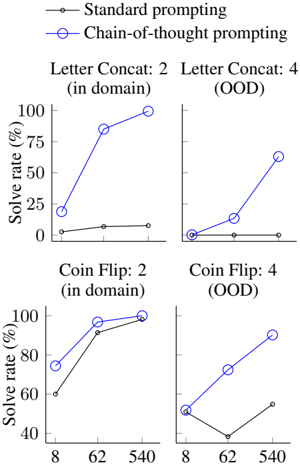
The image presents a comparative analysis of two prompting methods (Standard prompting and Chain-of-thought prompting) across four task conditions: Letter Concat (in-domain and OOD) and Coin Flip (in-domain and OOD). The chart uses line plots to visualize solve rate (%) against three x-axis values (8, 62, 540), with distinct markers for each prompting method.
### Components/Axes
- **X-axis**: Labeled with numerical values (8, 62, 540), likely representing problem size or condition variations.
- **Y-axis**: Labeled "Solve rate (%)" with a range from 0% to 100%.
- **Legend**:
- **Standard prompting**: Black dot (•) line.
- **Chain-of-thought prompting**: Blue line with open circles (○).
- **Subplot Titles**:
- Top-left: "Letter Concat: 2 (in domain)"
- Top-right: "Letter Concat: 4 (OOD)"
- Bottom-left: "Coin Flip: 2 (in domain)"
- Bottom-right: "Coin Flip: 4 (OOD)"
### Detailed Analysis
1. **Letter Concat: 2 (in domain)**:
- **Chain-of-thought prompting**: Solve rate increases from ~20% (x=8) to ~80% (x=62) to ~100% (x=540).
- **Standard prompting**: Flat line at ~5-10% across all x-values.
2. **Letter Concat: 4 (OOD)**:
- **Chain-of-thought prompting**: Solve rate rises from ~5% (x=8) to ~30% (x=62) to ~60% (x=540).
- **Standard prompting**: Flat line at ~0-5% across all x-values.
3. **Coin Flip: 2 (in domain)**:
- **Chain-of-thought prompting**: Solve rate starts at ~70% (x=8), peaks at ~95% (x=62), and remains stable at ~95% (x=540).
- **Standard prompting**: Starts at ~60% (x=8), dips slightly to ~55% (x=62), then rises to ~70% (x=540).
4. **Coin Flip: 4 (OOD)**:
- **Chain-of-thought prompting**: Solve rate increases from ~50% (x=8) to ~70% (x=62) to ~90% (x=540).
- **Standard prompting**: Starts at ~50% (x=8), drops to ~30% (x=62), then recovers to ~50% (x=540).
### Key Observations
- **Chain-of-thought prompting** consistently outperforms Standard prompting across all tasks and conditions.
- **OOD tasks** (e.g., Letter Concat: 4, Coin Flip: 4) show steeper improvement curves for Chain-of-thought prompting compared to in-domain tasks.
- **Standard prompting** exhibits minimal or negative performance in OOD scenarios (e.g., Coin Flip: 4 OOD shows a 20% drop at x=62).
- The x-axis values (8 → 62 → 540) likely represent escalating task complexity or problem instances.
### Interpretation
The data demonstrates that Chain-of-thought prompting significantly enhances solve rates, particularly in out-of-domain (OOD) tasks where Standard prompting struggles. This suggests Chain-of-thought prompting enables better generalization and reasoning for complex or unfamiliar problems. The x-axis progression (8 → 62 → 540) may reflect increasing task difficulty, with Chain-of-thought prompting maintaining high performance even at scale. Notably, Standard prompting’s performance degradation in OOD tasks highlights its limitations in handling novel or ambiguous scenarios. These trends align with prior research on Chain-of-thought prompting’s ability to improve logical reasoning in large language models.