## Diagram: Multi-Agent Decision-Making Process with LLM Integration
### Overview
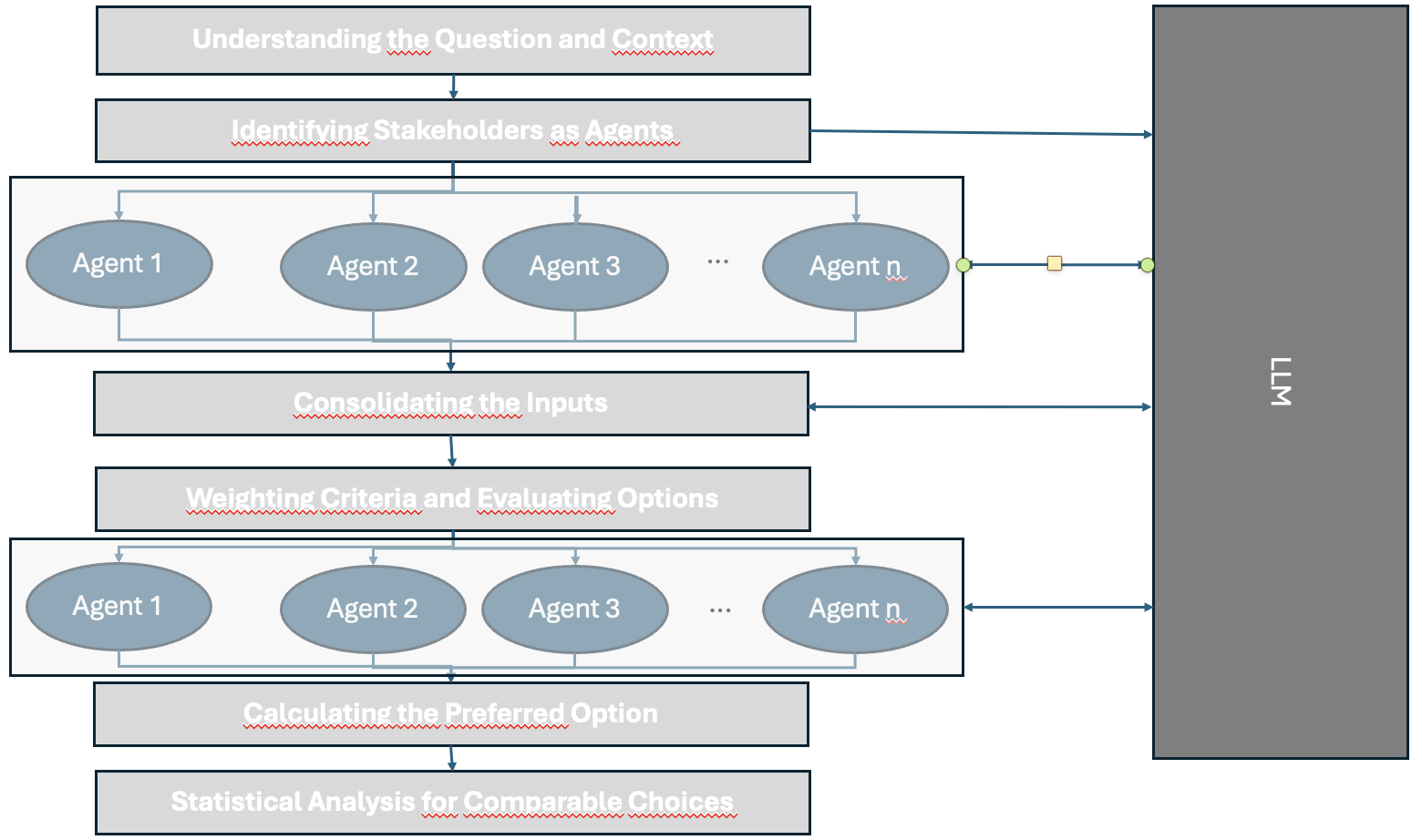
The image displays a flowchart illustrating a structured, multi-step process for decision-making that involves multiple agents and integrates with a Large Language Model (LLM). The process flows vertically from top to bottom, with specific steps interacting with a central LLM component on the right.
### Components/Axes
The diagram consists of the following primary components, listed in top-to-bottom order:
1. **Process Steps (Rectangular Boxes):**
* "Understanding the Question and Context"
* "Identifying Stakeholders as Agents"
* "Consolidating the Inputs"
* "Weighting Criteria and Evaluating Options"
* "Calculating the Preferred Option"
* "Statistical Analysis for Comparable Choices"
2. **Agent Groups (Ovals within larger containers):**
* **First Agent Group:** Contains ovals labeled "Agent 1", "Agent 2", "Agent 3", "...", and "Agent n". This group is positioned below "Identifying Stakeholders as Agents" and above "Consolidating the Inputs".
* **Second Agent Group:** Contains an identical set of ovals ("Agent 1" through "Agent n"). This group is positioned below "Weighting Criteria and Evaluating Options" and above "Calculating the Preferred Option".
3. **LLM Component (Large Vertical Rectangle):**
* A tall, dark gray rectangle on the right side of the diagram, labeled "LLM" in vertical text.
4. **Connectors (Arrows and Lines):**
* **Primary Flow:** A central vertical arrow connects all the rectangular process steps in sequence.
* **LLM Interactions:**
* A blue arrow points from "Identifying Stakeholders as Agents" to the LLM.
* A blue line with a small yellow square icon connects the right side of the first "Agent n" oval to the LLM.
* A blue arrow points from the LLM back to "Consolidating the Inputs".
* A blue arrow points from the LLM to the second agent group (specifically to the right side of the "Agent n" oval).
### Detailed Analysis
The process is a sequential workflow with parallel agent-based sub-processes and iterative LLM consultation.
* **Step 1: Understanding the Question and Context.** This is the initiating phase.
* **Step 2: Identifying Stakeholders as Agents.** Stakeholders are modeled as discrete agents. This step sends information to the LLM.
* **Agent Phase 1:** The identified agents (1 through n) operate, presumably generating individual perspectives or data. Their collective output is channeled to the next step. The connection from "Agent n" to the LLM suggests the agent outputs or a summary are sent for processing.
* **Step 3: Consolidating the Inputs.** This step receives input from the first agent phase and also receives processed information back from the LLM, indicating a consolidation or synthesis step that leverages the LLM.
* **Step 4: Weighting Criteria and Evaluating Options.** This step likely uses the consolidated inputs to establish evaluation metrics.
* **Agent Phase 2:** The same set of agents (1 through n) re-engages, now presumably to evaluate options based on the weighted criteria. This phase also receives direct input from the LLM.
* **Step 5: Calculating the Preferred Option.** The outputs from the second agent phase are used to compute a final decision.
* **Step 6: Statistical Analysis for Comparable Choices.** The final step involves analyzing the decision or alternatives statistically.
### Key Observations
1. **Dual Agent Involvement:** Agents are involved at two distinct stages: first for initial input generation after identification, and second for evaluation after criteria are weighted.
2. **LLM as a Central Processor:** The LLM is not a passive repository but an active participant. It receives information from the identification step and the first agent phase, and provides output to the consolidation step and the second agent phase. This suggests it performs functions like summarization, reasoning, or generating intermediate outputs.
3. **Closed Feedback Loop:** The connection from the LLM back to "Consolidating the Inputs" creates a feedback loop, implying the process may be iterative or that the LLM's output is essential for synthesis.
4. **Scalability:** The use of "Agent n" and ellipses (...) indicates the framework is designed to accommodate a variable, potentially large number of stakeholder agents.
### Interpretation
This diagram outlines a sophisticated, human-in-the-loop (or agent-in-the-loop) decision-making architecture. It formalizes the process of translating stakeholder interests into a quantifiable decision.
* **What it demonstrates:** The framework systematically decomposes a complex decision into manageable phases: problem definition, stakeholder representation, data gathering, criteria setting, evaluation, and final analysis. The integration of an LLM suggests it is used to handle the natural language understanding, synthesis of diverse agent inputs, and possibly the generation of evaluation criteria or options—tasks at which LLMs excel.
* **Relationships:** The agents represent decentralized viewpoints or data sources. The LLM acts as a central reasoning engine that interfaces with these agents at key points to structure their outputs and facilitate consensus or evaluation. The process steps provide the rigid scaffolding that guides this interaction toward a final, statistically validated outcome.
* **Notable Implications:** The model implies that raw stakeholder (agent) input is not directly used for calculation. Instead, it is first processed (by the LLM and consolidation step) and then re-evaluated by the agents themselves under new criteria. This could help mitigate bias or align disparate viewpoints. The final statistical analysis step adds a layer of quantitative rigor, suggesting the output is not just a single choice but a analyzed set of comparable alternatives. The red underlines on the text appear to be artifacts from a spell-checker in the software used to create the diagram and do not carry semantic meaning.