# Technical Document Extraction: Process Flowchart Analysis
## Overview
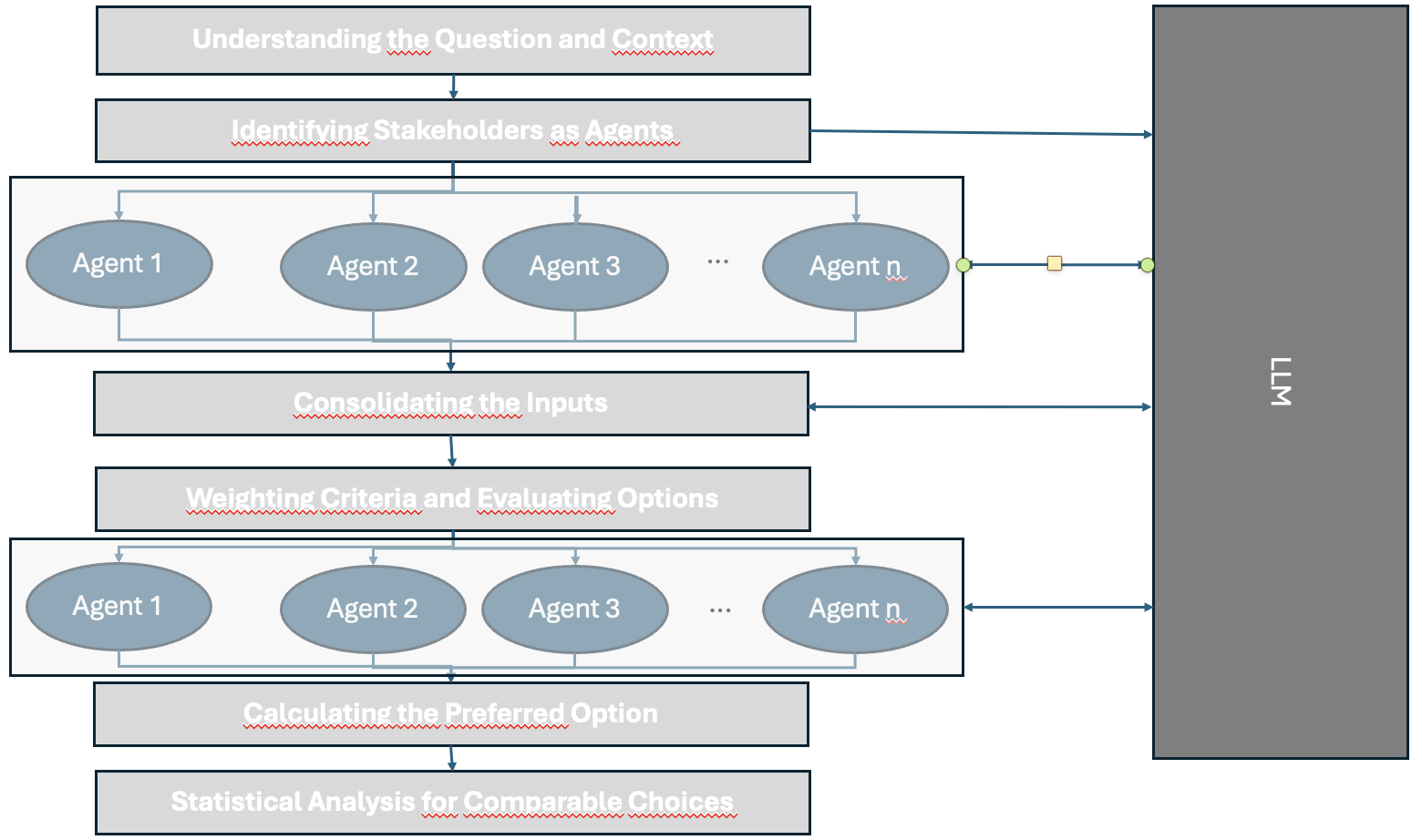
The image depicts a multi-step decision-making process involving human agents and a Large Language Model (LLM). The flowchart outlines sequential and iterative interactions between stakeholders, criteria evaluation, and final decision-making.
---
## Key Components
### 1. Process Steps
1. **Understanding the Question and Context**
- Initial phase for defining the problem scope.
- No direct connections shown.
2. **Identifying Stakeholders as Agents**
- Connects to the LLM (Large Language Model) via a bidirectional arrow.
- Triggers the agent workflow.
3. **Consolidating the Inputs**
- Receives aggregated data from all agents.
- Connects to the LLM via a bidirectional arrow.
4. **Weighting Criteria and Evaluating Options**
- Receives input from all agents.
- Connects to the LLM via a bidirectional arrow.
5. **Calculating the Preferred Option**
- Final decision phase.
- Connects to the LLM via a bidirectional arrow.
6. **Statistical Analysis for Comparable Choices**
- Final step in the process.
- No direct LLM connection shown.
---
### 2. Agent Workflow
- **Agents 1 to n** (represented as ovals) form a closed-loop system:
- Each agent connects to the next in sequence (Agent 1 → Agent 2 → ... → Agent n → Agent 1).
- All agents feed into both **Consolidating the Inputs** and **Weighting Criteria and Evaluating Options**.
- No explicit labels for agent roles or criteria.
---
### 3. LLM Integration
- The LLM (Large Language Model) is a large gray rectangle on the right.
- Connected to:
- **Identifying Stakeholders as Agents** (bidirectional).
- **Consolidating the Inputs** (bidirectional).
- **Weighting Criteria and Evaluating Options** (bidirectional).
- **Calculating the Preferred Option** (bidirectional).
---
## Flowchart Structure
- **Direction**: Top-to-bottom linear progression with lateral agent interactions.
- **Connections**:
- Arrows indicate sequential dependencies.
- Bidirectional arrows between agents and the LLM suggest iterative feedback.
- **No numerical data or trends** present; purely procedural.
---
## Observations
- The process emphasizes collaborative decision-making between human agents and AI (LLM).
- The LLM acts as a central hub for integrating and refining inputs.
- Agent interactions are cyclical, suggesting iterative refinement of inputs.
---
## Limitations
- No explicit criteria or weighting mechanisms defined for agents.
- No quantitative metrics or statistical methods detailed in the analysis phase.
- Agent roles and responsibilities are abstracted.
---
## Conclusion
This flowchart outlines a hybrid human-AI decision-making framework, emphasizing iterative collaboration and LLM-driven input consolidation. Further details on agent-specific criteria and statistical methods would enhance the model's applicability.