## Photograph: Interior Room Layout
### Overview
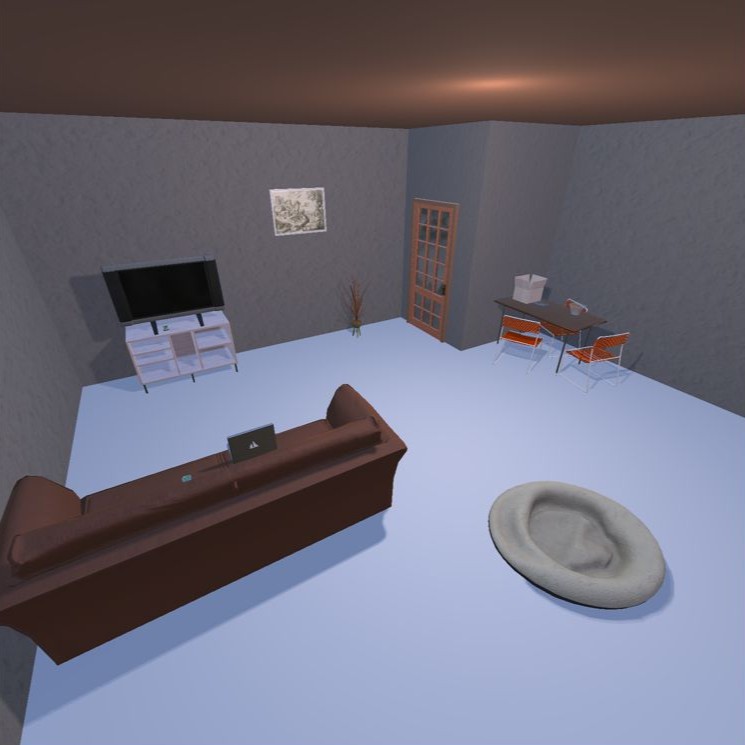
The image depicts a 3D-rendered or virtual environment of a room with gray walls, a brown ceiling, and a light blue floor. The room contains furniture and objects arranged in a functional layout, suggesting a living or multipurpose space. No textual data, charts, or diagrams are present.
### Components/Axes
- **Foreground**: A brown sofa with a laptop placed on it.
- **Left Wall**: A white TV stand holding a flat-screen TV.
- **Right Wall**: A small table with two orange chairs, a cardboard box, and a gray object (possibly a lamp or container).
- **Back Wall**: A wooden door with glass panels and a framed picture above it.
- **Center Floor**: A round, beige object resembling a hat or cushion.
- **Additional Details**: A small potted plant near the door and shadows cast by furniture.
### Detailed Analysis
- **Sofa**: Positioned diagonally in the lower-left quadrant, facing the TV. The laptop is centered on the seat.
- **TV Stand**: Located on the left wall, slightly above the sofa’s height. The TV is black and rectangular.
- **Table and Chairs**: Situated on the right wall, forming a compact workspace. The chairs have orange backs and white frames.
- **Door**: Central on the back wall, featuring a grid of glass panes. A framed picture (indistinct content) hangs above it.
- **Hat/Cushion**: A round, beige object sits on the floor near the center-right, slightly overlapping the sofa’s shadow.
- **Lighting**: Soft illumination from the ceiling, casting faint shadows of furniture.
### Key Observations
- The room balances leisure (sofa, TV) and work (table, chairs) zones.
- The hat/cushion’s placement is ambiguous—possibly decorative or an error in rendering.
- No visible text, labels, or numerical data in the scene.
### Interpretation
The room’s design prioritizes open space and minimalism, with furniture arranged to maximize visibility of the TV and accessibility of the workspace. The presence of the laptop on the sofa suggests a casual, hybrid use of the area. The hat/cushion’s inclusion may indicate a focus on comfort or a placeholder for future design elements. The absence of people or dynamic elements implies the scene is staged for conceptual or architectural purposes.
## Notes
- No textual information, charts, or data tables are present.
- All descriptions are based on visible spatial relationships and object attributes.
- Uncertainty exists regarding the purpose of the hat/cushion and the framed picture’s content.