\n
## Diagram: Human Pose Estimation Visualization
### Overview
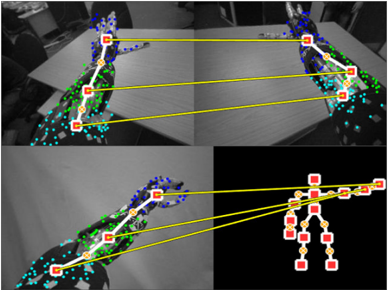
The image presents a visualization of human pose estimation, likely from a computer vision system. It shows two views of a person's arms and hands, along with a skeletal representation of a full body. The system has identified key points on the body and connected them with lines to represent the pose. The image is grayscale.
### Components/Axes
The image consists of three main sections:
1. **Top-Left:** A view of a person's left arm and hand, with keypoints marked.
2. **Top-Right:** A view of a person's right arm and hand, with keypoints marked.
3. **Bottom:** A combined view of the left arm and hand, alongside a full-body skeletal representation.
There are no explicit axes or legends in the traditional sense. The keypoints are represented by red squares, and the connections between them are yellow lines. The blue dots appear to represent the confidence or density of the pose estimation.
### Detailed Analysis or Content Details
The image shows a series of red squares (approximately 20-25 total) representing keypoints on the body. These points are connected by yellow lines, forming a skeletal structure.
* **Top-Left Arm:** The arm is extended, and the keypoints are located at the shoulder, elbow, wrist, and various points along the fingers. The lines connect these points in a natural anatomical order.
* **Top-Right Arm:** Similar to the left arm, the right arm is extended, and keypoints are marked at the shoulder, elbow, wrist, and fingers.
* **Bottom-Left Arm:** A closer view of the left arm, with similar keypoint markings.
* **Bottom-Right Skeleton:** A full-body skeletal representation. Keypoints are present at the head, neck, shoulders, elbows, wrists, hips, knees, and ankles. The lines connect these points to form a complete skeletal structure.
The density of blue dots is highest around the keypoints, suggesting a higher confidence level in the pose estimation at those locations. The density decreases further away from the keypoints.
### Key Observations
* The system appears to accurately identify keypoints on the arms and hands, even in a relatively complex pose.
* The full-body skeletal representation provides a complete overview of the person's pose.
* The blue dots indicate the confidence level of the pose estimation, with higher density indicating higher confidence.
* The image does not contain any numerical data or quantitative measurements.
### Interpretation
This image demonstrates the capabilities of a human pose estimation system. The system can identify keypoints on the body and connect them to form a skeletal structure, providing a representation of the person's pose. The confidence level of the pose estimation is indicated by the density of blue dots. This technology has applications in various fields, such as human-computer interaction, robotics, and sports analysis. The system appears to be robust enough to handle complex poses and provide accurate pose estimation. The lack of numerical data suggests that the image is primarily intended to demonstrate the visual output of the system rather than to provide quantitative measurements. The grayscale nature of the image suggests it may be a snapshot from a processing pipeline, rather than a final polished output.