## Commutative Diagram: Category Theory
### Overview
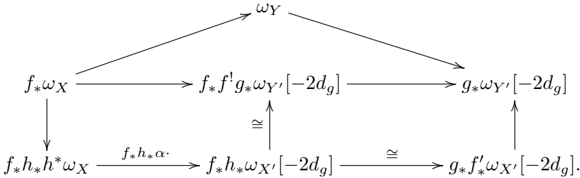
The image presents a commutative diagram, likely from category theory, illustrating relationships between objects and morphisms. The diagram consists of nodes representing objects (denoted with symbols like ω, X, Y, f, g, h) and arrows representing morphisms (transformations) between these objects. The diagram demonstrates how different compositions of morphisms result in equivalent transformations.
### Components/Axes
* **Nodes (Objects):**
* ωY (top center)
* f∗ωX (top left)
* f∗f!g∗ωY'[-2dg] (top center-right)
* g∗ωY'[-2dg] (top right)
* f∗h∗h∗ωX (bottom left)
* f∗h∗ωX'[-2dg] (bottom center-right)
* g∗f'∗ωX'[-2dg] (bottom right)
* **Arrows (Morphisms):** Arrows indicate transformations between objects. Some arrows are labeled with morphism compositions.
* f∗ωX → ωY (top-left to top-center)
* f∗ωX → f∗h∗h∗ωX (top-left to bottom-left, vertical arrow)
* f∗h∗h∗ωX → f∗h∗ωX'[-2dg] (bottom-left to bottom-center-right, labeled f∗h∗α)
* f∗f!g∗ωY'[-2dg] → ωY (top-center-right to top-center)
* f∗f!g∗ωY'[-2dg] → g∗ωY'[-2dg] (top-center-right to top-right)
* f∗h∗ωX'[-2dg] → f∗f!g∗ωY'[-2dg] (bottom-center-right to top-center-right, vertical arrow, labeled with "≅")
* g∗f'∗ωX'[-2dg] → g∗ωY'[-2dg] (bottom-right to top-right, vertical arrow, labeled with "≅")
* f∗h∗ωX'[-2dg] → g∗f'∗ωX'[-2dg] (bottom-center-right to bottom-right, labeled with "≅")
### Detailed Analysis or ### Content Details
The diagram is a 3x3 grid of objects connected by morphisms.
* **Top Row:** ωY, f∗ωX, f∗f!g∗ωY'[-2dg], g∗ωY'[-2dg]
* **Bottom Row:** f∗h∗h∗ωX, f∗h∗ωX'[-2dg], g∗f'∗ωX'[-2dg]
* **Vertical Arrows:** Connect the top and bottom rows, indicating equivalences or transformations.
* **Horizontal Arrows:** Connect objects within the same row, representing morphism compositions.
### Key Observations
* The diagram illustrates relationships between objects and morphisms in a categorical setting.
* The "≅" symbol indicates isomorphisms (equivalence) between certain transformations.
* The notation "[-2dg]" likely represents a shift or twist in the derived category.
* The diagram seems to describe a pullback or pushforward situation, involving functors f, g, and h.
### Interpretation
The diagram likely represents a commutative diagram in category theory, demonstrating the equivalence of different paths between objects. The presence of functors (f, g, h) and the notation "[-2dg]" suggest this diagram is related to derived categories or algebraic geometry. The diagram shows how different compositions of morphisms lead to the same result, highlighting the fundamental principles of category theory. The isomorphisms (≅) indicate that certain transformations are equivalent, simplifying the overall structure. The diagram is a visual representation of a complex mathematical relationship, allowing for a more intuitive understanding of the underlying concepts.