## Diagram Type: Mathematical Commutative Diagram
### Overview
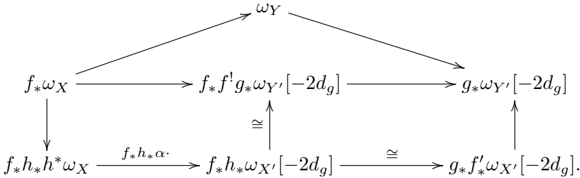
This image presents a complex mathematical commutative diagram, likely from the field of algebraic geometry, specifically involving derived categories, sheaf cohomology, and Grothendieck duality. It displays relationships between various objects (likely sheaves or complexes of sheaves) connected by morphisms (arrows), some of which are marked as isomorphisms.
### Components
The diagram consists of objects (nodes) and morphisms (arrows).
**Objects (Nodes):**
The diagram is structured with a top node and two main rows below it.
* **Top Node:**
* `ω_Y`
* **Middle Row (Left to Right):**
* `f_*ω_X`
* `f_*f^!g_*ω_Y'[-2d_g]`
* `g_*ω_Y'[-2d_g]`
* **Bottom Row (Left to Right):**
* `f_*h_*h^*ω_X`
* `f_*h_*ω_X'[-2d_g]`
* `g_*f'_*ω_X'[-2d_g]`
**Morphisms (Arrows) and Labels:**
* **From the Top Node:**
* An arrow points from `f_*ω_X` diagonally up-right to `ω_Y`.
* An arrow points from `ω_Y` diagonally down-right to `g_*ω_Y'[-2d_g]`.
* **Within the Middle Row:**
* A horizontal arrow points from `f_*ω_X` to `f_*f^!g_*ω_Y'[-2d_g]`.
* A horizontal arrow points from `f_*f^!g_*ω_Y'[-2d_g]` to `g_*ω_Y'[-2d_g]`.
* **From Middle to Bottom Row:**
* A vertical arrow points down from `f_*ω_X` to `f_*h_*h^*ω_X`.
* **Within the Bottom Row:**
* A horizontal arrow points from `f_*h_*h^*ω_X` to `f_*h_*ω_X'[-2d_g]`. This arrow is labeled with `f_*h_*α·` above it.
* A horizontal arrow points from `f_*h_*ω_X'[-2d_g]` to `g_*f'_*ω_X'[-2d_g]`. This arrow is labeled with the isomorphism symbol `≅` above it.
* **From Bottom to Middle Row:**
* A vertical arrow points up from `f_*h_*ω_X'[-2d_g]` to `f_*f^!g_*ω_Y'[-2d_g]`. This arrow is labeled with the isomorphism symbol `≅` to its left.
* A vertical arrow points up from `g_*f'_*ω_X'[-2d_g]` to `g_*ω_Y'[-2d_g]`.
### Detailed Analysis of Notation
The notation used is standard in algebraic geometry, particularly in the context of derived categories and duality theory.
* **`ω` (omega):** Typically denotes a dualizing complex or a canonical sheaf on a scheme. Subscripts like `_X`, `_Y`, `_X'`, `_Y'` indicate the scheme on which the sheaf is defined.
* **`f_*`, `g_*`, `h_*`, `f'_*`:** Denote the derived direct image functors associated with morphisms `f`, `g`, `h`, `f'`.
* **`f^!`:** Denotes the twisted (or exceptional) inverse image functor, central to Grothendieck duality.
* **`h^*`:** Denotes the derived inverse image functor.
* **`[-2d_g]`:** Represents a shift in the derived category by `-2d_g`, where `d_g` likely represents the relative dimension of the morphism `g`.
* **`≅`:** Indicates that the morphism is an isomorphism in the relevant category.
* **`f_*h_*α·`:** Represents a specific morphism, likely induced by a natural transformation `α` and the application of the functors `f_*` and `h_*`.
### Interpretation
This commutative diagram expresses a compatibility condition or a base change formula involving the direct image, inverse image, and twisted inverse image functors.
1. **Structure:** The diagram is built around a central rectangle in the bottom-right, which is shown to commute with the paths from `f_*ω_X` and to `ω_Y`.
2. **Duality:** The presence of `ω`, `f^!`, and the shift `[-2d_g]` strongly suggests a statement within Grothendieck duality theory.
3. **Base Change:** The setup with four schemes (`X`, `Y`, `X'`, `Y'`) and four morphisms (`f`, `g`, `h`, `f'`, `g'`) often arises from a cartesian or homotopy cartesian square of schemes, and the diagram likely expresses how duality functors interact with such a base change. For example, the isomorphism `f_*h_*ω_X'[-2d_g] ≅ f_*f^!g_*ω_Y'[-2d_g]` might be related to a base change isomorphism for the twisted inverse image `f^!`.
4. **Commutativity:** The diagram asserts that composing the morphisms along any two paths with the same start and end points yields the same result (in the derived category). For instance, the path `f_*ω_X → f_*h_*h^*ω_X → f_*h_*ω_X'[-2d_g] → f_*f^!g_*ω_Y'[-2d_g]` must be equal to the path `f_*ω_X → f_*f^!g_*ω_Y'[-2d_g]`. Similarly, the larger paths involving `ω_Y` and `g_*ω_Y'[-2d_g]` must also commute.