## Diagram: Colored Block Grid Layout
### Overview
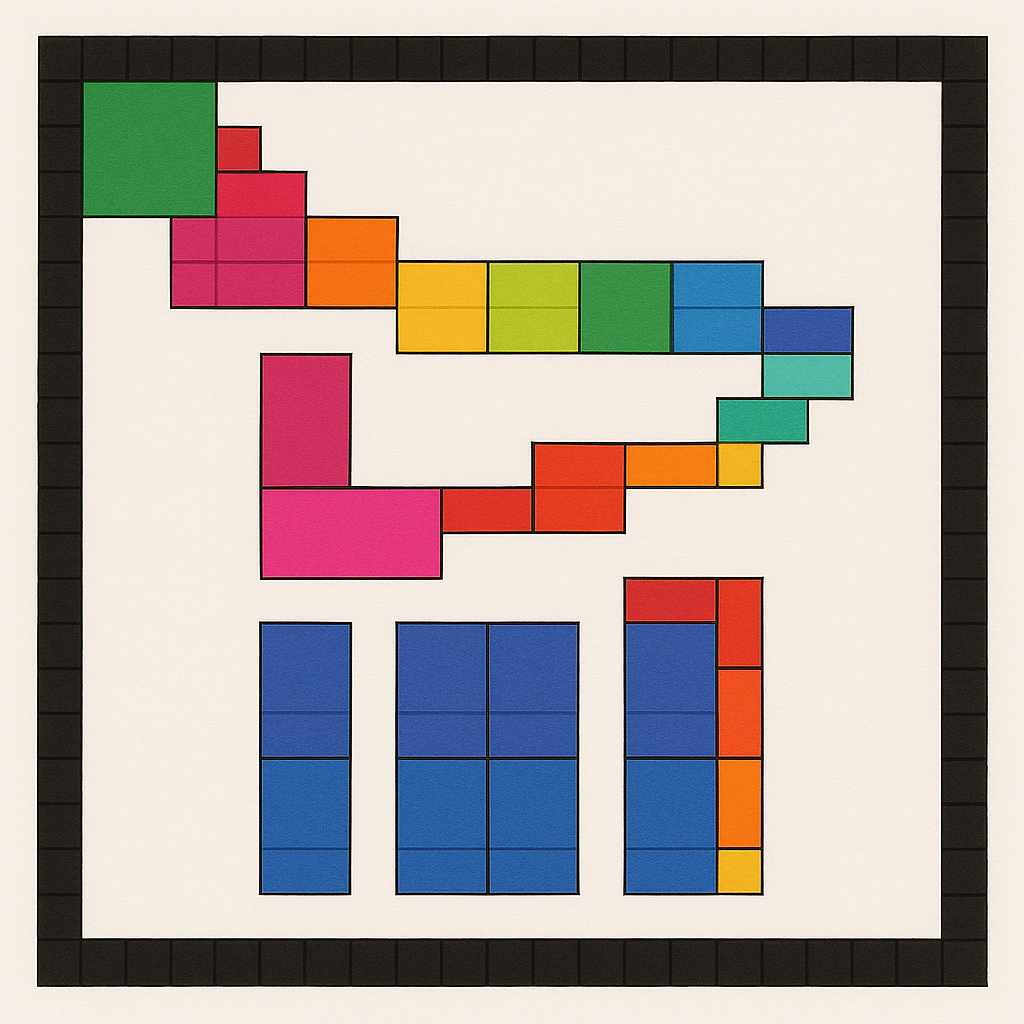
The image depicts a structured grid of colored rectangular blocks arranged within a black border. The blocks vary in size, color, and orientation, forming a non-uniform pattern. No textual labels, legends, or numerical data are visible.
### Components/Axes
- **Border**: A thick black rectangular border frames the entire grid.
- **Grid Structure**:
- Blocks are organized in rows and columns but lack consistent spacing or alignment.
- Colors include green, red, orange, yellow, pink, blue, and cyan.
- No axis titles, legends, or markers are present.
- **Text**: No visible text, labels, or annotations.
### Detailed Analysis
- **Top-Left Section**:
- A large green block dominates the upper-left corner.
- Smaller red and pink blocks are stacked vertically below it.
- **Middle Section**:
- A horizontal row of blocks spans the grid’s center, featuring yellow, green, blue, and cyan segments.
- Below this row, a pink block is positioned diagonally, adjacent to red and orange blocks.
- **Bottom Section**:
- Three vertical columns of blocks occupy the lower portion.
- Left and middle columns contain blue blocks with horizontal divisions.
- The right column includes blue, red, orange, and yellow blocks stacked vertically.
### Key Observations
1. **Color Distribution**:
- Blue and green blocks are the most prevalent.
- Red and yellow blocks appear in smaller quantities.
2. **Block Sizes**:
- Blocks range from 1x1 to 2x2 units (approximate).
- No clear pattern in size distribution.
3. **Orientation**:
- Most blocks are axis-aligned, but some (e.g., the pink block) are rotated.
4. **Absence of Text**:
- No labels, legends, or explanatory text are present.
### Interpretation
The diagram likely serves as a visual representation of a conceptual or abstract system. Possible interpretations include:
- **Color-Coded Data**: The blocks could represent categorical data (e.g., status indicators, priority levels) without explicit labels.
- **Layout Example**: It may illustrate a grid-based design principle, such as responsive layouts or modular systems.
- **Puzzle or Game**: The arrangement resembles a simplified version of a Tetris-like game or a color-matching puzzle.
- **Placeholder**: The lack of text suggests it might be a template awaiting further annotation.
Notable anomalies include the irregular spacing between blocks and the absence of a consistent color-to-meaning mapping. Without additional context, the diagram’s purpose remains ambiguous, but its structured yet chaotic arrangement implies a focus on visual organization or pattern recognition.