## Line Chart: Number of Responsive Plugs Over Time
### Overview
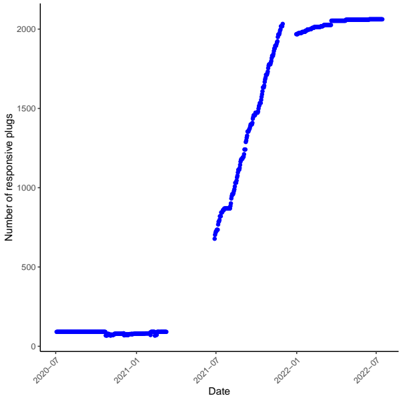
The chart depicts a time-series visualization of the number of "responsive plugs" from early 2020 to early 2022. The data shows a dramatic increase in the metric after a prolonged period of stability, followed by a plateau.
### Components/Axes
- **X-axis (Date)**: Labeled "Date," with ticks at 2020-01, 2021-01, 2022-01. The axis spans from early 2020 to early 2022.
- **Y-axis (Number of responsive plugs)**: Labeled "Number of responsive plugs," with increments of 500 (0, 500, 1000, 1500, 2000).
- **Legend**: Located in the top-right corner, with a blue line labeled "Responsive plugs."
- **Line**: A single blue line representing the data series.
### Detailed Analysis
- **2020-01 to 2021-01**: The line remains flat at approximately **100 responsive plugs**, with minor fluctuations (e.g., dips to ~80 in mid-2020, peaks at ~120 in late 2020).
- **2021-01 to 2022-01**: A sharp upward trend begins in mid-2021, rising from ~100 to ~2000 by early 2022. The increase is nonlinear, with a steep slope from mid-2021 to early 2022.
- **Post-2022-01**: The line plateaus at ~2000, with no further changes observed.
### Key Observations
1. **Stability (2020-2021)**: The metric remained near 100 for ~1.5 years, suggesting no significant changes in the system or environment during this period.
2. **Sudden Spike (Mid-2021-Early 2022)**: The number of responsive plugs increased by ~1900% in ~1 year, indicating a critical event (e.g., system upgrade, increased demand, or external factor).
3. **Plateau (2022)**: The metric stabilizes at its peak value, suggesting saturation or resolution of the driving factor.
### Interpretation
The data suggests a systemic shift occurred between mid-2021 and early 2022, causing a dramatic increase in responsive plugs. Possible explanations include:
- **Technical changes**: A software/hardware update may have improved responsiveness.
- **External factors**: Increased user activity or environmental conditions (e.g., temperature, humidity) could have triggered the response.
- **Data collection changes**: A recalibration of measurement tools might explain the spike.
The plateau in 2022 implies the system reached a new equilibrium. The lack of data before 2020 and after 2022 limits conclusions about long-term trends. The absence of secondary axes or annotations leaves the cause of the spike ambiguous, requiring further investigation.